33 Years Since Mysterious Jeep Accident Claiming Madan Bhandari's Life
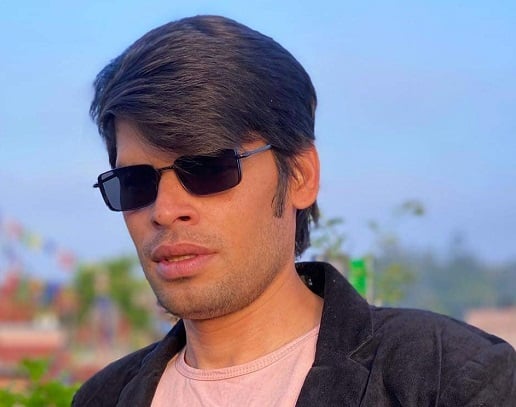

Kathmandu. 33 years have passed since the mysterious jeep accident in Dasdhunga, Chitwan, which claimed the life of the then General Secretary of CPN-UML, Madan Kumar Bhandari. This accident still remains shrouded in mystery.
Bhandari died in a jeep accident on Jestha 3, 2050, while returning to Chitwan after attending the third convention of UML Kaski.
During this period, Bhandari's successors माधव कुमार नेपाल, झलनाथ खनाल, and केपी शर्मा ओली became Prime Ministers. His party, CPN-UML, became a significant stakeholder in the government 13 times. Leaders of UML, who have accused Bhandari's death of being a conspiracy rather than an accident, failed to show promptness in investigating and identifying the perpetrators when they were in power.

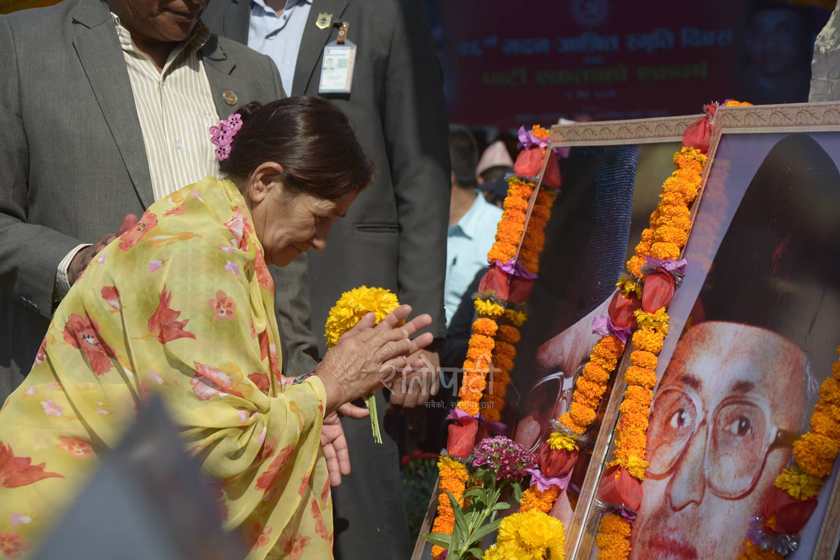
Bhandari's wife, विद्यादेवी भण्डारी, became the country's first female President after serving as Defense Minister. She was President from 2072 to Falgun 2079 BS. In the 2074 elections, the leftist alliance secured close to a two-thirds majority. Oli, who chaired the investigation committee for the Dasdhunga accident, became a powerful Prime Minister. Despite accusing the then government led by गिरिजाप्रसाद कोइराला of refusing to investigate before coming to power, Oli himself did not show interest in investigating and revealing the truth through the government during his multiple tenures as Prime Minister. In an interview with a television channel before coming to power, Oli alleged that the then government led by गिरिजाप्रसाद कोइराला refused to investigate.
"The then government did not even agree to investigate. They said no investigation was needed. They shot and killed at least 22 people who demanded an investigation. We will investigate this and find the murderers after we come to power," Oli had said.
Oli, who came to the party leadership from the ninth general convention of UML in 2071 BS, became Prime Minister four times in 2072, 2074, and 2081 BS. When he became a powerful Prime Minister with a two-thirds majority in 2074 BS, the state machinery was under his control. After the 2079 elections, UML was the main component of the government formed under the leadership of then Maoist Center Chairman प्रचण्ड. Oli, who became Prime Minister in Asar 2081 BS with the support of the largest party, Congress, was removed from office last year in August due to the 'Genji' movement.

However, former Foreign Minister and UML leader प्रदीप ज्ञवाली has explained this from two angles. Firstly, he argues that investigating high-level political assassinations is complex worldwide. Secondly, he stated in an interview with RatoPati that the investigation became more complicated due to the mysterious murder of the eyewitness, अमर लामा.
"The full facts of John F. Kennedy's assassination in America have not yet come out, even though the Kennedy family is still powerful in politics. Some aspects of Indira Gandhi and Rajiv Gandhi's assassinations in India remain a mystery. The forces used in such assassinations are stronger and more cunning than the country's investigative agencies," he said.
Gyawali stated that it was difficult to bring out the truth because Amar Lama, considered the final link in that incident, was also mysteriously murdered. "Why would the Maoists have to kill Amar Lama? If they had affection for Madan and hatred for Amar Lama, they should have apprehended him and handed him over to the police so that evidence would not be destroyed. This raises more questions," he said, "Therefore, it is a fact that the mystery has not been solved. Our efforts may have been incomplete in some respects, but I believe this mystery will be unveiled sooner or later."
Veteran leftist leader केशवलाल श्रेष्ठ also echoed Gyawali's argument, stating that it is complex to bring out the facts of high-level politicians' assassinations. "How many years has it been since the assassination of American President John F. Kennedy? Similarly, the assassinations of Indira Gandhi and Rajiv Gandhi in India remain a mystery even today," said Shrestha. "Regarding the murders of Madanji and Jeevrajji, various commissions were formed by the government and at the citizen level. The reports of these commissions were published in parts. They were not fully public. Rather than UML not wanting to investigate, such incidents are inherently mysterious."
Bhandari, the proponent of UML's guiding principle of People's Multiparty Democracy (Jajab) and a popular leader, was going to Pokhara to address the third convention of Kaski district before the accident. After addressing the convention at Dipendra Hall in Pokhara on Jestha 3, the then General Secretary Bhandari, along with Organization Department Chief Ashrit and ऋषिराम कट्टेल, left for Chitwan at 3 PM in a jeep with registration number Ba.A.Cha 8793.
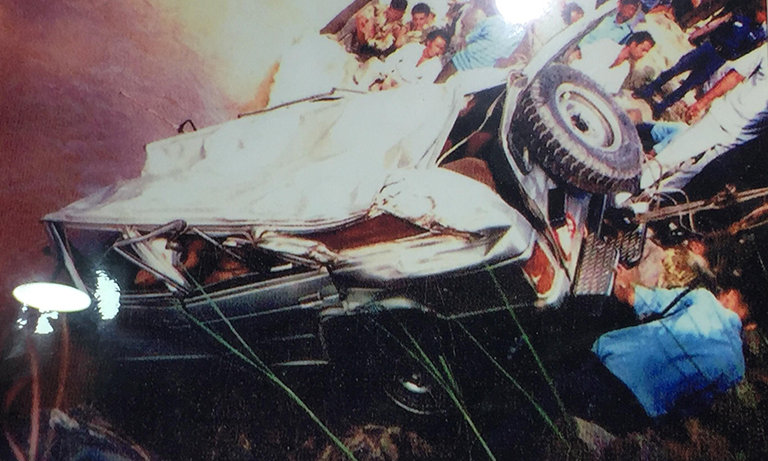
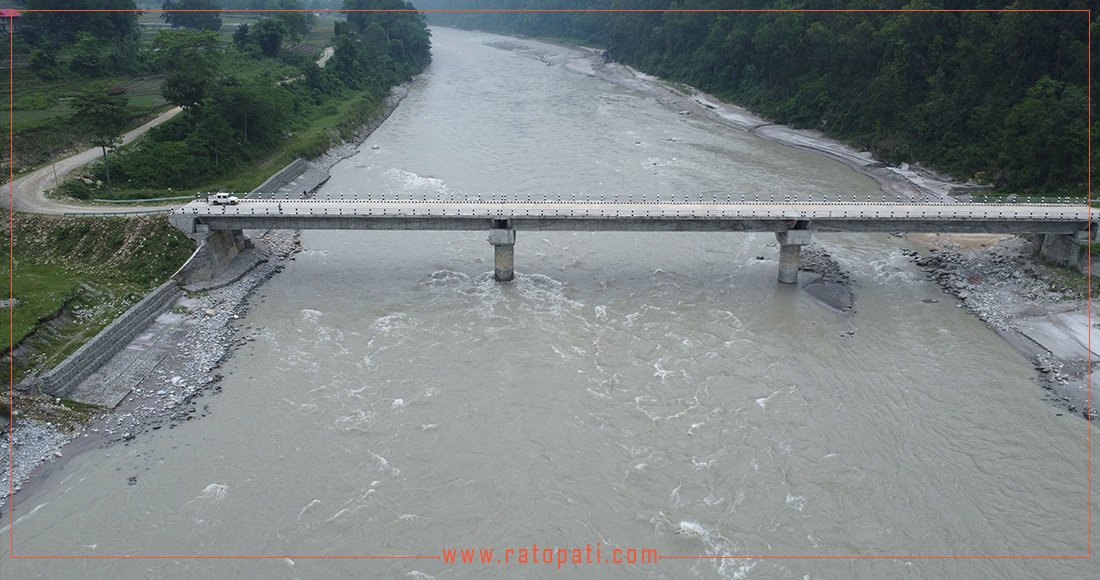
Bhandari was in the driver's seat, while Ashrit and Kattel were in the back seat. The driver was Amar Lama. Kattel disembarked at Aabukhairani in Tanahu as he had to go to Gorkha. It had been raining since morning, and the weather was bad that day. Around 5:30 PM, upon reaching Dasdhunga, the jeep lost control and fell about 150 feet into the Trishuli River. According to the investigation commission's report, the jeep's speed was 50-60 kilometers per hour. After the accident, Lama informed the central office and the district police after reaching Chitwan.
Upon receiving news of the incident, security personnel were mobilized for search and rescue. The next day, security personnel found the jeep carrying Madan Bhandari in the Trishuli River. Ashrit was found dead inside the jeep. Bhandari's body was found on Jestha 5, about 35 kilometers downstream in the Narayani River.
To investigate the accident, the then government led by गिरिजाप्रसाद कोइराला formed an investigation committee on Jestha 4 under the leadership of former judge प्रचण्डराज अनिल. However, UML rejected the government's investigation committee and formed its own committee under the leadership of standing committee member केपी ओली. On Asar 3, the Anil Commission submitted its report to the Prime Minister, concluding that it was an accident and not a murder. According to the report, the cause of the accident was excessive speed and driver negligence.
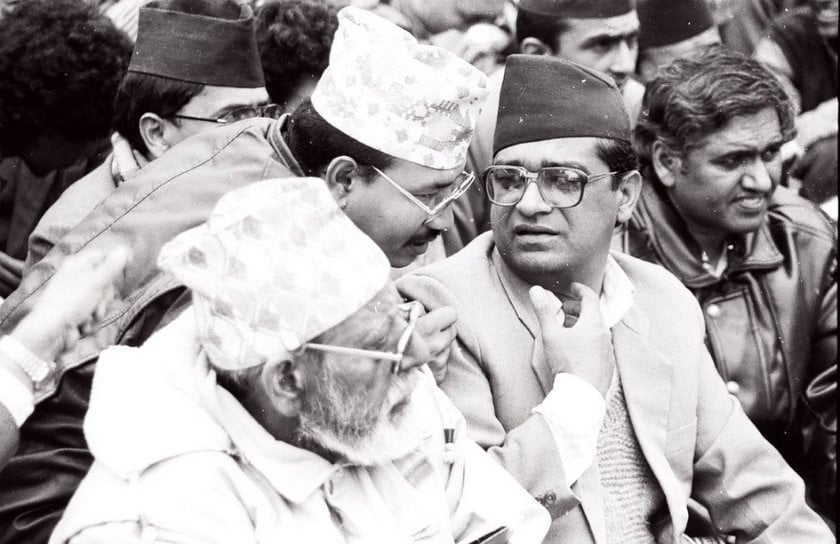
Meanwhile, on Jestha 5, the investigation committee formed by UML under Oli's leadership concluded that the Dasdhunga accident was a conspiracy rather than an accident. Although the report submitted to the central office on Asar 3 was not made public, its 15-point conclusion was released through the media.
UML intensified its protests, burning the Anil Commission's report and demanding the formation of another commission for an impartial investigation. As the protests turned violent, the government formed another commission on Asar 7 under the leadership of former judge त्रिलोक प्रताप राणा. That commission also concluded that Bhandari's death was an accident due to driver negligence, not murder. Similarly, a separate investigation committee was formed under the leadership of पद्मरत्न तुलाधर on behalf of civil society.
According to UML leader प्रदीप ज्ञवाली, the Anil Commission was formed initially after the incident. However, he stated that many activists lost their lives during the protests against it, calling it 'biased'. He recalled that the government later formed another commission under Rana's leadership, which UML accepted.
Gyawali recalled that separate commissions were formed at the citizen level under Tuladhar and by the party under Oli. However, he argued that none of these three commissions described it as a simple accident.
"None of these three commissions have called it a simple accident. The Trilok Pratap Rana Commission even stated that Madan's viscera were sent to London for testing, but the actual report could not be obtained because it was not preserved properly," he said. "Based on that, it generalized that the study so far does not allow us to call it a conspiracy or murder. However, it raised a big question mark as to why the viscera were not preserved properly. The commissions of पद्मरत्न तुलाधर and केपी ओली have confirmed a conspiracy."
Wapathi leader केशवलाल श्रेष्ठ stated that if UML had not wanted to investigate the Dasdhunga accident, a fact-finding committee would not have been formed. "It was only because the commission formed by the then government was not trusted that the party formed its own investigation committee. If there was no interest or desire, a committee would not have been formed," Shrestha said.
Chitwan District Court sentenced Amar Lama to five years imprisonment and a fine of five hundred rupees for reckless driving. Lama was murdered in Kirtipur on Asar 11, 2060 BS.
The committee led by Oli had collected facts by taking statements from the concerned individuals, visiting the accident-related sites, conducting a micro-study of the accident scene, technically examining the vehicle involved, re-examining the bodies for chemical analysis, and gathering related facts published in newspapers.
15-Point Conclusion of Oli Report:
1. The road at the accident site is wide, straight, and has a very gentle downhill slope. The road to the left of the accident site is wide and clear before the hillside. The vehicle was veering left, the accelerator was released, and due to the left and right turns, the vehicle, unable to control its speed, went off the road into the river. It appears the vehicle overturned and fell into the river after hitting the bank first.
2. The condition of the vehicle is good from all perspectives, and it does not appear that the accident was caused by any technical defect in the vehicle.
3. The vehicle's brakes are in good condition, and there is no indication that the driver attempted to apply the brakes at all.
4. The vehicle was under the complete control of the driver, Amar Lama, as he managed to avoid hitting the hut on the right side of the road and the wall on the left. In such a situation, without attempting to turn the vehicle towards the river and apply the brakes, without attempting to turn left, and without uttering a single word to alert the deceased comrades, the driver Amar Lama jumped out, preparing to escape. Before jumping out, driver Lama had put the vehicle's transmission in neutral. This indicates that Amar Lama acted intentionally and with the desire for the observed outcome in a planned manner.
5. The driver Amar Lama's actions, such as going to Narayan-ghat and spreading false information after reaching the river, washing blood from his mouth, cleaning mud from his clothes, and not staying at the scene for even fifteen minutes before sending others to inform the relevant authorities, instead of participating in the rescue efforts, prove that driver Amar Lama was part of a planned conspiracy.
6. The pile of sand and straw at the scene, which would only result in the vehicle falling into the river if the vehicle was driven towards it, appears to be deliberately placed. As there is no evidence to suggest that this pile of sand was placed naturally, the commission has considered these piles as a sign of the execution of the conspiracy.
7. The fact that the driver did not utter a single word to alert the deceased comrades while the vehicle was falling, continuously misled the party by spreading false information, and made statements indicating no concern for the party, suggests that driver Lama had no loyalty or allegiance to the party. However, a report from a psychiatrist indicates that the driver Lama's mental state was one of self-interest and no remorse.
8. It is proven that Comrade Jeevraj Ashrit's death occurred outside the vehicle, while it was in the water. However, in the case of Comrade Madan Bhandari, it will only be possible to determine where he died after some important aspects become clear.
9. It is proven that Comrade Madan Bhandari died outside the water, but the post-mortem report indicates both possibilities: death due to the impact of the fall or other types of injuries.
10. Chemical tests have not been conducted on the black stains seen on the seat and headrest of the vehicle where Comrade Madan Bhandari was sitting, and the blood stains found on the driver Lama's clothes. It is essential to conduct these tests.
11. It is possible that poison was used on the deceased comrades, which can only be detected through high-tech examination and has not been tested yet. It is necessary to determine this, and for this, the viscera kept in the Ronast laboratory should be sent to a laboratory in Scotland for technical examination.
12. If high-tech examination does not reveal the use of poison, the commission has concluded that a drug that cannot be detected by examination, such as a sedative, must have been used on the deceased comrades.
13. The commission concludes that there was a planned and systematic conspiracy in the Dasdhunga incident, and the main accused, driver Amar Lama, received support and protection even after the incident, indicating a serious and high-level conspiracy behind it.
14. It is not possible for Amar Lama alone to carry out a murder of this magnitude. The facts indicate a high-level conspiracy. It is the government's responsibility to uncover the truth and bring the conspirators before the public, and the government has not made any effort to fulfill this responsibility so far.
15. Finally, in the case of the Dasdhunga incident, the government showed more enthusiasm in publicity regarding the rescue efforts than in practical action, exhibiting indifference and negligence.
This specific news has been automatically translated by AI. As a result, there may be some inaccuracies or language errors.

_3t4V8H4io0.jpg)