33rd Madan-Ashrit Memorial Day Observed
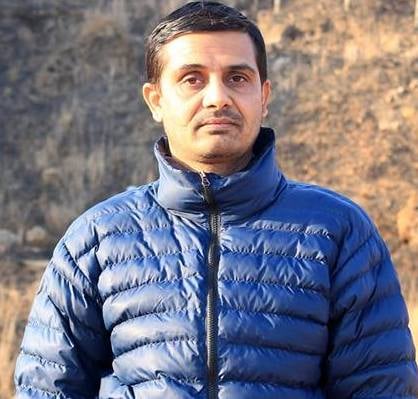

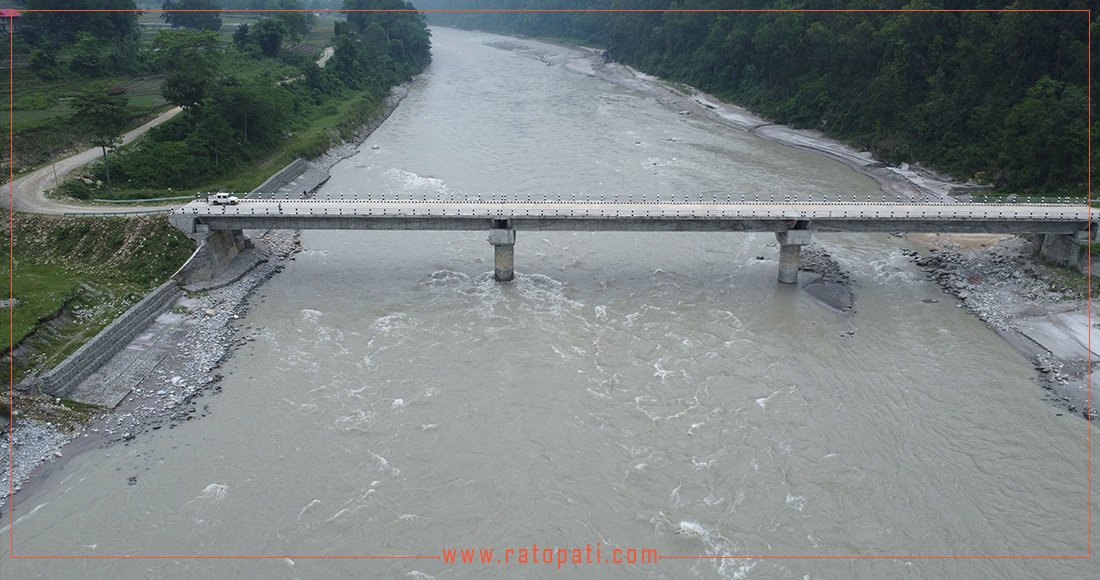
Kathmandu. Today is the 33rd Madan-Ashrit Memorial Day. On May 16, 1993, then CPN-UML General Secretary Madan Bhandari and Jivraj Ashrit died in a jeep accident in Dashdhunga, falling into the Trishuli River. Although three commissions were formed, the truth behind the incident has not been revealed to this day. Ratopati spoke with Pradip Gyawali, Chairman of the Madan-Ashrit Foundation and CPN-UML leader, about Madan Bhandari's contribution to Nepali politics and the circumstances of his death. Here is the dialogue with leader Gyawali:
How, where, and when did you first meet Madan Bhandari? Please tell us.
Although I had seen Madan Bhandari occasionally, I had a detailed conversation with him at the Fourth General Convention held in Siraha's Sarre Ambas in August 1989. I was also a delegate there. We had serious discussions with him on some issues. Specifically, regarding what the 'main policy slogan' should be, three different opinions arose within the party at that time. C.P. Mainali was of the opinion that it should only be 'Party Independence.' However, that would not capture the main spirit of ending the Panchayat system and establishing a multi-party system; it would be incomplete. On the other hand, some friends were of the opinion that we should go with the 'demand for a Constituent Assembly.' But that would close the door for cooperation between the Nepali Congress and the leftists, because the Nepali Congress had no possibility of joining a Constituent Assembly.
In that situation, the most appropriate slogan was to make 'Ending the Panchayat System and Establishing a Multi-Party System' the main slogan. I remember having a long discussion with Madan on that subject. He was also in favor of that. However, when a kind of compromise was reached among the leaders and the presidium expressed an intention to go with the Constituent Assembly, K.P. Oli was the first to oppose it. After that, we all opposed it, saying, 'This path will be wrong.'
During that process, I recall debating with many friends, including Madan, who were on the presidium. That was my first meeting.
After Madan Bhandari was elected General Secretary from the Fourth General Convention, what was his role in Nepal's politics and the party?
The Fourth General Convention ultimately passed the policy of joint struggle and people's movement to end the Panchayat system and establish a multi-party system. He was elected General Secretary at that very convention. Another significance of that convention is that it was from the Fourth General Convention that we passed the resolution to adopt a multi-party system even within a people's democratic system. This later evolved into 'People's Multi-party Democracy.'
After that, we united with Manmohan Adhikari's Marxist group and formed the CPN-UML after the success of the 1990 movement. At that time, there were some confusions and differences within the party.
What kind of differences were there?
For example, there was a debate whether the party should be fully open or if one wing should be open and the other underground. And there was also a debate whether to contest elections under the party's name or through a front. For instance, like Masal keeps the party underground and contests elections under the name of the National People's Front, there were discussions about whether to do the same. But Madan clarified everything very clearly, saying, 'We must go under the party's name and establish the party among the people.' He said, 'If something happens tomorrow, it is the conscious people who will save us. If you make the party a deity in a shrine, how will the people save it?' He led the initiative to open up the party, and ultimately that decision was made. Later, he also launched a nationwide campaign to make the party popular. After the 1991 elections, he went on a countrywide tour.
Was he not that well-known before the 1991 elections?
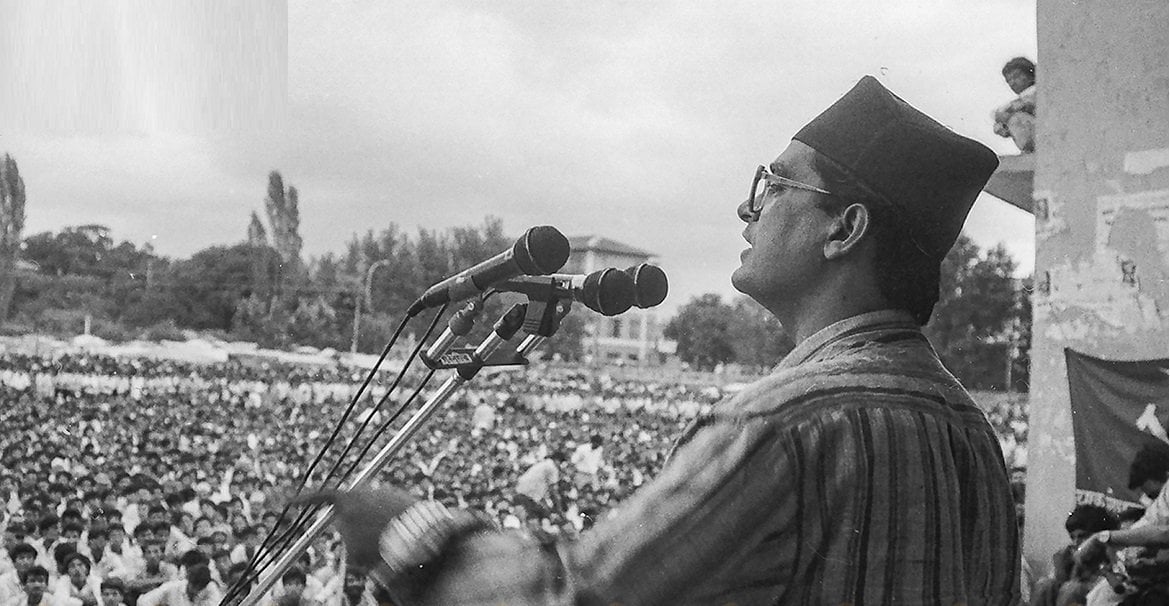
I recall that he became public as the party spokesperson in May 1990. But we had not revealed him as the General Secretary. He was formally revealed as the party's General Secretary on November 11, 1990. At that time, after the Constitution of the Kingdom of Nepal 1990 was promulgated, we organized a public assembly at Tundikhel's open stage to clarify it. We had 27 points of criticism regarding that constitution. He delivered his first address as the party's General Secretary to clarify these points, explain why this constitution was important, and what our disagreements were. It was probably at that time that he became public.
So, as General Secretary, Madan became public from that Tundikhel assembly?
As General Secretary, it was at that time. At other times, people saw him at programs but knew him as the spokesperson. But the fact that he was Madan Bhandari and the party's General Secretary was revealed on November 11, 1990.
Based on your acquaintance and association, what do you think was the reason for Madan Bhandari becoming so popular so quickly?
He had three or four amazing abilities. First, his greatest contribution is 'People's Multi-party Democracy.' At that time, the communist movement worldwide was going through a major crisis. Especially, the Soviet Union, the world's first socialist country, collapsed in 1991. Not only did socialism collapse there, but the country itself was divided into 15 parts. After that, socialist regimes in eight Eastern European countries, which ran on the Soviet Union's support, also collapsed. There was a strong wave from the capitalist world saying, 'Socialism and communists are finished now.' At that time, he said that this crisis was not a crisis of Marxism but a crisis of the one-party and authoritarian structure created by the Soviet Union. He said, 'We will not adopt that structure; we will come to power through multi-party competition and public mandate.'
_YvvysEbA7b.jpg)
The way he democratized the communist movement was his great contribution. This made him like a savior and guide of the communist movement's crisis. Communists were already popular in Nepal, and they had shed blood in the 1990 movement. But after defeating sitting prime ministers in two constituencies in Kathmandu and winning the elections, it gave inspiration to the whole world. Therefore, Newsweek even published his interview saying, 'Karl Marx is alive in Nepal.' Nevertheless, the main reason for Madan's popularity was his contribution to the democratization of the communist movement.
The second reason is his indomitable stance on nationalism. When the Tanakpur issue became controversial and Girija Prasad Koirala lied, saying, 'It's not a treaty, just an understanding,' Madan led the movement against it. He proudly championed Nepal's natural resources and sovereignty. Just as K.P. Oli became prominent by protesting the blockade, the struggle over Tanakpur made Madan a nationalist leader.
The third thing is his amazing oratory skill. He spoke artistically, in the language of the people, in a way that touched people's hearts. His oratory also played a role in making him popular. But it wasn't just about speaking well; the main reasons for his popularity were his good ideas and his contribution to nationalism and democracy.
At that time, democracy had just arrived in the country. Congress was a competitor. What was his perspective on competing parties?
Even before the 1990 movement, he was in favor of cooperating with Congress to move forward, believing that the Panchayat could not be overthrown otherwise. We passed that policy from the Fourth General Convention. After that, he came to Kathmandu and contacted Ganesh Man Singh. Ganesh Manji said, 'We will have a joint movement, but you communists are in many names; who should we work with?' Then, at Madan's initiative, the 'United Left Front' was formed under the leadership of Sahana Pradhan. He led the effort to bring various parties together to form the front. He also had a very good rapport with Ganesh Manji. He played a significant role in making the 1990 movement successful.
At that time, there wasn't much harmony between Ganesh Man and Girija Prasad; how was coordination achieved?
Yes. After the movement was successful, Girija Prasad Koirala gradually gained dominance in Congress. He was not in favor of cooperation with communists. In the 1991 elections, Madan proposed, 'For the sake of protecting democracy, let's maintain our understanding and cooperation for at least 10 years, and let's have an understanding in the constituencies where 10 top leaders are contesting.'
Was that Madan's proposal?
It was Madan's. But Congress did not want to hear it. Because they thought the communists would not win. They were still basking in the glory of the 15-year majority and thought that after the collapse of the Soviet Union, the communists in Nepal were also finished. When all else failed, he said, 'If nothing else, leave Dharan for our chairman Manmohan Adhikari, and we will leave Krishna Prasad Bhattarai.'
Congress did not accept that proposal either, did they?
They did not. Madan had put forward that proposal until the very end. After it was not accepted, unhealthy competition truly began. Before that, Girija Prasad Koirala said, referring to an incident, 'The UML, Masal, and Mandale are all the same.'
After Girija Prasad adopted an extremely anti-communist stance, the tussle had already begun before the elections. When Congress did not agree to maintain minimal goodwill even for the elections, we fought alone. Later, Congress formed a majority government and began taking action against employees, signing the Tanakpur agreement, and suppressing protestors from the beginning. Thus, our distance from the government grew.
It has been 33 years since Madan passed away, but those who remember him are still numerous. You have been in government repeatedly, and his wife also became President. But what do you think is the reason why the truth about the Dashdhunga accident or conspiracy has not been revealed to this day?
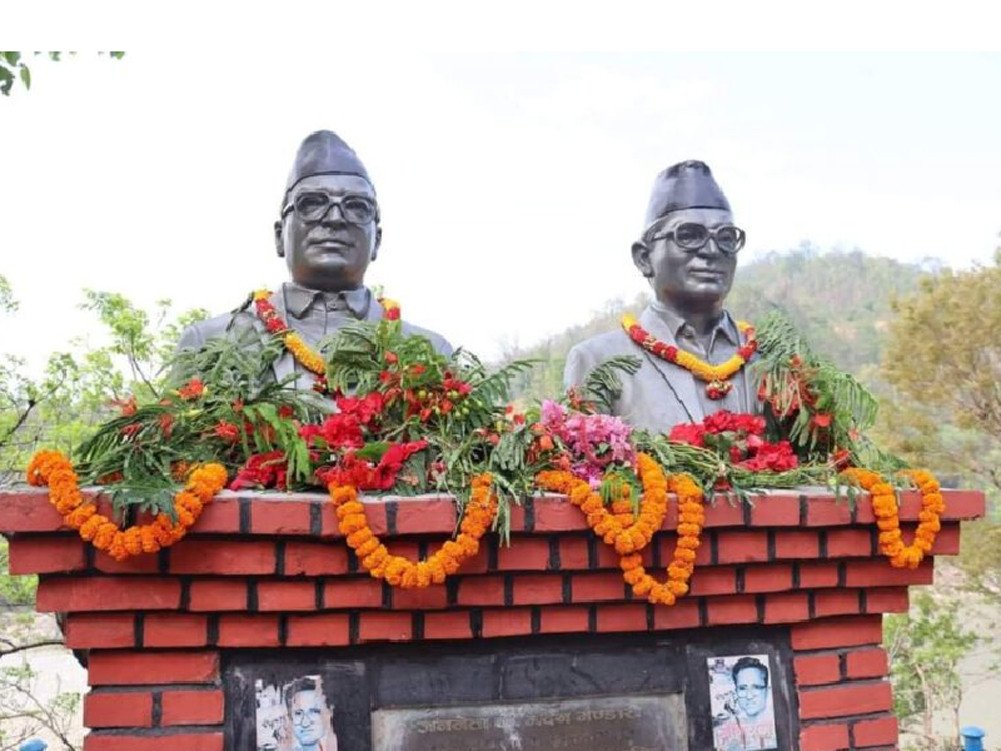
After that incident, an Anil Commission was formed initially. But we protested on the streets, saying it was 'biased.' Many of our comrades were killed in the protests. Later, the government formed another commission under the leadership of Trilok Pratap Rana, which we accepted. Meanwhile, commissions were formed at the citizen level under Padmaratna Tuladhar and by the party under K.P. Oli.
None of these three commissions have called it a normal accident. Even the Trilok Pratap Rana Commission stated that Madan's 'viscera' was sent to London for testing, but because it was not preserved properly, a factual report could not be obtained. Using that as a basis, it generalized by saying, 'Based on the studies so far, it cannot be called a conspiracy or murder.' However, it did raise a big question mark about 'why the viscera were not preserved?' The commissions led by Padmaratna Tuladhar and K.P. Oli have confirmed a conspiracy.
In summary, the consensus was that this was not a natural death. That place is also not conducive to a natural accident. It is unnatural for the driver to come out safely, his body and clothes not getting wet, and not sustaining any serious injuries, while the other two died instantly.
Regarding why it hasn't been revealed to this day, two things need to be considered. First, high-level political assassinations are always complex worldwide. The full truth behind the assassination of John F. Kennedy in America has not come out to this day, even though the Kennedy family is still powerful in politics. Some aspects of Indira Gandhi and Rajiv Gandhi's deaths in India remain a mystery. The forces used in such assassinations are more powerful and cunning than the country's investigative agencies.
Second, our last link was Amar Lama, but he was also mysteriously murdered. Why would the Maoists have to kill Amar Lama? If they had affection for Madan and hatred for Amar Lama, they should have apprehended him and handed him over to the police so that evidence would not be destroyed. This raises more questions. Therefore, it is a fact that the mystery has not been solved. Our efforts may also have been incomplete in some respects, but I believe that this mystery must be unveiled someday.
Some people say that the report of the commission formed under K.P. Oli from within the party was also not made public. Is that true?
That report was made public and printed at that time. Later, I also heard that the original copy could not be found in the library. I don't have an update on that, but I have studied the report he prepared.
What was the essence of your study?
In summary, the consensus was that this was not a natural death. That place is also not conducive to a natural accident. It is unnatural for the driver to come out safely, his body and clothes not getting wet, and not sustaining any serious injuries, while the other two died instantly. All the circumstances of where the vehicle fell are suspicious.
Do you remember how long that report was?
I don't have an exact idea of the size.
CPN-UML has adopted the 'Jabaj' propounded by Madan as its guiding principle. However, there are rumors that one faction within the party is not following that principle. How do you view the current state of Madan and CPN-UML in this context?
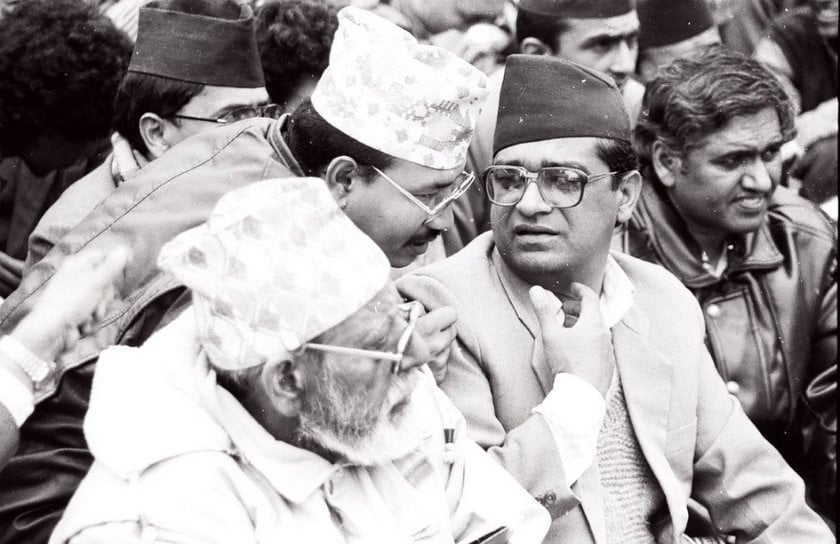
'Jabaj' propounded by Madan has greatly guided Nepal's political transformation. It has played an ideological role in establishing the republic, bringing the Maoists to the peace process, making Congress supportive of social justice issues, and building a constitution oriented towards socialism. 'Jabaj' is the guiding principle of CPN-UML, and Madan Bhandari is the pathfinder. There may have been weaknesses in practice at times, but there is no problem with our intentions, motives, and the truth of our principles.
You have expressed a sentiment of doing justice to Madan. However, some time ago, the party chairman made statements that seemed to spread disgust towards Madan himself. How true are the accusations of 'cooperative fraud' and 'bigamy' against him?
If you look at the 'full text' of that statement, it will be clear. There may be a debate about whether those words were necessary in that context. But the context at that time was that while responding to questions raised about leadership, he (the chairman) meant to say, 'Leaders are subjected to false propaganda in every era.' He meant that even an influential leader like Madan was subjected to such false accusations at that time. He did not say, 'Madan did that,' but rather, 'Even Madan was accused of such things.'
Were such accusations made against Madan?
Yes. For example, during the underground period, when there was starvation, farmers broke into communal granaries and distributed food. Madan Bhandari was falsely implicated in that. Ganesh Manji had also said, 'They emerged from a hole.' He said that to illustrate how propaganda and misinformation are spread to assassinate the character of leaders. Whether it was necessary to say that on Madan's anniversary is a matter of debate.
In conclusion, how do you personally remember Madan Bhandari?
He was a leader of unique intellect and talent, capable of understanding the pulse of the times, extremely dedicated, and patriotic. He once said—if necessary for the country, we are ready to resign not just our parliamentary seats but our lives. Therefore, I want to remember him as our mentor, guide, and source of inspiration.
This specific news has been automatically translated by AI. As a result, there may be some inaccuracies or language errors.

_3t4V8H4io0.jpg)