National Pride Projects in Nepal Face Delays and Cost Overruns


Projects for which the entire nation can be proud are national pride projects. We know and understand large and important development projects as national pride projects. These projects, mostly operated by the government, play an important role in the overall development of the country, economic progress, and improvement of the living standards of the people.
National pride projects are large, strategic, and high-impact infrastructure projects selected by the Government of Nepal (Council of Ministers' decision). They are named pride projects because they reflect Nepal's honor, self-reliance, and bright future. Special importance is given to them on the recommendation of the National Planning Commission. Pride projects contribute greatly to national unity, prosperity, and long-term development.
Initially, 17 were announced in fiscal year 2068/69, and currently, there are 27 pride projects. Overall, national pride projects are also the foundation for making Nepal prosperous and self-reliant. Only their timely completion can change the face of the country. However, delays and cost increases are adding many challenges.
According to the Department of Water Resources and Irrigation, out of a total of 3.5577 million hectares of arable land in Nepal, 2.536 million hectares are irrigable. So far, irrigation access has been provided to about 1.587910 million hectares of land. There is still a big challenge to provide irrigation facilities to about 1 million hectares of land.
Here, we intend to discuss the national pride projects related to irrigation connected with Banke, Bardia, and Surkhet.
Sikta Irrigation Project (Banke)
The Sikta Irrigation Project is a national pride project of Nepal. Water is being diverted from the Rapti River in Agaiya, Banke, to manage irrigation. With the goal of providing irrigation facilities to 42,766 hectares of land, this project started construction in fiscal year 2062/63.
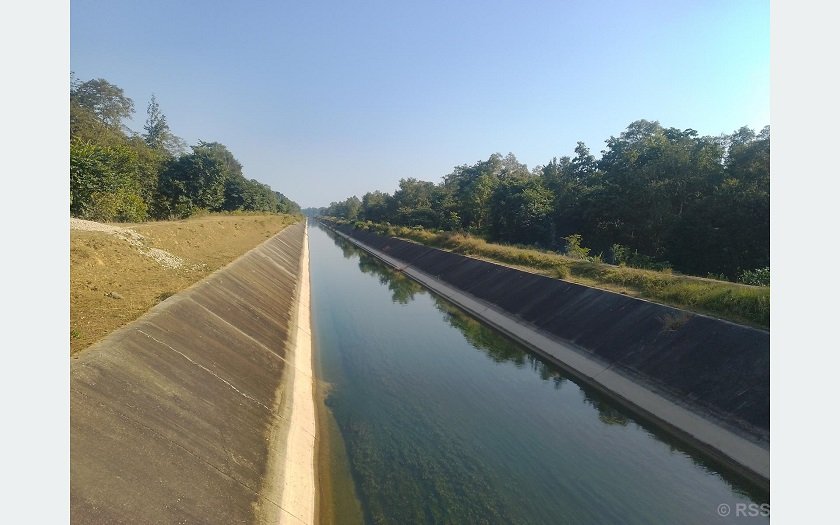
Even after two decades, the project's progress is not as expected. Dams and some canals have been built on the Rapti River, but the construction of canals and structures is still slow. So far, structures have been expanded to only 22,500 hectares. The physical progress is only 46 percent so far.
The construction of 45 km of the Western Main Canal and 37 km of the Eastern Main Canal has been completed. Irrigation facilities have been provided to 24,000 hectares so far. The project, which started with the government's own resources, has seen its cost increase from 12.80 billion to 52.89 billion. It is estimated that it will take another 7-8 years to complete the project, but even that is not certain.
- Challenges
The project has been facing delays for a long time. Land acquisition, compensation disputes, shortage of construction materials, contractor disputes, canal encroachment, slab collapse problems, and numerous doubts and questions about quality are the main challenges. Lack of budget has also been affecting the work.
Sometimes, environmental impacts (deforestation, pollution) and local disputes have also halted progress. At this pace, it is warned that it may not be completed even in decades.
- Possibilities
After the completion of the project, agricultural production in Banke district will increase significantly. Productivity of crops like paddy, wheat, and vegetables will increase, improving farmers' income. About seventeen thousand households and four lakh farmers will benefit. The intensity of cropping is estimated to increase from 168 percent to 242 percent. This will strengthen food security, job creation, and the local economy.
The government has recently adopted a policy to complete stalled projects. This project can be completed on time with adequate budget, effective monitoring, local cooperation, and technical improvements. If Sikta is successful, it can become an example for other irrigation projects.
Babai Irrigation Project (Bardia)
The Babai Irrigation Project is a national pride project in Bardia. This project was started in fiscal year 2045/046 with the government's own resources. The project was initiated with the aim of providing irrigation facilities through canals, branch canals, and sub-branch canals in the eastern and western parts using water from the Babai River. The goal is to provide year-round irrigation facilities to about 36,000 hectares of land in Bardia.
The total revised cost has reached 18.96 billion, while the initial estimate was 2.87 billion. So far, it has increased about 66 times. Physical progress is considered to be about 82 percent. Irrigation facilities have been provided to more than 27,000 hectares through 66.1 km of main canals (34.5 km to the east, 31.6 km to the west) and 321.5 km of branch and sub-branch canals.

The project, which involved acquiring 386.79 hectares of land, is targeted for completion by fiscal year 2082/83, but the exact completion date is still uncertain. Farmers have started receiving water in some areas, but full irrigation is still pending.
- Challenges
The main challenges are that it has not been fully completed even after 37 years, and the cost has increased 66 times. Problems like contractors abandoning work, repeated floods and natural disasters are also major challenges. Insufficient annual budget, weak inter-agency coordination, poor quality construction, and the tendency to extend deadlines are also reasons for construction delays. Dissatisfaction due to land compensation, land acquisition, and insufficient water supply according to farmers' expectations is another challenge. These problems and challenges need to be addressed in a timely manner.
- Possibilities
The Babai Irrigation Project is the 'lifeline' of irrigation development in Western Nepal. In 37 years, the work on the Babai Irrigation Project has reached 82 percent. Progress has been good in the recent phase. It is now in the completion stage. If fully completed, Bardia will have year-round irrigation facilities.
Production of paddy, wheat, vegetables, etc., will increase significantly. The economy (agriculture-based) will strengthen, and employment will be created. Local markets will become vibrant. There is hope for increased food security and farmers' income.
Recently, the minister directed to terminate stalled contracts, which shows the possibility of improvement. However, for that, the government must ensure management of stalled contracts, 3-shift work, digital monitoring, and adequate budget. If this can be done, this project can be fully completed by 083.
This project can have a significant impact by connecting with other projects like Bheri-Babai.
Bheri-Babai Diversion Multipurpose Project (Surkhet)
The Bheri-Babai Diversion Multipurpose Project is a national pride project located in Surkhet. The project involves diverting 40 cubic meters per second of water from the Bheri River through a 12 km long tunnel into the Babai River.
Started in fiscal year 2070/071, this project was targeted for completion in fiscal year 2076/077, but it is uncertain when it will be finished. Physical progress is 69 percent so far. While the tunnel construction under the project is progressing rapidly, construction of other structures has not gained momentum.
_LKGNzayehi.jpg)
The project aims to provide irrigation facilities to 51,000 hectares of land in Banke and Bardia. It also aims to generate 46 MW of hydropower. The cost of the project, which used a Tunnel Boring Machine for the first time in Nepal, has increased from 16.43 billion to 36.80 billion.
- Challenges
The main challenge of the project is the lack of progress as per the target. The overall physical progress is only 69 percent so far. The tunnel (12.2 km) was constructed in 2076 using a Tunnel Boring Machine for the first time in Nepal. However, the work on the second phase (dam, powerhouse, penstock, etc.) has been delayed. Work that should have been completed in 080 is being prepared for a fourth extension (3 years and 4 months extension requested). The initial cost is estimated to increase from 33 billion to over 45 billion.
The COVID-19 pandemic halted work for about two years, causing a significant impact. The project states that subsequent material shortages, design changes, consultant changes, and river flow have also had an impact. Karnali Province has made a demand, saying, 'If you take water, give us electricity.' This demand has not been met since 2076.
Challenges in project implementation have been added due to the prevention of inundation of more than 32 hectares of arable land, compensation to affected parties, negative impact on the migratory system of fish in the Bheri River, and the non-addressal of demands for local community employment and basic infrastructure development.
- Possibilities
The project is expected to contribute significantly to agriculture, energy, and economic development. Irrigation will be available year-round in 51,000 hectares of land in Banke-Bardia. It is projected that income from electricity and agriculture will be around 4.5 billion rupees annually due to increased agricultural production. As the first major inter-river water transfer project, it will also guide future projects (like Sunkoshi-Marin).
An additional 46.8 MW of hydropower will be added, supporting the national grid. It can become an example of water resource sharing between two provinces, contributing to long-term water management. If the project is successful, there is also the possibility of increased farmers' income, reduced food crisis, job creation, and local development.
If coordination can be increased immediately between the contractor, the federal government, and both provinces to accelerate the work, this project can provide concrete benefits to farmers, the energy sector, and the national economy.
Conclusion
These national pride projects are the 'lifeline' of the prosperity of the respective districts, but due to 'tortoise-like progress,' they do not appear to be worthy of pride. If these projects are completed, an agricultural revolution can occur in Banke and Bardia. Year-round irrigation will increase the production of paddy, wheat, and vegetables, strengthening food security.
The government has recently committed to not leaving pride projects 'unattended.' If progress is accelerated by changing contractors, working in three shifts, digital monitoring, and enacting special laws, progress can be rapid. Through the expansion and maintenance of the irrigation system and the optimal use of modern technology, the economy can be uplifted through agricultural production, but for that, the government itself needs to stand firm.
This specific news has been automatically translated by AI. As a result, there may be some inaccuracies or language errors.




_6FSvCrCShE.jpg)