Nepali Leftist Politics at a Crossroads: Ideological Drift and Generational Divide Threaten Future

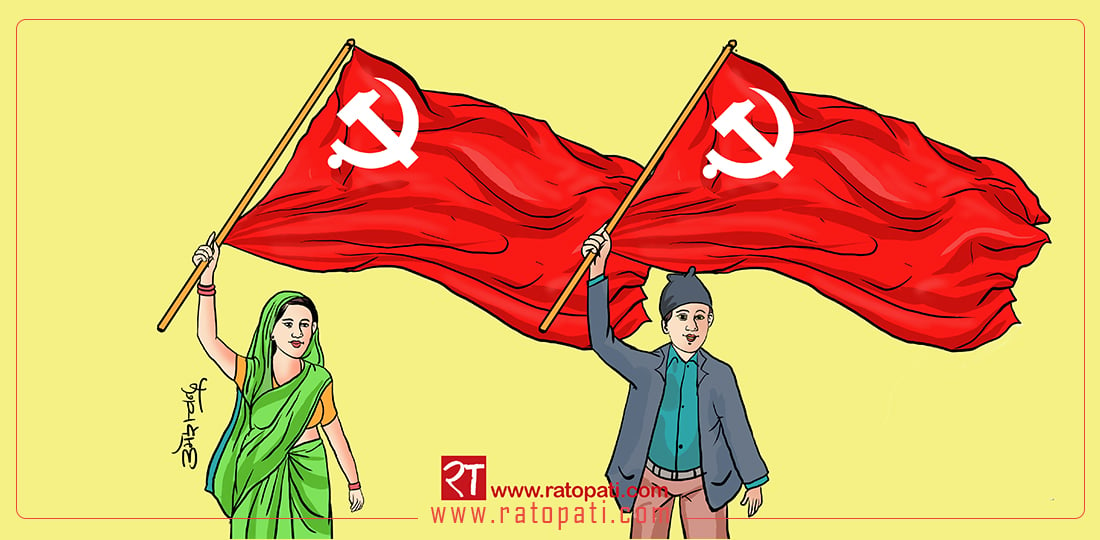
Nepali leftist politics stands today ensnared in complexity and challenges. This ideology and power, possessing a long and glorious history, find themselves on trial. To comprehend this, one must examine the objective circumstances of the year 083 (Nepali calendar) through a dialectical materialist lens. A realistic analysis hinges on whether the current state of the communist movement represents merely a 'quantitative decline' or a 'qualitative deviation'.
Generally, during the Panchayat era, this movement was class-based and played a historic role in dismantling the semi-feudal class structure of Nepali society. After 046 (Nepali calendar), the ideological experiments of People's Multy-Party Democracy and People's War took root in Nepali soil, breathing life into the movement. Following the change of 062/063 (Nepali calendar), that political capital was gradually dissipated in parliamentary arithmetic, power-centric activities, and the confusion of self-interest. Thus, the communist movement lost both its class base and ideological direction.
The greatest challenge of the present is ideological deviation and the growing influence of right-wing populism. Recent election data indicates a crumbling of the traditional vote bank of leftist parties and the rise of new, ideologically hollow populist forces. The policies, programs, and lifestyles of mainstream leftist parties like UML and Maoist have become akin to those of capitalist parties. The alignment between ideology and performance has fractured.
Consequently, the people have begun seeking alternatives to the alternatives. This is not a sudden phenomenon but a result of the leftists submerging their revolutionary character in the parliamentary quagmire. Specifically, the acceptance of issues of national sovereignty (MCC) and strategic agreements by leftist forces was a grave strategic error in the history of the movement. This not only destroyed the anti-imperialist image of communists but also created serious distrust among cadres and the general public regarding the leadership's national stance.
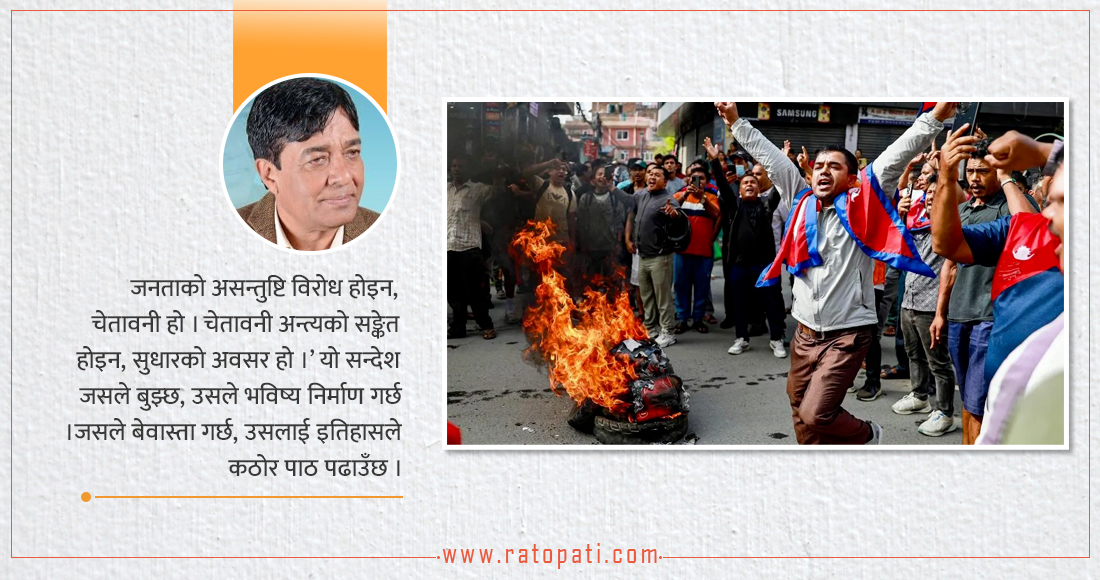
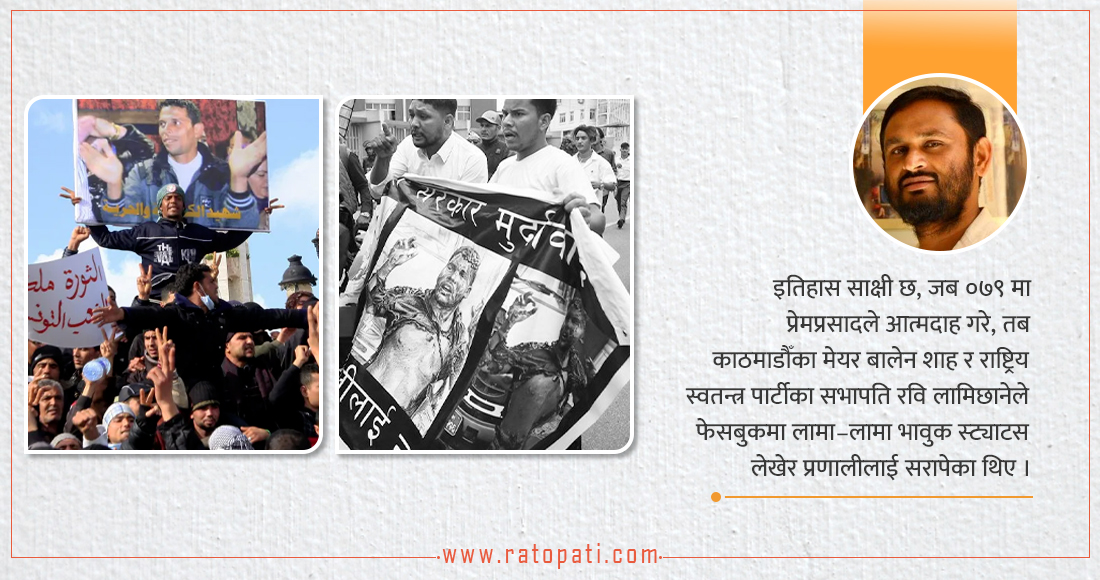
The second significant aspect of the imbalance in leftist politics is the deepening chasm with the Gen Z, or the new generation. The popular uprising of last Bhadra (Nepali calendar) made it clear that Nepal's youth, constituting the majority of the population, were not satisfied with the old-fashioned 'analog' leadership and abstract revolutionary dogmas. The youth entering the labor market were concerned neither with the leadership's jail time nor with tales of war.
They were seeking digital transformation, guaranteed employment, and transparent governance. They wished to bring the prosperity that the world was calling for to Nepal. However, Nepali leftist parties remained shackled by old structures, working styles, and bureaucratic frameworks. Youth voices were completely suppressed and partially banned. As a result, the relationship between leftist cadres and leadership transformed from respect to doubt, and from command to deviation.
The recent leftist movement witnessed a severe bourgeoisification. Full-time party workers began engaging not in political training and public service but in scandals for personal gain. They became entangled in a web of commissions, contracts, and corruption. They were deeply involved in areas directly felt by the public such as municipalities, wards, consumer groups, cooperatives, infrastructure construction, material procurement, and contracts. Not a single original model of leftist socialist reform could be presented at the municipal level.
Nepali leftist politics must also be viewed from an economic perspective. Essentially, Marxist ideology is based on economics, and changes in production relations and systems give birth to new ideas. However, even after the establishment of the republic and the capitalization of Nepali society, communists did not pay attention to this matter.
The creative implementation of Marxism faded into the background. They increasingly became proponents of capitalist systems like liberalization, intermediation, and open competition. Leftists merely became ordinary actors within these systems. It is due to this ideological deviation and consequential emptiness that today's new generation has become alienated from the leftist movement. Furthermore, failing to advance ideology in a timely manner over the past 20 years, and especially in the context of the constitution oriented towards socialism, was tantamount to pushing the movement into ideological emptiness.
Nepali leftist politics must also be viewed from an economic perspective. Essentially, Marxist ideology is based on economics, and changes in production relations and systems give birth to new ideas. However, even after the establishment of the republic and the capitalization of Nepali society, communists did not pay attention to this matter.
Leftist governments failed to break the structural web of the remittance economy. The contribution of the agricultural and industrial sectors to the Gross Domestic Product continued to shrink.
A consumption-oriented, imported, and dependent economy flourished. The socialism-oriented path envisioned by the leftists remained confined only to slogans. Instead of establishing the working class's access to the means of production, collaboration with comprador capitalism further endangered that class. Extreme unemployment, unequal and low wages, occupational insecurity, devaluation of labor power, and youth exodus continued to escalate.
This accelerated the destruction of the fundamental ideals and moral ground of communists. Entrusting basic services like education and health to comprador capitalists eroded the ideological foundation. The poor and working class could not even feel the presence of a leftist government. This disconnect from labor and production became another reason for the erosion of public trust.
Leftists should be among the landless, cooperatives and microfinance victims, farmers, and laborers. Protecting arable land and creating a network of small and medium-sized industries through cooperatives to cut the roots of comprador capitalism is the only path for the revival of the left today.
Even in this critical hour, a clear roadmap for leftist reorganization has not emerged. We must now move forward not through ritualistic unity but through an ideological-cultural revolution. The strategic starting point must be a new model of production-oriented socialism. This is not merely about distributing government subsidies but about community production systems based on ecological agriculture and food sovereignty, similar to successful experiments in Kerala or Latin America.
Ensuring housing for the homeless and access and control over means of production and resources for genuine farmers must be the Marxist task of today. Leftists should be among the landless, cooperatives and microfinance victims, farmers, and laborers. Protecting arable land and creating a network of small and medium-sized industries through cooperatives to cut the roots of comprador capitalism is the only path for the revival of the left today.
Organizationally, communist parties must embrace the concept of digital Leninism, making their structures transparent and technology-friendly. Maintaining financial transparency by using technologies like 'blockchain' for everything from the party's levy system to decision-making processes, and implementing an 'internal primary' election system for leadership selection, is imperative.
Unless the strict adherence to the 70-year age limit policy and at least 50 percent representation of young experts in policy formulation are implemented, winning the trust of the new generation will be impossible. Furthermore, every leftist cadre must compulsorily engage in some form of productive labor or income-generating work and connect with the public through non-profit cooperatives.
The historical reality today is that the leftists will either ruthlessly restructure themselves on the path of production, transparency, and generational transition, or they will remain merely a failed experiment in the pages of history. To break the consumerist and bourgeois culture rooted in society and among cadres, a combination of clear ideology, discipline, and practical practice is essential.
Understanding Nepal's specific geo-political sensitivities, a foreign policy of Himalayan neutrality must be put forth. Abandoning the dependent mentality created by projects like MCC, the voice of the Global South must be amplified. Only by measuring relations from Moscow to New Delhi and Beijing against the yardstick of national sovereignty and class interests can the Nepali leftist movement regain its lost credibility.
Furthermore, reviving the concept of a united front and mobilizing farmers', women's, and Dalit movements as autonomous and empowered entities under a common socialist agenda is the need of the hour. Brother organizations must now be developed as autonomous social movements.
In conclusion, the historical reality today is that the leftists will either ruthlessly restructure themselves on the path of production, transparency, and generational transition, or they will remain merely a failed experiment in the pages of history. To break the consumerist and bourgeois culture rooted in society and among cadres, a combination of clear ideology, discipline, and practical practice is essential.
For reform, what is needed now is not cosmetic patching but surgical operation. Only through ideological, organizational, tactical, technical, production-oriented, balanced, and youth-centric transformation can leftist politics and movements reach the goal of socialism.
This specific news has been automatically translated by AI. As a result, there may be some inaccuracies or language errors.