Nepal's Private Sector Alarmed by Recent Wave of Business Arrests


Kathmandu. The private sector, a key pillar driving the nation's economy, is currently gripped by fear due to a series of arrests targeting business leaders.
Recently, various allegations have been leveled against industrialists and businesspeople. The government is currently investigating businessman Deepak Bhatt on charges of money laundering. Following Bhatt, other business figures have also been detained for investigation.
The private sector has labeled these arrests as a 'crackdown.' Industrialists and business leaders state that the recent wave of arrests and detentions has discouraged and terrified the entire private sector.
Following the formation of a strong government with a near two-thirds majority, the private sector had expected political stability and an investment-friendly environment. Although the government calls the private sector its partner, the three major umbrella organizations of the private sector have accused the state of treating them like criminals.
The Federation of Nepalese Chambers of Commerce and Industry (FNCCI), the Confederation of Nepalese Industries (CNI), and the Nepal Chamber of Commerce have issued a joint statement demanding an immediate halt to the crackdown on businesspeople.
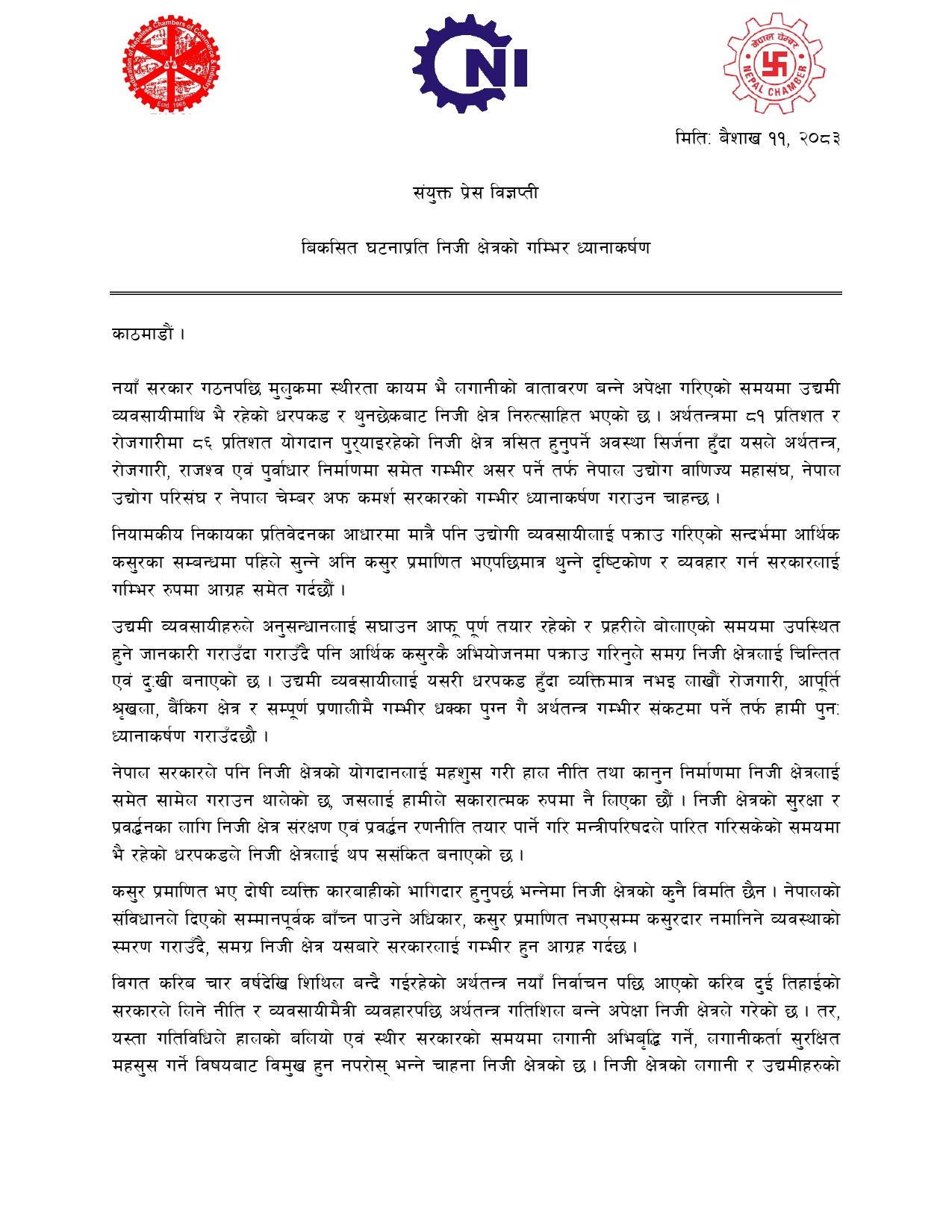
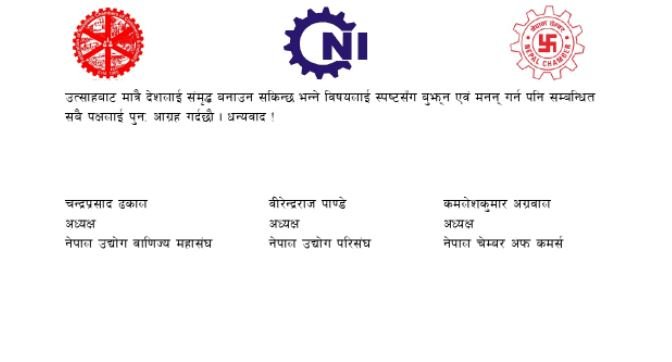
FNCCI President Chandra Prasad Dhakal, CNI President Birendra Raj Pandey, and Chamber President Kamlesh Kumar Agrawal issued a joint statement opposing the arrests. They have drawn the government's attention to adopting a 'listen first, then detain only after guilt is proven' approach regarding economic offenses.
The private sector stated that this harsh and ruthless style of the state has created a sense of insecurity among industrialists. The statement mentions that entrepreneurs who have invested billions in the country for years and provided employment to millions are beginning to feel persecuted by the state itself.
Businesspeople have clarified that they are not above the law and are fully prepared to cooperate with investigations. They stated they are ready to appear for questioning whenever summoned by the police.
The joint statement from the three organizations says, 'The government's practice of arresting people in a raid-like style and keeping them in custody has created distrust in the entire system. The private sector has no objection to guilty individuals facing action once the offense is proven.'
The private sector views the arrest of reputable industrialists and businesspeople based solely on preliminary reports from regulatory bodies, without sufficient investigation and evidence, as an abuse of state power and a form of terror.
Stating that the private sector contributes 81 percent to the country's total economy and 86 percent to job creation, business leaders warned that such government actions would deal a severe blow to the overall economy, employment, revenue collection, infrastructure development, and the national supply chain.
Recently, the arrest of Shekhar Golchha, an industrialist and immediate past president of the FNCCI, by the Central Investigation Bureau (CIB) of the Nepal Police has sent shockwaves through the business community. Prior to him, businessmen Deepak Bhatt and Sulav Agrawal were taken into custody for investigation.
The private sector complains that the state machinery is mocking the right to live with dignity granted by the Constitution of Nepal and the universal legal principle that one is not considered a culprit until guilt is proven.
Finance Minister Dr. Swarnim Wagle had made very promising commitments immediately after taking office and during various meetings with the private sector. He had assured that he would introduce a policy of seeking solutions through financial penalties rather than creating a spectacle by handcuffing individuals in cases of 'white-collar crime.'
Finance Minister Wagle had claimed that the government was in favor of allowing businesspeople to face cases without defaming them by stuffing them in jail, and that he would implement a 'listen first, then detain' policy.
However, the private sector has expressed dissatisfaction that even before those assurances and commitments from the Finance Minister could fade, the Department of Money Laundering Investigation under the Ministry of Finance and the police mechanism under the Home Administration are arresting one major businessman after another.
Businesspeople complain that while one thing is said at the policy level, the administration and police mechanism are ruthless in implementation, raising serious questions about the state and government's words and actions. The private sector views the state as a mechanism that causes trouble rather than a guardian that promotes investment.
Representatives of the private sector have expressed strong anger at this double standard of the government. Prabal Jung Pandey, an executive member of the FNCCI, said the entire private sector is stunned by the government's crackdown. In a social media post, he commented that this move by the government has severely disrupted the country's industrial environment and pushed the morale of businesspeople to rock bottom.
Dinesh Shrestha, President of the Nepal Chamber of Commerce and Industry, Kathmandu, has even called on industrialists and businesspeople to unite and, if necessary, engage in peaceful protests.
President Shrestha said that businesspeople affiliated with the federation should not remain silent during this sensitive time. Shrestha stated that the state will have to pay a heavy price in the future for its current actions. He called the trend of detaining businesspeople in the name of financial investigation wrong.
Similarly, Prakash Dulal, Deputy General Secretary of the Independent Power Producers' Association, Nepal (IPPAN), said the government's policy toward the private sector is not good. He sarcastically asked where the election promises of the Rastriya Swatantra Party (RSP) had disappeared.
He said, 'Where did the RSP's manifesto promise to listen to businesspeople first disappear? Here, the communist mindset of 'detain first, then listen' has become dominant. Does the government think an investment environment will be created in the country by detaining big businesspeople?'
Dulal said that in the current situation, the 'detain first, then listen' mindset has become dominant in the state machinery. He questioned the government, asking how an investment environment can be created in the country by detaining the country's largest taxpayers and businesspeople.
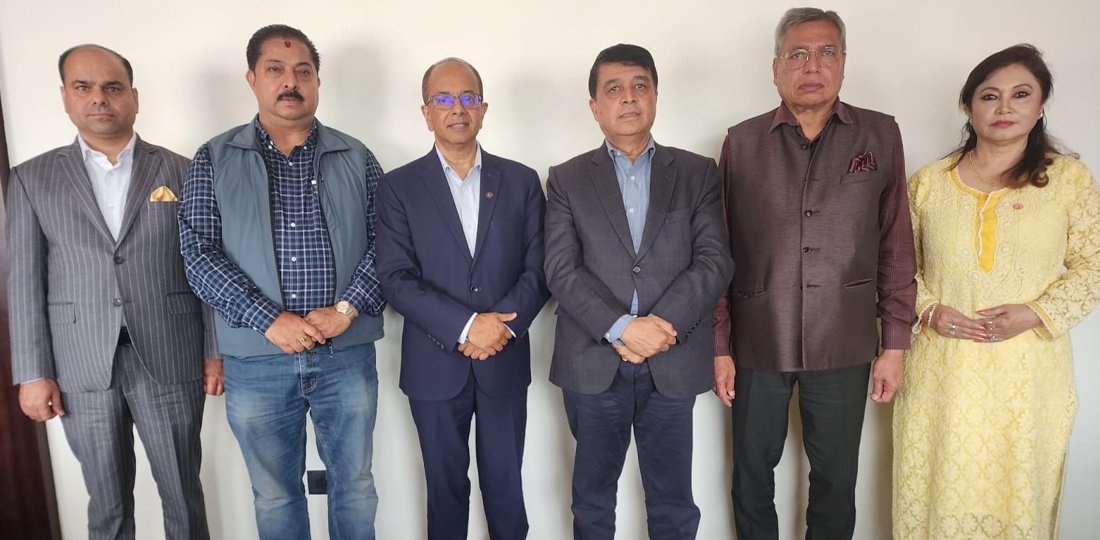
Similarly, the Morang Industry Organization has also stated that it is not fair to treat those doing business within the scope of state policy and law like criminals. The Morang Industry Organization says that while no guilty person should escape, the act of arresting innocent people without evidence and damaging their social reputation has completely shattered business confidence.
The Nepal Chamber of Commerce and Industry, Kathmandu, has also expressed serious concern over the crackdown and arrests being made in the name of investigation against industrialists and businesspeople. The association has opposed the incident of keeping Golchha in custody for investigation.
The association's statement says, 'It is condemned that Golchha was kept in custody in a way that caused unnecessary pain, harassment, and humiliation while investigating an offense under the Securities Act, 2063. The association concludes that such developments create unnecessary pressure and an atmosphere of fear on the private sector, negatively affecting the overall business environment.'
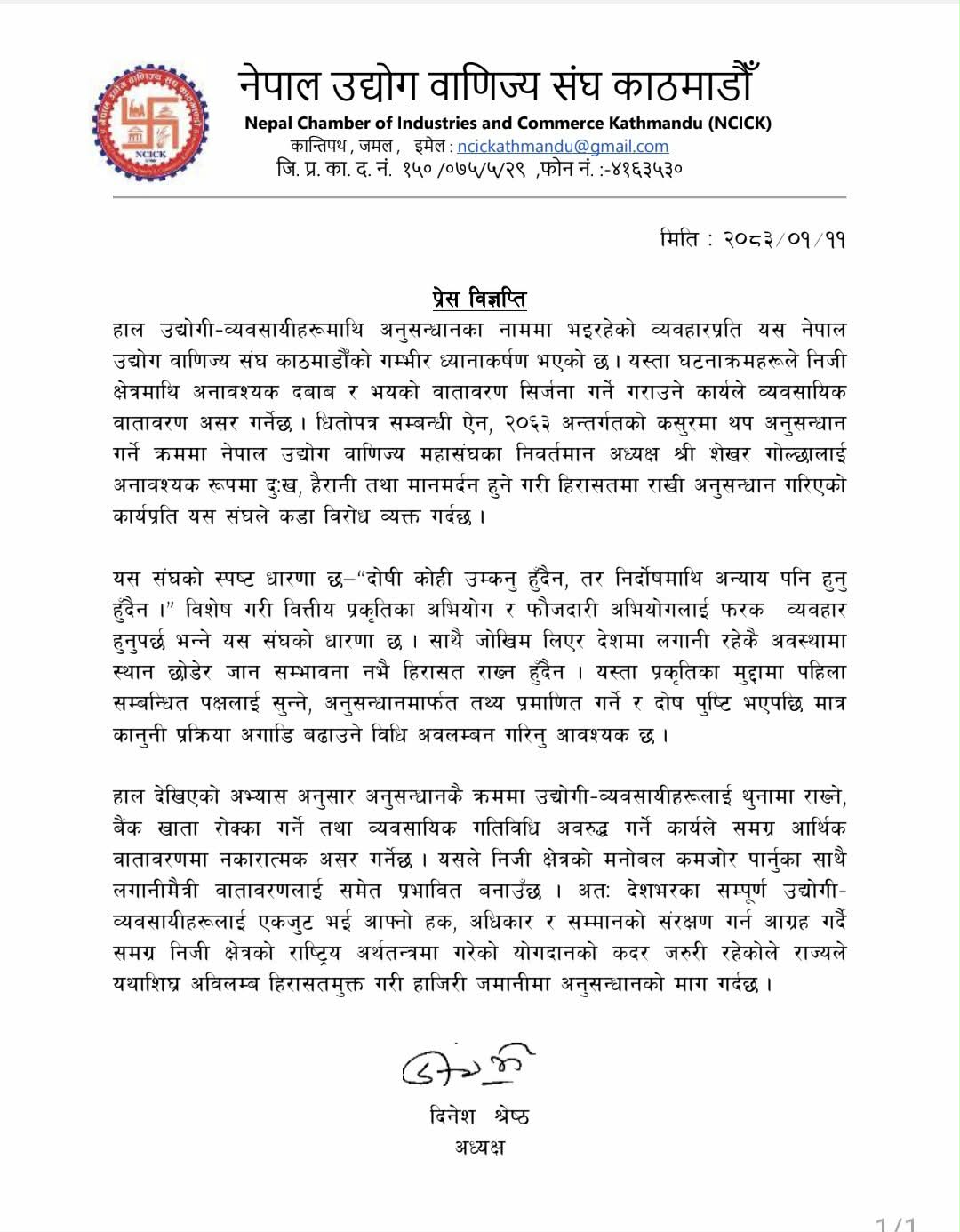
The association stated that its clear position is that 'no guilty person should escape, but there should be no injustice to the innocent.' The association has demanded that financial offenses and criminal offenses should be treated differently. The association insists that in a situation where businesspeople taking risks and investing in the country are not likely to flee, they should not be kept in custody.
The statement says, 'It is necessary to adopt a method of listening to the concerned parties first in such types of cases, verifying facts through investigation, and only proceeding with the legal process after the guilt is confirmed.'
The association pointed out that detaining businesspeople, freezing bank accounts, and obstructing business activities during the investigation process have a serious impact on the economy and the investment-friendly environment. The association expressed concern that this weakens the morale of the private sector.
All three umbrella organizations of the private sector have demanded that the government create an environment where investors feel safe, acknowledging the reality that the country's economic development is only possible by keeping private sector investment and the morale of entrepreneurs high. The private sector says that if the government does not practically implement the 'listen first, and detain only after guilt is proven' policy in time, the country's economy will have to suffer irreparable damage.
This specific news has been automatically translated by AI. As a result, there may be some inaccuracies or language errors.

_IvrWQ1hN9m.jpg)