Asian Share Markets Decline Amid West Asia Tensions and AI Bubble Concerns
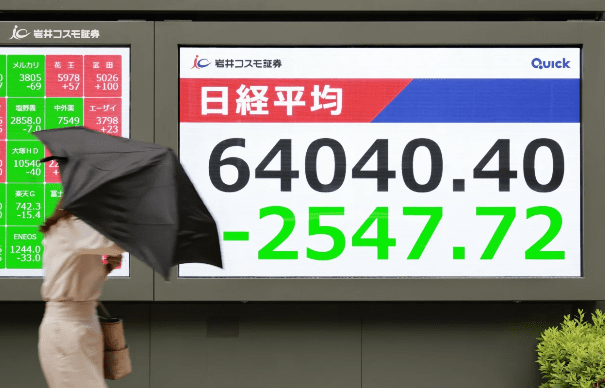
Kathmandu. Asian share markets saw a widespread decline on Monday due to rising tensions in West Asia and concerns about a potential 'bubble' in the field of artificial intelligence (AI). Last Friday, US share indices had seen a sharp decline when the stock market closed.
The Asian stock markets also came under pressure, partly due to the impact of this. On Monday, South Korea's main stock index Kospi saw the biggest decline.
During initial trading, this index had fallen by nearly 9 percent. By the afternoon, the decline narrowed to 4.92 percent. Shares of AI and technology sector companies saw particular pressure.
Samsung Electronics' shares fell by 5.7 percent and SK Hynix's shares by 2.7 percent. Japan's Nikkei-225 fell by 3.75 percent, while Taiwan's Taiex fell by 3.47 percent.
Hong Kong's Hang Seng fell by 1.18 percent, while China's Shanghai Composite Index saw a decrease of 1.26 percent. Earlier on Friday, the US technology-focused Nasdaq Composite had fallen by 4.18 percent.
This is considered the biggest daily decline in the Nasdaq since April 2025. Similarly, another index, the S&P 500, also fell by 2.64 percent. This was the biggest decline since October.
According to analysts, concerns have increased that the share prices in the AI sector might just be a speculative bubble, after US AI and chip manufacturer Broadcom released weaker-than-expected revenue projections.
The expectation that interest rates may rise in the coming months, following the release of data indicating a relatively strong employment market in the US, has also put pressure on technology shares.
Meanwhile, news of the largest military confrontation since the temporary ceasefire between Israel and Iran in April has further increased uncertainty in the global market.
This has increased concerns about disruptions to oil supply, which is expected to have a direct impact on Asian economies dependent on oil imports.
This specific news has been automatically translated by AI. As a result, there may be some inaccuracies or language errors.