
Karnali Province Initiates Budget Formulation Process for Fiscal Year 2083/084
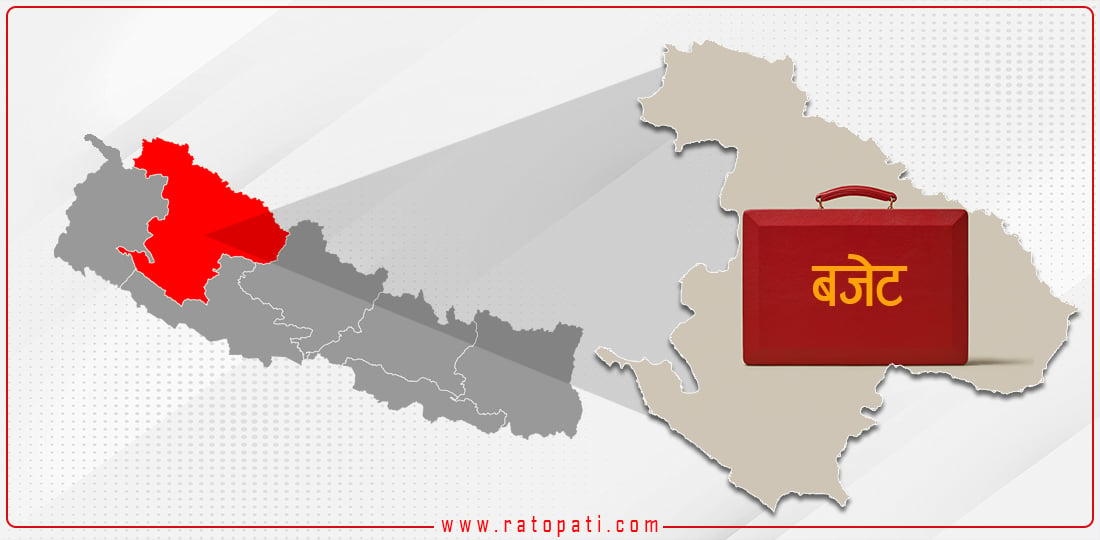
Surkhet. The Karnali Province government has initiated the budget formulation process for the fiscal year 2083/084. The Ministry of Economic Affairs stated that it is currently forming resource estimation committees and sub-committees, alongside reviewing statistical data.
To streamline budget preparation, it is customary to form a Revenue Advisory Committee led by the Finance Secretary. Chet Kumar Timilsina, spokesperson for the Ministry of Economic Affairs and Planning, told Ratopati that various other thematic sub-committees have also been established.
‘These committees conduct in-depth analyses regarding internal revenue estimates, resource identification, and the implementation status of the current fiscal year's budget,’ he said.
According to Timilsina, the process of inviting feedback from stakeholders regarding conditional grants has also begun. ‘Local levels and public institutions have been requested to submit proposals for projects/programs to be implemented under conditional grants provided by the provincial government by Baisakh 21,’ he stated.
The provincial government provides conditional grants for projects implemented by local levels with costs ranging from 1 million to 5 million. For this, local levels must submit a maximum of 5 projects within a total cost limit of 10 million.
Similarly, public institutions and beneficiaries are required to submit a maximum of 2 projects within a 5 million limit, while members of the Karnali Provincial Assembly are to submit projects within a 20 million limit. The Karnali provincial government, which has been distributing budget for various schemes to lawmakers annually, is preparing to continue this practice this year as well.
According to the Ministry of Finance, a notice was issued for the first phase of supplementary and special grant-related schemes from Falgun 1 to Chaitra 1. Based on that notice, plans have already been received from local levels, and discussions regarding those projects are underway.
Spokesperson Timilsina mentioned that work from other offices and ministries is also ongoing.
- Central 'ceiling' yet to arrive
Although internal preparations for the budget have begun in the province, Timilsina notes that the budget 'ceiling' from the federal government has not yet been received.
‘If the ceiling had arrived from the center, we would have set the limits for the upcoming budget and distributed them to the ministries accordingly,’ he said, ‘We plan to estimate and distribute the budget as soon as we receive it from above.’
He stated that it is not possible to estimate the budget for the upcoming year at this moment, clarifying that the final provincial budget will be based on what is received from the federal government.
Finance Minister Rajiv Bikram Shah has been in Kathmandu for some time. ‘I came to Kathmandu for a meeting of the Expert Council a few days ago. I also attended a couple of other party meetings,’ he said, ‘I am returning on Thursday (today).’
This time, the provincial government will not construct projects under 5 million for road infrastructure and under 2 million for others.
Minister Shah stated that work has not started because the ceiling has not arrived from the center, but it will begin once it is received.
Similarly, the project selection process has already begun. According to the project selection procedure established by the provincial government, lawmakers have already conducted project selection programs in their respective home districts.
With the mandatory provision to select projects from the district level, the crowd of people seeking plans at the ministry has ended.
This time, the provincial government will not construct projects under 5 million for road infrastructure and under 2 million for others.
‘The provincial government will no longer implement projects with a budget lower than that,’ said Surya Nath Yogi, Vice-Chairman of the Provincial Planning Commission, ‘However, small irrigation projects related to agriculture have been kept outside this limit. Such projects will be implemented even if they are up to 1 million.’
He mentioned that the responsibility for small projects will be transferred to local levels, and the provincial government will focus on strategic and large-scale projects.
According to Yogi, projects with a cost limit above 5 million operated by the provincial government must be mandatorily entered into the 'Project Bank'.
‘This means large projects will be kept in a central record, which will help eliminate duplication and ensure efficient allocation of resources,’ he said.
- Karnali's budget to be based on savings
A large portion of the budget brought by the Karnali provincial government is based on unspent savings, and it is estimated that a larger amount will be saved this time.
The government, which brought a budget of 32.99 billion 66 million 55 thousand for the current fiscal year, has spent 8.03 billion 62 million by the end of Chaitra, which is 24.21 percent of the total budget.
Karnali's internal resources are very weak. Therefore, the Karnali budget is usually built based on full federal grants and the remaining accumulated funds.
Currently, due to the Iran war, the price of petrol and diesel has increased, and bitumen supply has stopped, causing development work to slow down. Blacktopping work has ceased. In this situation, it is difficult to implement even 60 percent of the capital budget in the current fiscal year.
In this situation, a large amount will be saved. The size of the upcoming budget will be determined based on this.
If 80 percent of the current budget is spent, there will be minimal savings in the reserve fund.
The budget of over 31 billion for the current fiscal year was brought based on savings of nearly 6 billion.
Karnali's internal resources are very weak. Therefore, the Karnali budget is usually built based on full federal grants and the remaining accumulated funds.
Here is Karnali's past budget
- Fiscal Year 074/075: Total budget 1.02 billion 5 million
- Fiscal Year 075/076: Total budget 28.28 billion 28 million
- Fiscal Year 076/077: 34.35 billion 37 million 72 thousand
- Fiscal Year 077/078: 33.74 billion 13 million 53 thousand
- Fiscal Year 078/079: 36.54 billion 66 million 36 thousand
- Fiscal Year 079/080: 32.61 billion 61 million 36 thousand
- Fiscal Year 080/081: 33.37 billion 97 million 7 thousand
- Fiscal Year 081/082: 31.41 billion 41 thousand
- Fiscal Year 082/083: 32.99 billion 66 million 55 thousand
This specific news has been automatically translated by AI. As a result, there may be some inaccuracies or language errors.

-(2)_QJLjKxR87n.jpg)