Finance Minister Fails to Meet Deadline for Economic White Paper


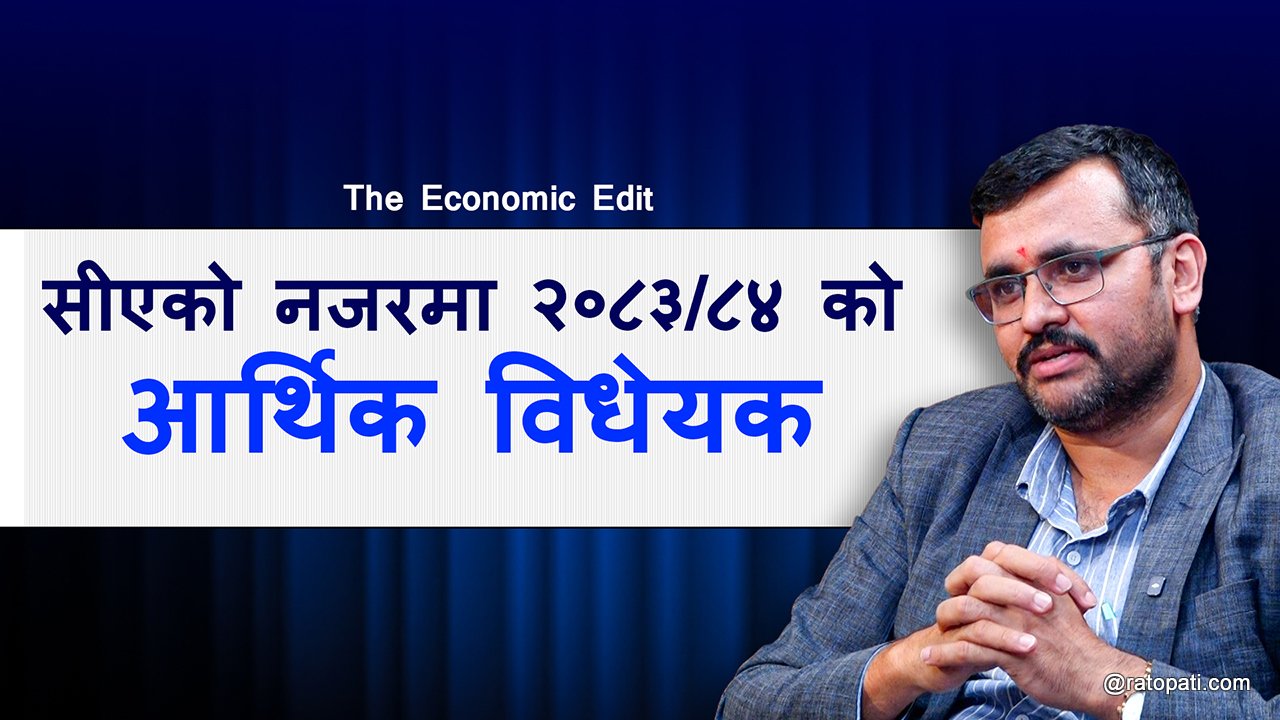
Kathmandu. Even after 22 days of leading the government, Finance Minister Dr. Swarnim Wagle has failed to release the country's economic status report (White Paper).
Upon assuming office on Chaitra 13, Finance Minister Wagle had decided to prepare a White Paper within five days, covering the economic situation up to the day before his appointment, but that deadline has passed, and the economic status report has not been released.
Finance Minister Dr. Wagle made three important decisions upon taking office. First, to repeal 15 acts, including the Department of Revenue Investigation, as recommended in the report of the High-Level Economic Reform Suggestion Commission 2081.
Second, to immediately prepare an economic status report 'White Paper' up to Chaitra 12, 2082, and create a 100-day, semi-annual, and annual action plan for implementing election promises.
Third, the purpose of bringing this White Paper was to show the real state of the country's economy and prepare a solid foundation for reforms and the new budget.
Among these, the second decision to release the White Paper has already been delayed according to the deadline he set himself. With the decision not being implemented within the timeframe set by the Finance Minister himself, questions are being raised about the government's working style and the performance of the 'action-oriented' minister.
The responsibility for preparing the economic status report was given to the team of Mahesh Bhattarai, head of the Economic Policy Analysis Division of the Ministry of Finance. It was said that the document should be prepared by including representatives of Nepal Rastra Bank. It was supposed to be released on Chaitra 17, but it was not. News appeared in the media that the Ministry of Finance was preparing to release the economic status report on Sunday, Chaitra 22, but the White Paper was not released. On the 22nd, the Speaker of the House of Representatives was elected and other tasks were made public. The White Paper could not be issued that day either. When trying to understand from Finance Minister Wagle's secretariat why the economic status report, which was said to be released in five days, was stopped, there was no response from there. Ratopati could not even contact the head of the Economic Policy Analysis Division who was given the responsibility.
However, Ministry of Finance spokesperson Tankaprasad Pandey speculated that the Economic Policy Analysis Division might have prepared the economic status report and submitted it to the Finance Minister. But he said he did not have full information on the matter. However, he seemed confident that the ministry would release it.
Past experiences and current expectations
In the past, when a new government came, it was a trend to selectively pick economic data to make the previous government's work look bad. Now, many expect the new government to bring a real picture of the economic situation.
Finance Minister Wagle also decided to bring an economic status report by setting a deadline for the past trend, but the economic status report did not come within the set deadline. After the 2074 general election, a left-alliance government was formed, which was close to a two-thirds majority. Dr. Yubaraj Khatiwada was the Finance Minister of that government. He entered the cabinet as an expert Finance Minister.
At that time, Khatiwada issued an economic White Paper immediately after taking office. Through the White Paper, he released data showing that the then Congress-Maoist coalition government had made the economy chaotic. He strongly included economic adversities such as increased imports, decreased foreign exchange reserves, and increased current account and balance of payments deficits in the White Paper.
He was initially known as an expert Finance Minister by declaring that the country's treasury was almost empty through the White Paper, but he could not succeed in the end. By the time he left office, the economy was in crisis.
Now, a government with a nearly two-thirds majority has been formed from the election held on Falgun 21, including the Rastriya Swatantra Party. Wagle has also taken charge as an expert Finance Minister. There is an expectation of a White Paper from Finance Minister Wagle that reflects the real economic situation of the country.
For some years, Nepal's economy has been in a sluggish state. Although the external economy looks somewhat strong, the internal economy is weak. Economic opportunities in the country are limited, which is making the problem of unemployment severe. In such a situation, the government with a nearly two-thirds majority has the challenge of accelerating the economy and meeting the expectations of the people.
As the current government is being formed, the war between America-Israel and Iran in West Asia has increased the challenge due to the disruption in oil supply and the impact that the war may have on remittances. On the other hand, government spending also appears to be low.
Revenue collection and expenditure status
According to the Ministry of Finance, the government had collected 780 billion 120 million 200 thousand rupees in revenue until Chaitra 12. During the same period of the last fiscal year, 744 billion 800 million 480 thousand revenue was collected. There is data that revenue collection has increased by 4.74 percent this time.
According to the data up to the end of Chaitra, 84.11 percent of revenue has been collected in the 9 months of the current fiscal year. According to the data of the Financial Comptroller General Office, a total of 891 billion 560 million 290 thousand rupees of revenue has been collected until the end of Chaitra, which is 6 percent more than the same period last year.
Of the collected revenue, the largest share was received from Value Added Tax (VAT) of 261 billion 410 million and Income Tax of 215 billion 900 million rupees. Collecting more than 93 percent of the target in the month of Chaitra alone is considered positive.
Although there is an improvement in revenue collection, the state of the government's development expenditure (capital expenditure) is very weak. Only 23.58 percent of the allocated capital budget, i.e., 96 billion 190 million 510 thousand rupees, has been spent until the end of Chaitra.
Which is lower than the same period last year. Ordinary current expenditure has already reached 63.3 percent (747 billion 520 million).
Data shows that the government's total budget expenditure has reached 53.97 percent of the target, i.e., 1 trillion 59 billion 950 million rupees so far. The government is also far behind in receiving foreign grants. Only 29.21 percent of the annual target has been received as grants.
The need for Finance Minister Wagle to release a real status report and present a clear roadmap for economic reform has become even more urgent.
This specific news has been automatically translated by AI. As a result, there may be some inaccuracies or language errors.
_jxKX1kXOlf.jpg)

_htFaNqpIDJ.jpg)