Intergovernmental Finance Council Meeting: Local and Provincial Leaders Voice Frustrations Over Fiscal Federalism
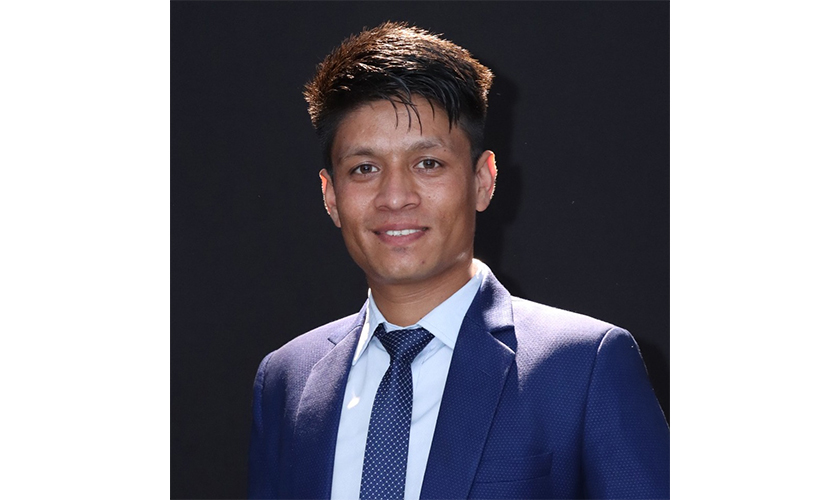

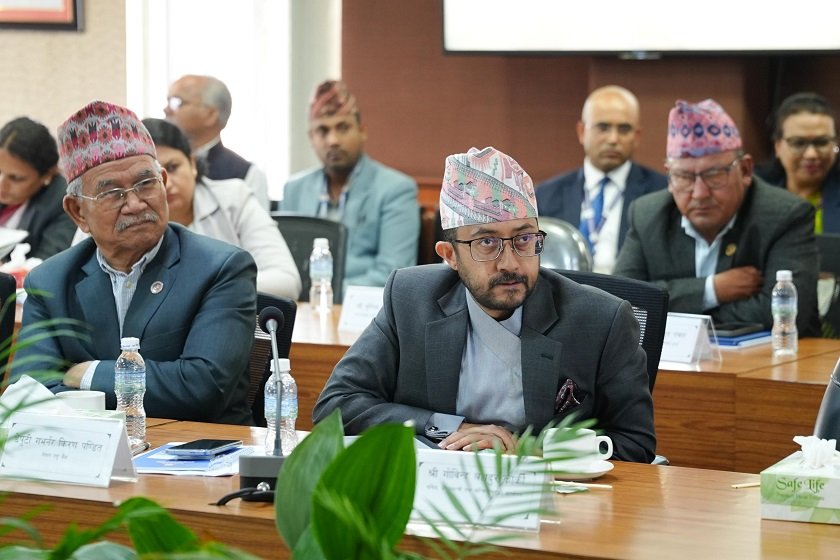
Kathmandu. Finance Minister Dr. Swarnim Wagle convened the first meeting of the Intergovernmental Finance Council and Thematic Committees on Thursday since assuming office.
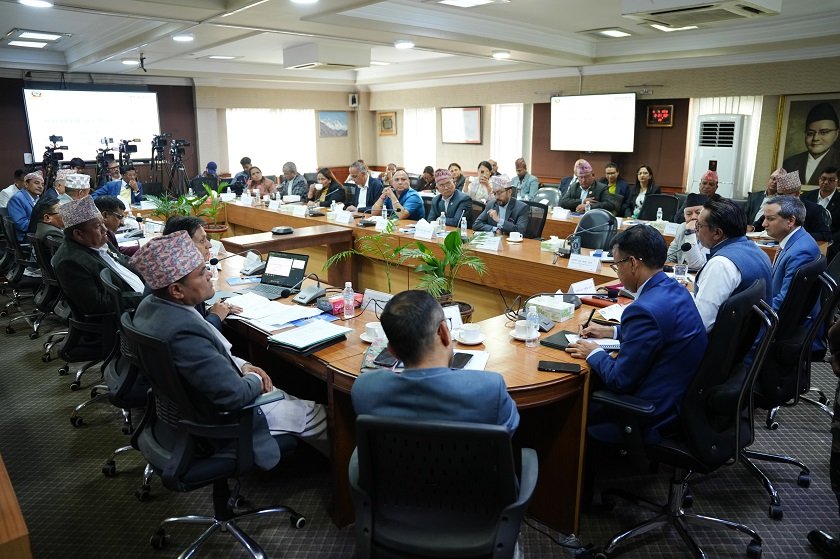
The meeting, held at the Finance Ministry's Sarwan Shamsher Hall, lasted for five hours, from 10:00 AM to 2:30 PM. Presiding over the session, Dr. Wagle listened to suggestions from local representatives, provincial finance ministers, and experts.
At the start, Joint Secretary of the Finance Ministry, Sevanta Pokharel, briefed the attendees on the agenda. Following this, local government heads were given the floor. The discussions primarily focused on the upcoming budget and policies formulated by the central government.
Local representatives expressed their trust in the current government and the Finance Minister, while noting that demands raised in previous meetings remain unaddressed. They also directed sharp criticism toward the central government.
Several provincial finance ministers and local representatives voiced frustration against the centralized mindset of Singha Durbar. They criticized the federal government's dual character, inconsistencies in budget distribution, and policy mismanagement, labeling the council meetings as mere rituals.
Their unified message was: 'Stop the game of pretending to devolve power while keeping the keys and treasury at the center, effectively paralyzing provincial and local governments.'
Jit Bahadur Sherchan of Gandaki Province noted that he had not even completed one day in office but attended the meeting to emphasize that the federal government must fully transfer powers to the provinces.
He demanded that the current government allocate the upcoming fiscal year's budget based on actual needs, suggesting a focus on tourism, hydropower, and tunnel projects. He remarked, 'The provincial government lacks a budget. We are treated like budget agencies; the central government should treat us as implementing bodies.'
Criticizing the Finance Minister, he questioned, 'The federal government increases its budget size to 21 trillion, but cuts the equalization grant for provinces from 123 billion to 98 billion? Is this what fiscal federalism means?'
Kiwi takes 4 years to fruit, but banks demand installments in 1 year!
Bagmati Province Finance Minister Prabhat Tamang strongly criticized the Nepal Rastra Bank's monetary policy and impractical agricultural loan arrangements. 'Our banking policy is ridiculous. A farmer takes a loan for kiwi farming, which takes at least four years to bear fruit. Yet, the bank demands installments within a year. How can the agricultural sector rise with such policies?' he asked.
He demanded policy reforms, suggesting that grace periods for agricultural loans should be determined based on the nature of the crop. Minister Tamang also expressed strong objections to the federal government's tendency to withhold fiscal equalization grants at the end of the year, questioning how provinces can proceed with projects without budget certainty.
He further alleged that the federal government has shrunk provincial revenue by granting land plotting rights to bodies like the Kathmandu Valley Development Authority, despite land registration being a primary source of provincial income.
Setting a 30 million limit, but distributing 1.5 million projects!
Karnali Province Minister for Economic Affairs and Planning, Rajiv Bikram Shah, highlighted the practical difficulties in budget formulation, citing the pressure from party cadres and political instability. He admitted that while he wanted to bring a budget based on expert advice, he was forced to accommodate the demands of party workers.
He pointed out that despite federal ministers claiming they would not include projects under 30 million in the federal budget, the 'Red Book' still contains road projects worth 1.5 million and 3 million. 'How are we supposed to work with such double standards?' he asked.
He noted that in Karnali alone, projects worth approximately 4 billion are stalled due to contractor negligence, with legal hurdles often preventing action.
1.5 million in internal revenue, how to run a government?
Sudurpashchim Province Finance Minister Bahadur Singh Thapa highlighted the dire state of internal revenue collection, noting that the province is 85-90% dependent on federal grants. 'With only 1.5 million in internal revenue and a borrowing limit of just 12%, how can we develop the province?' he asked.
Koshi Province Finance Minister Ram Bahadur Magar warned that rising fuel prices would impact the construction sector, ultimately affecting capital expenditure targets for all three tiers of government.
Local government's outrage: Engineers or Dozer Operators?
Local representatives complained about the extreme shortage of staff, with some municipalities operating without accountants. Bhim Prasad Dhungana, President of the Municipal Association of Nepal, criticized the distorted model of development, stating, 'Engineers today are not engineers, but dozer operators. They just destroy hills. Instead of providing technical support, the federal and provincial governments are cutting our budgets.'
Lalitpur Metropolitan City Mayor Chiribabu Maharjan argued that the 'Public Procurement Act 2063' is the main obstacle to development and demanded immediate amendments. He noted that the cumbersome act hinders the preservation and reconstruction of heritage sites.
He suggested changing the fiscal year timeline to improve spending efficiency and curb the trend of 'Asare Bikas' (end-of-fiscal-year development).
Deputy Mayor of Palungtar Municipality, Bandana Pandey, disagreed with the government's decision to restrict official advertisements to state-owned media, arguing it weakens information access at the local level.
Bhume Rural Municipality Vice-Chair Sabina Budha urged the government not to discriminate in budget allocation based on accessibility, demanding a separate reservation for remote areas.
99.2 percent budget cut for a single municipality!
Acting Chairman of the National Natural Resources and Fiscal Commission, Juddha Bahadur Gurung, shocked the assembly by revealing that the budget for some municipalities, such as Konjyosom in Lalitpur and one in Terhathum, had been cut by up to 99.2 percent due to flawed distribution formulas.
Policy defense by Planning Commission and Rastra Bank
Vice-Chairman of the National Planning Commission, Dr. Min Bahadur Shrestha, and Deputy Governor of Nepal Rastra Bank, Kiran Pandit, promised policy reforms. Dr. Shrestha acknowledged the duplication of projects and emphasized the need for a 'Project Bank.' Deputy Governor Pandit assured that the Rastra Bank would review policies regarding grace periods for agricultural loans.
What did the Finance Minister say?
Concluding the meeting, Finance Minister Swarnim Wagle stated that the country's economy cannot be run with traditional reforms. 'Your complaints are valid. Our system is rotten from within. We don't need incremental reforms; we need a big bang reform,' he said.
He announced that the government is in the process of repealing or amending about 15 outdated acts. He assured that the federal government is committed to allocating resources in a way that strengthens provincial and local governments in the future.
The four-hour meeting highlighted that while Nepal's federalism may appear politically strong, it faces a serious financial crisis.
This specific news has been automatically translated by AI. As a result, there may be some inaccuracies or language errors.
_jxKX1kXOlf.jpg)

_htFaNqpIDJ.jpg)