
Year in Review: The Disappearance of the Maoist Center and the Decline of Leftist Politics in 2082
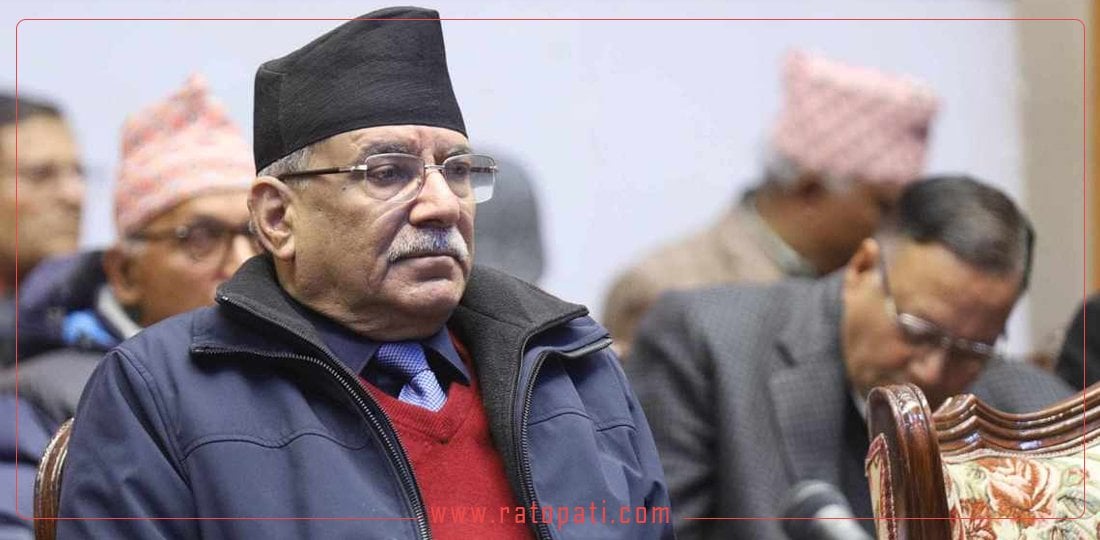
Kathmandu. The year 2082 marked the disappearance of the former CPN (Maoist Center) led by Prachanda. The then CPN (Maoist), led by Prachanda, had launched an armed rebellion on Falgun 1, 2052, with nationalism, democracy, and public livelihood as its core agendas.
Millions of Maoist leaders and cadres are unhappy that the party, which established itself in national politics through a decade-long (2052-062) rebellion, lost its identity within 30 years. However, top leaders insist they have not abandoned Maoist ideology but have unified with like-minded groups according to the times. Former Maoist Center General Secretary Dev Gurung argued that changing the party's name does not mean abandoning Maoist ideology.
'We changed the party name to unify with like-minded leftist forces. Maoism is the developed form of Marxism. Regardless of the form, we are moving forward based on the essence of Marxism, Leninism, and Maoism. Therefore, party names can change according to the times,' he told Ratopati.
Against the backdrop of setbacks in every election, Prachanda formed the Nepali Communist Party on Kartik 19 by merging with eight factions, including the CPN (Unified Socialist) and the Nepal Socialist Party. Before the unification announcement, an 18-point agreement was reached between the unification factions at the central office in Parisdanda on Kartik 16. The first point of the agreement states that the party's guiding principle remains Marxism-Leninism.

Leaders like Janardan Sharma, Ram Karki, and Sudan Kirati left the party, claiming the unification was against the decision of the Central Committee meeting. They alleged that the party was unified in haste to avoid a special general convention, which had been announced for Mangsir when internal contradictions reached their peak.
Concluding that the party unification was against the spirit of the Gen-Z movement in Bhadra, Sharma formed the Progressive Democratic Party (Pralopa) in alliance with the Nepal Socialist Party (Naya Shakti) led by Baburam Bhattarai and the group that separated from the Rastriya Swatantra Party (RSP).
Looking at Prachanda's past background and working style, the formation and dissolution of parties can be considered natural. He interprets the formation and dissolution of parties as a 'discontinuity in continuity.'
Prachanda has practiced this many times in the past. After obtaining membership in the Communist Party of Nepal in 2028, Prachanda became the General Secretary of the CPN (Masal) in 2045, after passing through the CPN (Fourth Convention) led by Mohan Bikram Singh in 2031. Upon taking leadership, he formed the CPN (Unity Center) in 2047 by joining various leftist factions.
After the party split in 2051, Prachanda reorganized the CPN (Maoist) and led the People's War. In the 2064 Constituent Assembly election, the Maoists became the largest party by winning 220 seats. In 2065, Prachanda merged the party with the CPN (Unity Center) Masal to form the UCPN (Maoist).
After the party split in 2069, he formed the CPN (Maoist Center) in 2074 by joining various leftist factions. In 2074, an agreement was reached for an electoral alliance with the largest leftist party, CPN (UML), with the condition of party unification. They secured a near two-thirds majority in the election.
As per the prior agreement, the Nepal Communist Party was formed on Jestha 3, 2075. At that time, Prachanda agreed to abandon Maoist ideology and accept Marxism and Leninism as the party's guiding principles. However, the party unity did not last even three years. On Falgun 23, 2077, the Supreme Court dissolved the NCP due to a dispute over the party's name. Following the court's order, Prachanda reorganized the former CPN (Maoist Center).
Even after forming an alliance with the Congress and the Unified Socialist in the 069 election, the Maoists could not achieve the expected results. The Maoists, who won 53 seats with 1.303 million votes in the 2074 election, shrank to 32 seats with 1.175 million votes in the 2079 election. Following the Gen-Z uprising, in the election held on Falgun 21 under special circumstances, Prachanda participated in the election by unifying with 17 additional leftist factions.
However, amidst the nationwide wave of the new party RSP, the Nepali Communist Party could not achieve the expected victory. While top party leaders were swept away in the electoral tsunami, Prachanda won from his People's War base area, Rukum East.
The RSP, which became the fourth force by winning 20 seats in the previous election, achieved an unprecedented victory this time by winning 182 seats, nearly two-thirds. The Nepali Communist Party could only win 17 seats in total, 8 directly and 9 proportionally.
In terms of proportional votes, the NCP shrank to 811,000, losing 364,000 votes compared to the votes received by the former Maoists in the previous election. After Prachanda abandoned the party and ideology, his successor Netra Bikram Chand 'Biplav' reorganized the party and entered the election under the name CPN (Maoist). However, Biplav's party could not even cross 25,000 votes. Not only the Nepali Communist Party, but leftist forces have weakened in the history of Nepal in this election. Out of 10,835,27 valid votes, the total votes received by all leftist forces participating in the election is 2,378,000. Overall, the votes received by the leftists are 21.50 percent.
Nepali Communist Party leader Jagannath Khatiwada says that the leftist movement has suffered a major blow due to the assassination of communist principles, ideas, and ideals.
'We could not operate based on the values, recognition, principles, ideals, and thoughts of the Communist Party. In a way, there was an assassination of ideals and principles. As a result, the communist movement suffered a major blow,' he said.
This specific news has been automatically translated by AI. As a result, there may be some inaccuracies or language errors.

_xNfaHPeaw1.jpg)
_bYdCl5n4QS.jpg)