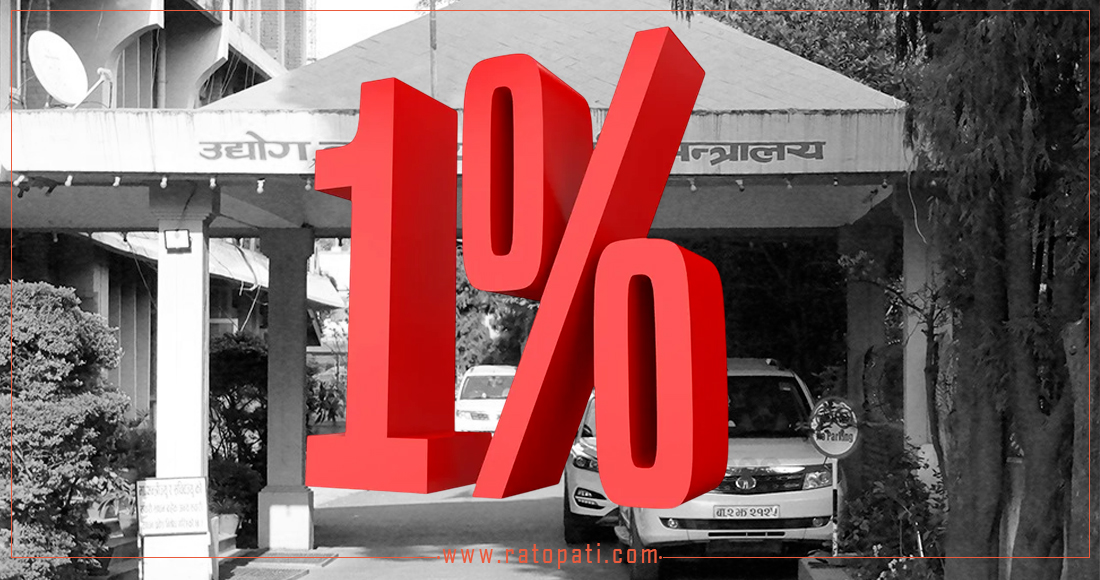
Kathmandu. The draft of the 'Company Act, 2083' recently unveiled by the Ministry of Industry, Commerce and Supplies has created a significant stir in the capital market. Investors have become concerned after the government's draft proposed a 1 percent fee on share transfers exceeding twenty-five lakh rupees. A widespread debate and protest on this issue began among those concerned with the capital market from Monday morning on social media. Investors are in confusion with the apprehension that an additional 1 percent expenditure will be added to regular transactions in the secondary market (NEPSE) after this proposal came in the draft. Following widespread protest and criticism, the ministry has signaled that it will amend the controversial provision. Investors' widespread protests have also led to the closure of the NEPSE index falling on the first trading day of the week. The NEPSE index fell by 16.54 points to 2,632.96 points.
- Ministry's Clarification, 'This is not final, it will be amended'
Following intense criticism of the proposed provision, the ministry has started preparations to correct it. Kalpana Shrestha, a member of the draft committee and joint secretary at the ministry, clarified that the provision would be amended based on the suggestions received. She said, 'We put the draft on the website with the objective of receiving suggestions from the general public and stakeholders. Many suggestions have been received, and we are currently in the process of amending it. The ministry has only prepared the draft; it is not the final act. This provision will be amended.' She informed that points in the draft that are technical or have disagreements from stakeholders will be finalized after discussion. Ministry spokesperson and joint secretary Netra Prasad Subedi also stated that this matter is under discussion. He said, 'The act that has been made public now is a draft. The ministry is in continuous discussion with stakeholders regarding this. Amendments may be made based on the suggestions received. This is not the final policy.'
- What is in the proposed draft?
Section 89 of the draft prepared by the ministry contains provisions related to share transfer fees. Subsection 1 of which states, 'If shares worth twenty-five lakh rupees or more are transferred or bought and sold, the person receiving the right upon recording such share details in the office shall have to pay a share transfer fee at the rate of 1 percent.' The main point of contention is the provision in Subsection 2, which states, 'In case of share trading through the Securities Exchange Market (Stock Exchange) system, the concerned Securities Businessperson (Broker) shall collect the said fee and deposit it in the Federal Consolidated Fund.' This point has led to the interpretation that an additional 1 percent fee will be levied on every large transaction settled in the secondary market, spreading fear among investors.
Capital market experts and businesspersons have strongly criticized this proposal, calling it 'counterproductive.' Former President of the Nepal Stock Brokers Association, Priyaraj Regmi, interpreted this as a move that attacks the ecosystem of the capital market itself. Regmi said, 'This tax that is being imposed on the capital market is like slaughtering the egg-laying hen to sell the meat all at once. When the cost of transactions increases, people will hesitate to buy and sell shares. If there are no transactions, prices are not determined, and if prices do not rise, the government will also lose capital gains tax.' He stated that such a provision would not provide good prices and easy exit in the secondary market, and therefore, companies would not be willing to come to the primary market either. There are also differences in interpretation of this matter among public figures. Member of Parliament Hari Dhakal claimed that this provision would not apply to the secondary market and urged investors not to panic. He said, 'It appears that there is a widespread debate recently about a 1 percent tax on share transactions. However, one thing needs to be clearly understood: when we trade shares in the secondary market through TMS and NEPSE, the broker does not charge a 1 percent tax or fee. The final tax applicable to secondary market transactions is the capital gains tax of 7.5 percent or 10 percent.' He explained that this provision would only apply to 'off-market' transactions where the name is directly transferred in the company. Meanwhile, share market investor and businessman Ambikaprasad Poudel believes that the language of the draft carries the risk of encompassing all types of transactions. Poudel said on social media, 'How have you understood what is intended by Subsections 1 and 2 of Section 89 of the proposed Company Act 2083? Not being a law student, at first glance, it appears that after this law comes into effect, a 1 percent transfer fee will have to be paid by the buyer on all types of transactions exceeding twenty-five lakh rupees.'
- Current Provisions and Proposed Burden
According to the current Company Act 2063, certain fees are applicable only when registering a company, increasing capital, or changing its name. There is no provision for collecting transfer fees on the purchase and sale of shares. In stock market transactions, investors currently pay 0.015 percent to the Securities Board and commissions ranging from 0.24 to 0.36 percent to brokers. In addition, a capital gains tax of 5 percent or 7.5 percent has been applicable. If the proposed 1 percent fee comes into effect, the buyer of shares above twenty-five lakh rupees will have to pay an additional twenty-five thousand rupees immediately. Investors say that this will increase the cost for investors and reduce liquidity in the market. Although the ministry has stated that this provision was placed for suggestions and will be amended, it has created psychological panic in the market. Investors have demanded that Subsection 2 of the draft be completely removed or that transactions in the secondary market be clearly exempted.



_xNfaHPeaw1.jpg)

_bYdCl5n4QS.jpg)