Looking Back at 2082: A Year of Political Upheaval and the Rise of Gen Z

Kathmandu. The year 2082 proved to be a year of political turmoil. The Gen Z movement, which took place on Bhadra 23 and 24, toppled the state power that had been under the control of the Congress and Communists for the past 35 years. The Gen Z movement led to the collapse of the coalition government led by KP Sharma Oli.
Driven by the Gen Z movement, the House of Representatives was dissolved, and the general election, originally scheduled for 2084, was held within this year.
In the House of Representatives election held on Falgun 21, the Rastriya Swatantra Party (RSP), formed three and a half years ago, succeeded in leading the government by winning 182 seats, nearly a two-thirds majority. In this election, traditional political parties considered masters of power politics, such as the Nepali Congress, CPN-UML, and the Nepali Communist Party, were soundly defeated.
Until the Gen Z movement, state power had been a game of 'musical chairs' played alternately by Oli, Sher Bahadur Deuba, and Pushpa Kamal Dahal 'Prachanda'. This election saw the departure of old faces from parliament, which is now dominated by new and young figures.
Former Mayor of Kathmandu Metropolitan City and rapper Balendra (Balen) Shah entered federal politics. Resigning from his mayoral post, he became a candidate for the House of Representatives from Jhapa-5. Running on an RSP ticket, he not only defeated former Prime Minister and UML Chairman Oli but also succeeded in becoming the country's executive head, the Prime Minister.
With the rise of young Balen in national politics, the era of experienced veterans like Oli, Deuba, and Prachanda appears to be in decline. Influential leaders, including Deuba, Oli, and Prachanda, who have served as Prime Ministers multiple times, have appeared on the 'radar' of money laundering investigations.
Former Prime Minister Oli and former Home Minister Ramesh Lekhak, accused of suppressing the Gen Z movement, were released on Chaitra 26 after spending 13 days in police custody. The high-level investigation commission led by Gauri Bahadur Karki, formed by the government, concluded that Oli and Lekhak were morally responsible for the deaths of 77 people, including 23 Gen Z protesters. The government formed under Balen's leadership has signaled its intent to take strict measures in favor of good governance and social justice.
The significant events that occurred in the political sphere this year are presented in brief.
- Oli government toppled within 27 hours of the movement's start
The cabinet meeting held on Bhadra 9 decided to shut down social media platforms that were not registered within 7 days, in accordance with the 'Directives for Regulating Social Media Use, 2080'. Along with the government's decision to shut down social media, Gen Z youth called for a peaceful protest on Bhadra 23, citing corruption and mismanagement.
The protest, which remained peaceful until 12 noon, suddenly turned violent. The government's brutal suppression of the protesters resulted in the deaths of 23 youths. On Bhadra 24, enraged protesters caused destruction by setting fire to the Parliament building, the Prime Minister's office at Singha Durbar, the Supreme Court, political party offices, leaders' private residences, business establishments, and government offices across the country.
_MIIDMVO8ri.jpg)
_oO992jJ6tw.jpg)
An additional 53 people lost their lives during the arson. As the movement turned violent, Prime Minister Oli fled from his official residence in Baluwatar to Supartar in Hetauda via army helicopter. Former Prime Minister and Nepali Congress President Sher Bahadur Deuba, along with his wife, Foreign Minister Arzu Rana, were severely beaten by protesters at their own residence in Budhanilkantha. The Deuba couple was rescued late at night with the help of the army and taken to a safe location.
The President, Vice President, Speaker, ministers, high-ranking state officials, and former Prime Ministers were moved to safe locations by the army. Due to the Gen Z movement, Nepal's politics were turned upside down in just 27 hours. This was the first incident in history where a government collapsed in such a short period.
The violent protests on the streets only calmed down after the army was deployed on the night of the 24th. The country went through a state of lawlessness for three days. On the night of Bhadra 27, an interim government was formed under the leadership of former Chief Justice Sushila Karki through the mediation of the army. That same night, on the recommendation of the Karki government, President Ramchandra Paudel dissolved the House of Representatives and announced elections for Falgun 21.
_3NfkLFpXHq.jpg)
For a month after the movement, leaders of the old political parties did not appear in public. The morale of security personnel had plummeted significantly. The atmosphere of fear and terror among the general public had not yet dissipated. There was also uncertainty about whether the elections would be held on time. After the Gen Z movement, there was no clear roadmap for the direction national politics would take. Seeing the line of youths at the Army Headquarters in Bhadrakali to become Prime Minister clearly highlighted how weak our state power had become.
- From party dissolution to leadership capture
As the impact of the Gen Z movement began to normalize, the activities of political parties increased. Slowly, party leaders began to appear in public, but the influence of the movement began to be seen within every party. Pressure for leadership transition and party reorganization increased.
_UZ9JPOifLZ.jpg)
The Maoist Center and Unified Socialist, which carried the legacy of the People's War and the People's Movement, dissolved to form the Nepali Communist Party. Suspending the provisions in the statute, KP Sharma Oli was elected chairman for the third time at the party's 9th and 10th general conventions. General Secretaries of the country's oldest party, Congress, Gagan Thapa and Bishwa Prakash Sharma, captured the party through a special general convention and reorganized it under their own leadership. While a wave of unity and polarization swept through Madhesh-based parties, the RSP, which had been weakening after the Gen Z movement, succeeded in becoming a powerful party after joining forces with Bibeksheel Sajha and former Kathmandu Metropolitan Mayor Balendra (Balen) Shah.
- Prachanda's abandonment of Maoism and formation of NCP
Pressure mounted on the leadership within the former CPN (Maoist Center) to call a special general convention. Under pressure from all sides, Chairman Pushpa Kamal Dahal 'Prachanda' called a special meeting of the Central Committee in the second week of Ashoj. Leaders including Senior Vice Chairman Narayan Kaji Shrestha, Deputy General Secretary Janardan Sharma, Secretary Ram Karki, and Central Member Sudan Kirati pressured Prachanda to step down immediately.

However, after the faction demanding leadership change became a minority, the meeting approved Prachanda's proposal to dissolve the Central Committee and hold a special general convention in Mangsir. Despite this, contrary to the Central Committee's decision, Prachanda agreed to merge with 10 factions, including the CPN (Unified Socialist) and Nepal Samajwadi Party, on Kartik 19.
The party was reorganized to form the Nepali Communist Party. Disagreeing with the party's decision, leaders like Janardan Sharma and Ram Karki separated. They joined forces with the Nepal Samajwadi Party (Naya Shakti), patronized by Baburam Bhattarai, to form the Progressive Democratic Party (Pralopa).
In a bid to restore the power he had been losing by combining 25 different leftist factions, Prachanda even abandoned 'Maoism', which he had adopted for 30 years. On the other hand, disagreeing with the decision to merge with the Maoists, leaders including former Unified Socialist General Secretary Ghanshyam Bhusal, Kisan Shrestha, and Ram Kumari Jhakri separated.
- Gen Z toppled the government, but not Oli's ambition
Pressure mounted on Chairman Oli to step down within the largest leftist party, CPN-UML. Dissatisfaction in the UML had peaked after the 9th and 10th general conventions suspended the two-term limit and the 70-year age limit, paving the way for Oli to become chairman for a third term.
_qLClpv8yEn.jpg)
Amidst the dissatisfaction, the legislative convention held in Godawari, Lalitpur, from Bhadra 20-22 approved Oli's proposal. Former Vice President Bidhya Devi Bhandari, then Vice Presidents Asta Laxmi Shakya, Yubaraj Gyawali, Surendra Pandey, Secretary Yogesh Bhattarai, and Gokarna Bista expressed their dissatisfaction. But the Oli government collapsed due to the Gen Z movement the very next day.
The dissatisfied faction demanded Oli's resignation, stating that the government's wrongdoings had caused great damage to the country and the party. Defensive due to the growing pressure within the party, Oli called a Central Committee meeting in the last week of Ashoj. The Central Committee meeting held on the 29th decided to hold the 11th general convention in the last week of Mangsir. Chairman Oli and Senior Vice Chairman Ishwor Pokharel competed in the general convention by forming panels. However, except for Gokarna Bista and Yogesh Bhattarai, the Oli group won all positions. Oli's arrogance and ambition did not stop even after losing power due to the Gen Z movement. The UML decided to go into the House of Representatives election by making the widely unpopular Oli its candidate for the next Prime Minister. However, the UML was soundly defeated, and Oli was also defeated by Balen in Jhapa-5.
- Deuba, who lost party power in the greed for Prime Ministership
Meanwhile, within the Nepali Congress, the main partner of the Oli government during the Gen Z movement, the group led by then General Secretaries Gagan Thapa and Bishwa Prakash Sharma launched a signature campaign for a special general convention, pressuring President Sher Bahadur Deuba to step down.
Amidst pressure from all sides, Deuba called a Central Working Committee meeting on Ashoj 28. He handed over the responsibility of Acting President to Vice President Purna Bahadur Khadka and flew to Singapore for treatment. In the meeting, the Gagan-Bishwa Prakash group submitted the signatures of 51 percent of the general convention representatives to Acting President Khadka. But Khadka could not resolve the internal conflict for a month.
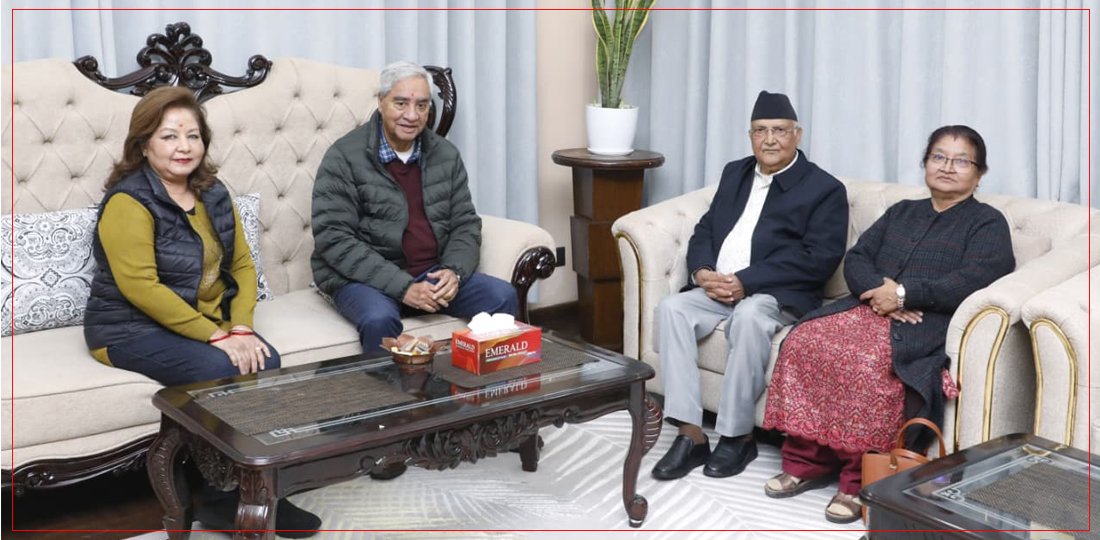
After returning to the country, Deuba became active again. The work execution committee meeting held on Poush 18 decided to hold the regular general convention from Baisakh 28-31. The decision of the work execution committee meeting was approved by the Central Committee meeting held on Poush 30. But challenging the party's decision, the Gagan-Bishwa Prakash group called a special general convention in the last week of Poush.
Thapa was elected President from the general convention. A new working committee was selected under his leadership. The Deuba group filed a petition at the Election Commission against the decision of the special general convention. The commission decided in favor of the special general convention. Khadka reached the Supreme Court against the commission's decision, but the court issued an order providing relief to the Gagan-Bishwa Prakash faction until the final verdict of the case.
The case regarding the legitimacy of the party is currently sub-judice in court. Deuba, who remained silent on every action of the Oli government in the greed of becoming Prime Minister in 083, ended up losing his party power as well.
- RSP became powerful with the chemistry of Rabi-Balen
The Rastriya Swatantra Party (RSP), which had been mired in various legal and political troubles since its inception, became even weaker during the Gen Z movement. Chairman Rabi Lamichhane was in Nakkhu jail for trial in various cooperative fraud, organized crime, and money laundering cases. Rabi was also accused of holding dual passports and citizenship.

Rabi was accused of forging documents to get out of jail on the strength of the movement on Bhadra 24. The Karki commission report even mentions that an environment was created for prisoners across the country to escape after Rabi was released. After facing criticism from all sides and seeing that it would cause further damage to the party, Rabi went back to jail. Released by court order in the first week of Poush, he merged his party with Bibeksheel Sajha, the Balen group, various Gen Z groups, and the Tharuhat/Tharuwan group. Especially, the chemistry between Rabi and Balen succeeded in making the RSP a legally powerful party through the election.
- Balen's rise from the Falgun 21 election
Concluding that the formation of the interim Prime Minister Sushila Karki government and the dissolution of parliament were unconstitutional, 165 outgoing MPs from Congress-UML filed a case in the Supreme Court. More than 12 lawyers filed writ petitions. The court did not hear the writ petitions filed by political parties and lawyers. There were various doubts about whether the elections would be held on time due to the lack of direct dialogue between the government and the old political parties. But dispelling all these doubts, the Karki government held continuous dialogues with the top leaders of various political parties. The Election Commission actively moved the election process forward.

Slowly, all political parties agreed to go to the polls. Finally, the election was held peacefully on Falgun 21. From the election results, the RSP set a record by winning an unprecedented majority, i.e., 182 seats. The Congress, UML, NCP, RPP, and Madhesh-based parties, which had been in state power for the past 34 years, suffered a major blow.
While Congress was limited to 38, UML to 25, NCP to 17, and RPP to 5 seats, the Madheshi parties were wiped out. The newly opened Labor Culture Party won 7 seats through direct and proportional representation. Compared to the RSP, Congress, UML, and NCP could not even reach half in terms of seat numbers and votes. In most of the 165 constituencies, the old parties could not even become competitors. In many places, the deposits of the three old parties were forfeited, while the Madheshi parties were reduced to zero.
With the final results of the election coming in, RSP senior leader Balendra (Balen) Shah succeeded in becoming the youngest elected Prime Minister on Chaitra 13. There is a dominance of youth in the government. Dol Prasad Aryal of the RSP was elected unopposed as the Speaker of the House of Representatives. Ruby Kumari Thakur of the Labor Culture Party has been elected as the Deputy Speaker.
- High-level state officials in custody
The day after the Balen government was formed, on the morning of Chaitra 14, police arrested former Prime Minister Oli and former Home Minister Lekhak and kept them in custody. Due to Oli's health condition and age, he was kept under strict security surveillance at Tribhuvan University Teaching Hospital, Maharajgunj, as per the court's order. Both Oli and Lekhak were released on Chaitra 26 on the order of the Supreme Court.
Former Energy Minister Deepak Khadka is currently in police custody on charges of money laundering. The Commission for the Investigation of Abuse of Authority has filed a case in the Special Court against former Speaker Krishna Bahadur Mahara in the vape-based gold smuggling case. Arrest warrants have been issued against former Prime Minister Deuba and his wife. Investigations are also underway against former Prime Ministers Oli and Prachanda for money laundering.
This specific news has been automatically translated by AI. As a result, there may be some inaccuracies or language errors.