Madhesh Province Struggles with Irrigation Crisis Despite Government Promises

Janakpurdham. Although Madhesh Province has approximately 602,000 hectares of arable land, only 49 percent of it has access to irrigation facilities. Data shows that the majority of the province's agricultural sector remains dependent on rainwater.
Despite the provincial government claiming to provide relief to farmers by spending millions of rupees annually in the name of irrigation, more than 51 percent of the land remains without irrigation facilities.
The Madhesh provincial government had previously unveiled an ambitious plan with the catchy slogan 'Water in every field, work in every hand' targeting farmers. However, this slogan appears to have been limited to cheap popularity.
Due to declining annual rainfall and irregular use of groundwater in the province, the risk to farmers' production is increasing. Although the government has invested heavily in building structures like deep boring, power drills, and tube wells to solve the problem, most of these structures have not come into operation, rendering the investment ineffective.
A deep boring project built at a cost of 9.5 million rupees in Sakari, Manara Siswa Municipality-10 of Mahottari district, has not yet come into operation. According to local resident Bhagwan Jha, even though the structure is ready, farmers have not been able to benefit from it due to a lack of electricity connection, maintenance, and management.
Looking at the district-wise situation, 55 deep boring units have been installed, including 33 in Mahottari and 22 in Dhanusha. However, most are in a state of disuse. Similarly, although a total of 216 power drill tube wells have been installed, including 43 in Mahottari and 123 in Dhanusha, many of these structures have not been able to come into operation.
The provincial government has also been running a tube well distribution program with the aim of expanding irrigation access. Statistics show that in the last fiscal year, shallow tube wells were distributed to 405 farmers in Parsa, 312 in Rautahat, 34 in Bara, 232 in Saptari, 209 in Siraha, 205 in Mahottari, and 145 in Sarlahi.
Amlesh Yadav, acting chief of the Groundwater Resources and Irrigation Development Division Office in Mahottari, stated that the structures could not be operated due to a lack of budget, theft of transformers, problems in power supply, and weaknesses in technical management.
He said, 'Building structures is not the only solution; their operation and management are equally important. Due to a lack of necessary attention in that direction, many projects have been abandoned.'
The provincial government has also been running a tube well distribution program with the aim of expanding irrigation access. Statistics show that in the last fiscal year, shallow tube wells were distributed to 405 farmers in Parsa, 312 in Rautahat, 34 in Bara, 232 in Saptari, 209 in Siraha, 205 in Mahottari, and 145 in Sarlahi.
The Ministry of Land Management, Agriculture, and Cooperatives has stated that the distribution process is continuing in the current fiscal year as well. Farmers complain that while this program has provided relief to a limited area, it has not been able to solve the problem in the long term.
Farmers who have been farming relying on rainwater seem disappointed with the government's plans. Ramji Sah of Mithila Municipality-4 said, 'It does not rain according to the season; we rely on rainwater.'
He believes the government should take concrete steps and make long-term arrangements regarding irrigation facilities. He mentioned that even the boring wells installed with government subsidies do not produce water.
Similarly, Naresh Yadav of Chakraghatta Municipality-3 said that although the issue of irrigation is raised every year, it remains limited to speeches and commitments. He said, 'The lack of irrigation has a direct impact on the production of major crops like paddy, wheat, and maize. When water does not reach on time, planting is delayed, production decreases, and costs increase.'
Farmers say that the lack of an effective irrigation system in the agriculture-dominated region of Madhesh Province is becoming a matter of long-term economic risk.
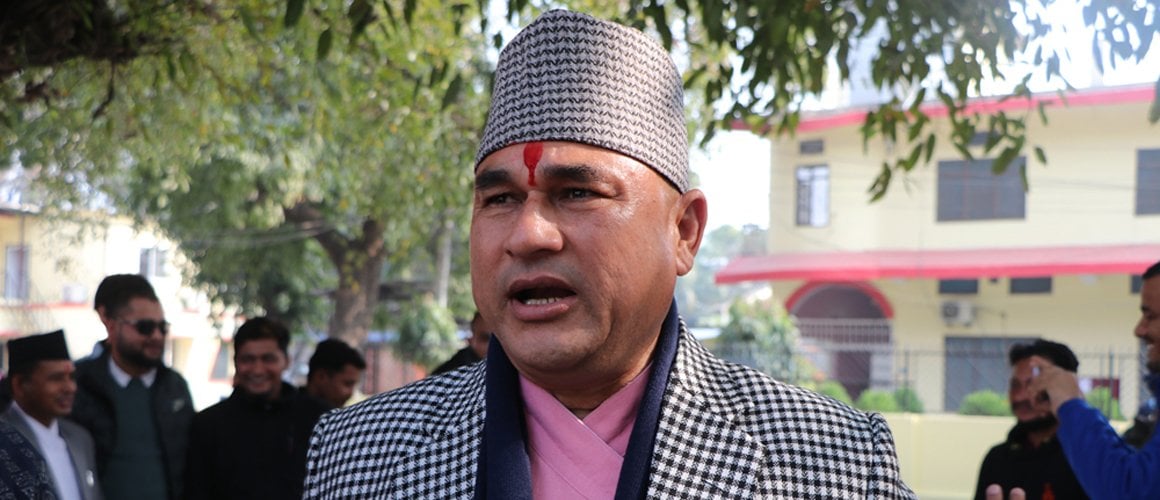
Meanwhile, Madhesh Province Agriculture Minister Shyam Patel said that this time, applications submitted by farmers across the province for shallow tube wells will be managed for everyone according to the rules.
He said, 'Since fertilizers are under the jurisdiction of the federal government, we cannot do anything about that, but the provincial government can manage irrigation. About 800 people have filled out forms for shallow tube wells in Parsa alone. We will provide them to those who have applied.'
Farmers say that the lack of an effective irrigation system in the agriculture-dominated region of Madhesh Province is becoming a matter of long-term economic risk.
According to them, sustainable management, regular maintenance, ensuring power supply, and active participation of local levels are necessary rather than just building structures to solve the irrigation problem. Similarly, if community management systems, solar-powered irrigation, and technology-friendly solutions can be adopted, the irrigation crisis in Madhesh could move towards a resolution.
This specific news has been automatically translated by AI. As a result, there may be some inaccuracies or language errors.