Banarasidham: A 418-Year-Old Beacon of Social Equality in Baitadi

Kanchanpur. Although the constitution, laws, and policy provisions prohibit caste-based discrimination and untouchability, their remnants remain deeply rooted in various sectors of society. In rural areas, where these practices are intertwined with tradition, culture, and social structures, it appears that the complete eradication of caste-based discrimination will take time.
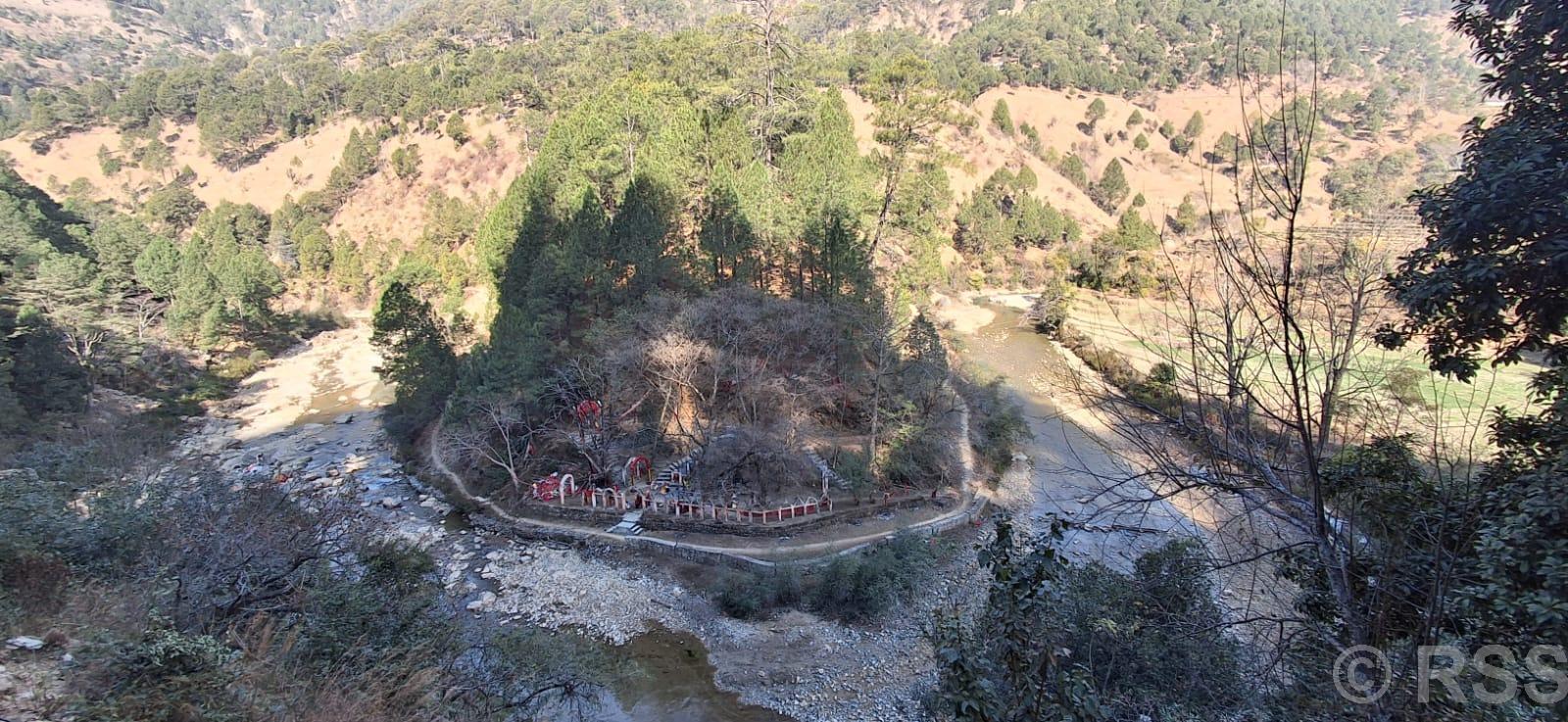
Despite widespread discussions on equality, inclusivity, and social justice in political, social, and intellectual forums, the challenge of establishing equality in practice persists. However, the Banarasidham and Vishwanath Jyotirlinga Shaktipeeth, located in Patan Municipality-3 of Baitadi in Sudurpashchim Province, is recognized as a historical site where the practice of social equality began 418 years ago.
At this Shaktipeeth, Dalit and Brahmin priests have been performing rituals together in the same temple area. Because of this tradition, Banarasidham can be considered a historical 'living museum' against caste discrimination. Ironically, despite carrying such a historical message of social equality, the temple lags behind in terms of development, with a master plan worth millions remaining limited to paper due to a lack of budget.
Traditionally, religious sites were considered the exclusive domain of upper castes, with Dalit communities often banned from entering temples or performing rituals. However, the tradition at Banarasidham in Baitadi is the opposite.
Researcher and Acharya Pandit Ganesh Prasad Pant, who has been studying the history of the temple area, states that the tradition of Dalit and Brahmin priests jointly performing rituals, distributing prasad, and conducting religious ceremonies has continued uninterrupted for over four centuries.
According to him, the history of Banarasidham is linked to the reign of Maharaja Manuk Chand (Mani Chand) of the then Swarad region. History suggests that around 1604, caste discrimination was at its peak in the Swarad region. As social harmony began to crumble due to untouchability, social discrimination, and caste divisions, King Manuk Chand instructed the Royal Guru and Royal Astrologer, Veerabhadra Pant, to find a solution.
“At the initiative of the Royal Guru, a meeting of representatives from various castes and communities was called,” said Acharya Pant. “Representatives from various groups including Pandit, Bhatta, Bhat, Bista, Awasthi, Koli, Damai, Luhar, Kumal, and Pahari participated in the meeting. After a long discussion, a historical decision was made: there should be no caste-based discrimination in the field of religion, worship, and religious faith.”
“This decision was later formally passed by the Royal Council, after which individuals from the Dalit community were appointed as priests, and the tradition of performing joint rituals with Brahmin priests began,” he said. This tradition has continued uninterrupted for about 418 years to this day.
Maniram Koli, Vice-Chairman of the Banarasidham Vishwanath Sewa Samaj, describes this decision made years ago as a social reform movement. “At that time, caste discrimination was strictly enforced in Hindu society,” he said. “Implementing equality in the religious sphere at such a time is considered a major social change.” According to him, viewing Banarasidham merely as a center of religious faith is incomplete. From a sociological perspective, this temple appears as a symbol of a historical movement against caste discrimination.
Even today, the tradition of receiving tika, prasad, and having rituals performed by Dalit priests continues at this temple. Devotees visiting here do not choose priests based on their caste. The tradition of Brahmin and Dalit priests sitting together to perform joint rituals, conduct religious ceremonies, and distribute prasad to devotees remains intact.
“This sends a message of equality, coexistence, and inclusivity in society,” said Koli, who serves as a senior campaigner for the temple. “Despite being a religious site, it is conveying a message of social change; this temple has been teaching for four hundred years that social unity is more important than social division.”
According to religious belief, Banarasidham is described in the Manaskhanda of the Skanda Mahapurana. The text mentions that Lord Shiva instructed his Ganas, Gandharvas, Yakshas, Kinnaras, Dikpals, and Lokpals to build a beautiful city and establish a Jyotirlinga there. It is believed that this temple was established in the beautiful Banarasipuri, located at the confluence of the Saryu and Gomti rivers, at the foot of Nil Parvat, and in the middle of Asi-Barun.
The Vishwanath Jyotirlinga here is worshipped as the one that takes 84 forms, involves bathing in 22 ponds, is the guru of 12 Masans, is honored by 84 Siddhas, and is the guru of 16 Shivalayas. This is why the temple is recognized as a Shaktipeeth, says society member Lakshmi Bhat.
Thousands of devotees from various parts of India and Nepal visit Banarasidham during religious fairs held on various festivals and occasions. The 22-pond Kumbh Mela, held in the month of Magh, is particularly famous, featuring a special tradition of collecting water from 22 reservoirs to bathe the main Shiva Linga.
Devotees come to Banarasidham not only from the Sudurpashchim districts of Nepal but also from various places in India, including Uttarakhand, Uttar Pradesh, Punjab, Lucknow, and Karnataka. This demonstrates the cross-border religious significance of the temple. According to tradition, devotees come to worship with offerings, gold and silver ornaments, Panchebaja, and flags, says Gopal Singh Bhat, an expert on the temple area.
He believes that if proper publicity, road access, bridge construction, guest houses, drinking water, toilets, and accommodation facilities are developed, Banarasidham has high potential to become an important center for religious tourism.
For the worship and management of the temple, 666 ropanis of land have been managed in the name of Banarasidham Vishwanath Guthi. The local management committee has completed temple construction, stairs, walls, and renovations through donations and support.
The construction of a 75-foot-tall temple in this area was also made possible through local efforts. This shows the activism of the local community, but the development of a temple with such great religious and historical significance is not possible through local efforts alone.
A Detailed Project Report (DPR) has been prepared for the overall development of the Banarasidham area. A DPR worth approximately Rs 188 million has been prepared, but so far, only a very small budget has been received from the state, said society chairman Uttar Bahadur Chand.
“The temple committee has incurred a debt of over Rs 1.6 million while constructing physical structures in the temple area,” he said. “We have visited various agencies demanding a budget to complete the construction work, but no agency has been able to manage the budget so far.”
He states that physical infrastructure such as bridge construction over the river, road expansion to the temple, construction of guest houses, toilets and drinking water arrangements, embankment construction, wall and conservation work, and accommodation for religious tourists are necessary for the development of the temple area.
“This is the only religious area in the Sudurpashchim region with a distinct identity where the Dalit community serves as priests,” said Chairman Chand. “The Dalit community has been the caretakers of the temple area for generations; we need everyone's support for the development of this temple, which carries the message of social equality.”
He mentioned that although a large budget is required for all these works, the work could not move forward due to a lack of funds. He said, “There is a river near the temple, and due to the lack of a bridge, devotees are forced to take a detour; it takes a long time to cover a short distance, and one has to climb cliffs.” He believes that if Banarasidham can be developed systematically, the economic condition of this area could change.
If religious tourism is developed, it will create employment and income opportunities for locals through hotel businesses, shops, transportation, guide services, handicrafts, local agricultural product sales, and cultural programs, says the head priest of the temple, Dhire Luhar.
“Since Banarasidham has religious, historical, and social significance, if proper investment is made, this temple can become a major religious tourism destination in Sudurpashchim,” he said. “Despite having history, religious significance, a social message, and tourism potential, Banarasidham has not been able to fall under the state's priority.”
He says that such a temple, carrying a message of equality and having historical, religious, and social importance, has not been able to develop as expected due to a lack of funds, lack of infrastructure, and state neglect. He said, “The story of Banarasidham is not just the story of a temple; it is a history against discrimination, a message of equality, and a story of development potential, so it is necessary to view it as an important heritage of religious coexistence.”
This specific news has been automatically translated by AI. As a result, there may be some inaccuracies or language errors.