Baglung Media Fair Concludes with Focus on Journalism Ethics and Technology

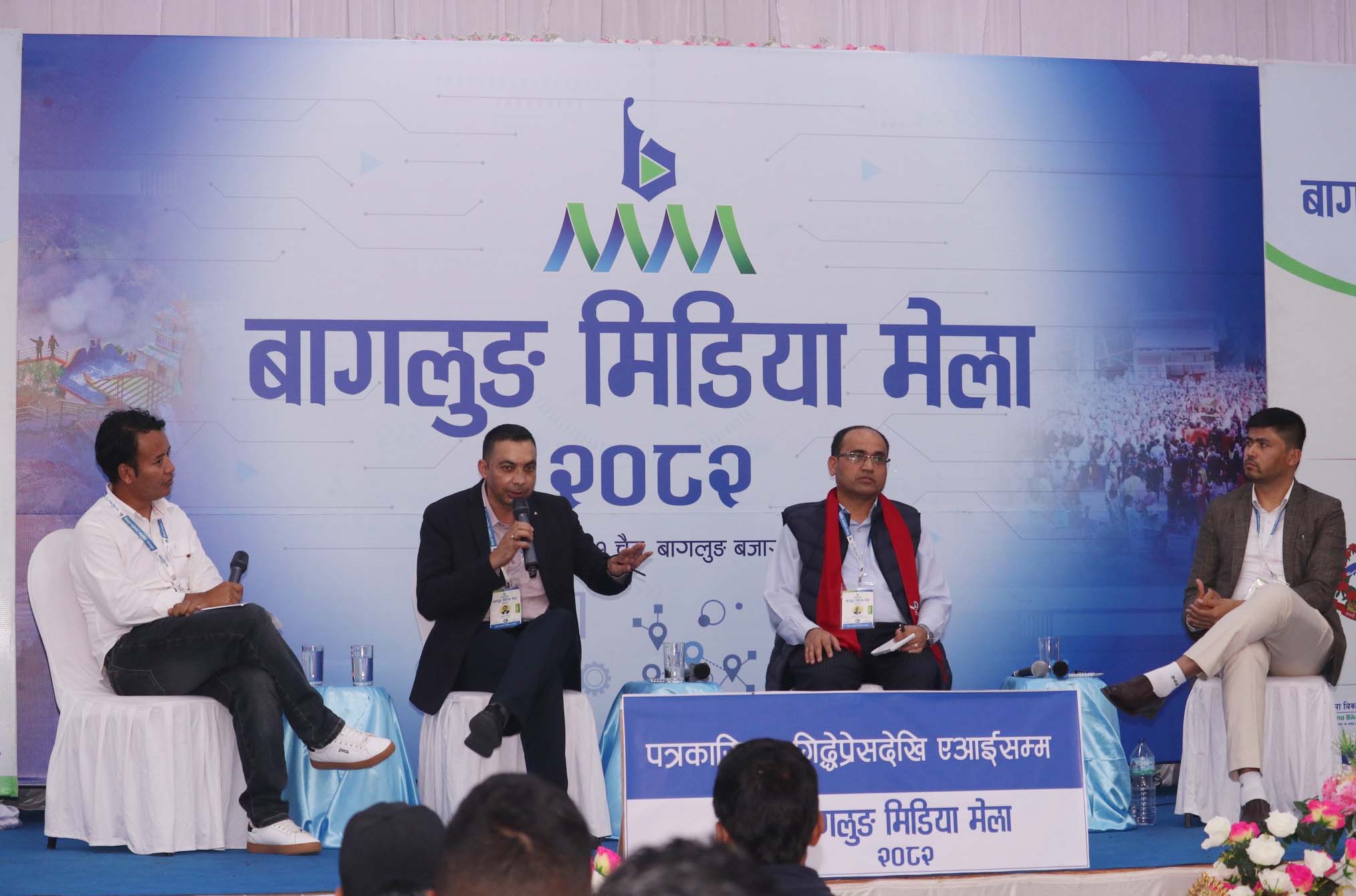
Baglung. The two-day 'Baglung Media Fair,' organized by the Federation of Nepali Journalists (FNJ) Baglung, concluded on Saturday. The fair wrapped up after discussions ranging from traditional press to modern Artificial Intelligence in journalism. Over a dozen topics were deliberated upon, with both veteran and new-generation journalists discussing the state of the profession.
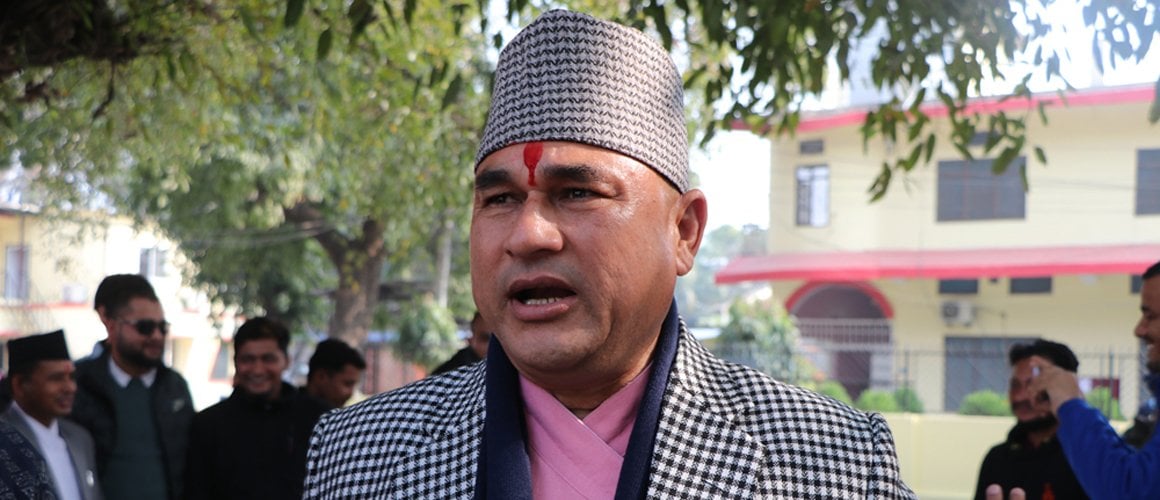
On the final day, a debate was held on 'Journalism Style: Polite or Aggressive.' Former FNJ Central President Dharmendra Jha stated that an aggressive style of questioning, forcing guests into a corner, is not the duty of a journalist. He argued that such an approach is not sustainable and does not align with journalistic ethics.
Jha noted that many journalists who adopted aggressive styles have had to leave the profession, suggesting that both senior and young journalists can produce sharp content through hard work. He emphasized that failing to adhere to basic values makes a journalist appear like an accused person in custody.
He said, 'Press freedom is the foundation of democracy. A journalist who wants a free press cannot be aggressive. One can effectively write about weaknesses through investigative journalism. Journalists should be polite and intellectual. Many who presented themselves aggressively left the profession quickly.'
Journalist Yubaraj Kandel argued that an aggressive style is a tool for journalists. He remarked that how a subject is raised is crucial, noting that ordinary news cannot bring good governance or curb corruption.
'Journalists have different styles; one cannot be polite when dealing with sensitive issues, corruption, or irregularities,' he said. 'To get answers, one must ask tough questions; we cannot get the answers we seek by asking simple questions.'
Journalist Shubhashankar Kandel stated that rather than being aggressive or soft, journalists should seek the truth. He believes that once the truth is found, it can be presented in any style, provided the principles of journalism are not forgotten.
Former Editor-in-Chief of Rastriya Samachar Samiti (RSS), Ekraj Pathak, mentioned that journalism styles are changing with the development of information technology. He observed that people now watch short video clips on social media but have stopped reading in-depth stories.
He suggested that AI can be used as a tool but should not be fully relied upon, as it lacks emotions and sensitivity, which only human journalists can provide.
Lokantar.com editor Bimal Gautam noted the increasing use of AI in journalism. He advised that journalists should not rely entirely on AI and that content should be verified before use to ensure effectiveness.
Tech Pana editor Gopal Saud emphasized that journalists must keep pace with technological developments. Expressing concern that journalism is being threatened by journalists themselves, he noted that content produced by ordinary citizens and journalists is becoming similar. He stressed that journalists must be responsible to maintain credibility.
The fair also discussed 'Press Freedom: A Right or a Responsibility?' FNJ General Secretary Ram Prasad Dahal pointed out the challenge of delivering news in seconds, often called 'hurried literature.' He warned that while AI provides technical ease, it could lead journalists away from real journalism.
Press Council Nepal member Keshavsharan Lamichhane stated that journalism has lost credibility due to the failure to follow the code of conduct. He suggested that journalists should be held accountable under existing laws for mistakes made outside of their professional duties.
The fair included sessions on 'Baglung's Development: Agriculture or Tourism?', 'New Media: Name and Fame', 'Regional Media: Strong or in Crisis?', 'Mother and Motherland', 'Where is the Local Government?', 'Marginalized Voices in Media', and 'What Should the FNJ Look Like Now?'
Various sessions featured speakers including the first Nepali to reach Antarctica, Bhuwansingh Bishwakarma, singer Basanta Thapa, vlogger Srijana Sijju, film journalist Barsha Basnet, planner Bijayraj Panta, IT expert Chirag Thapa, former FNJ Baglung presidents, and local government officials.
FNJ Baglung President Ram Thapa informed that the fair included photo exhibitions, traditional media equipment displays, live painting, and wall magazine competitions.
A 10-point declaration was issued at the end of the fair. It emphasizes accepting new dimensions of media and focusing on quality and credible news production. It also calls on all three levels of government to implement policies that support the appropriate use of digital and social media to improve the livelihoods of journalists.
This specific news has been automatically translated by AI. As a result, there may be some inaccuracies or language errors.