Koshi Province Faces Legal and Procedural Scrutiny Over Multi-Billion Budget Requests
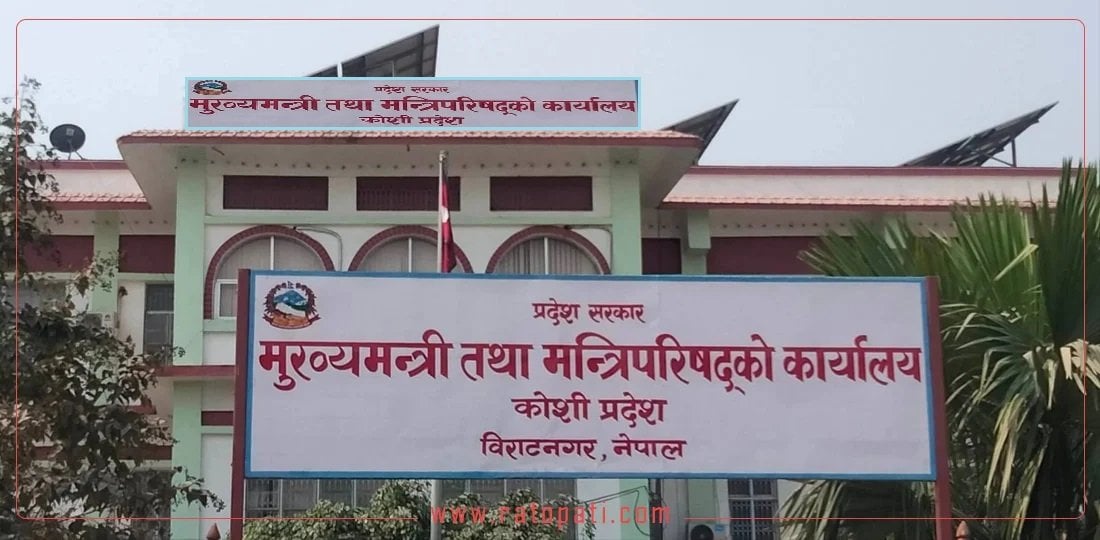
Biratnagar. The Koshi Province government has requested billions in budget from the federal government for 22 major projects for the upcoming fiscal year (2083/084), but the recommendation process for these projects has become embroiled in serious legal and procedural controversy.
Facts have emerged that projects worth 5.13 billion rupees, recommended under special and supplementary grants, lack the minimum legal standards and documentation mandated by the federal government. Among these, 13 of the requested projects are new.
High-level sources claim that the newly proposed projects specifically lack the mandatory technical and environmental impact assessment reports required by the 'Special Grant Procedure, 2081' and 'Supplementary Grant Procedure, 2081'.
Section 6 of the 'Special Grant Procedure, 2081' issued by the Federal Ministry of Finance clearly stipulates that when provincial or local levels propose projects, certain minimum documents must be entered into the electronic (online) system. These include feasibility studies, drawings, designs, detailed proposals with specifications, environmental assessment reports approved according to prevailing laws, and a certified copy of the Council of Ministers' decision based on the recommendation of the Planning Commission in the case of the province.
Similarly, Section 7 of the 'Supplementary Grant Procedure, 2081' contains even stricter provisions. A Detailed Project Report (DPR) is mandatory for projects exceeding 100 million rupees. Most road projects recommended by Koshi Province have costs ranging from 300 million to 900 million rupees. However, it is claimed that these major projects were recommended in name only, without the necessary DPRs and environmental studies.
Taranath Niraula, Vice-Chairman of the Koshi Province Planning Commission, admitted that he was searching for the documents himself. When asked at a press conference in Biratnagar on Wednesday whether the documents required by the procedure were available, he said, 'I am also searching for the documents you are asking about. You and I will collaborate in the search for these documents.'
The fact that the leadership of a responsible body like the Planning Commission is saying 'I am also searching' highlights how weak the legal foundation of the recommended projects is. This has raised questions about the recommendation process of the Planning Commission itself.
Officials from the Ministry of Physical Infrastructure Development have defended this. Ministry Information Officer Lalit Kumar Chaudhary argued that it is impossible to enter projects into the system without documentation.
Generally, the task of entering provincial projects into the electronic system is the responsibility of the Ministry of Economic Affairs and Planning. However, sources claim that this time, bypassing coordination and procedures between ministries, the projects were entered directly from the Office of the Chief Minister and Council of Ministers.
'Previously, it was always entered by the Ministry of Finance, but this time the Chief Minister's Office did this work,' the source said. This procedural change has strengthened suspicions that there is an attempt to hide 'conflicts of interest' and 'documentary incompleteness' in the projects.
Officials from the Ministry of Physical Infrastructure Development have defended this. Ministry Information Officer Lalit Kumar Chaudhary argued that it is impossible to enter projects into the system without documentation.
He said, 'It may take a few days to make these documents available to you, but projects cannot be entered without documentation.'
However, high-ranking officials of the provincial government have challenged Chaudhary's claim. According to these officials, no feasibility studies or environmental reports have been prepared for any of the newly proposed projects.
Newly proposed projects under the special grant include a 100 million rupee 'Foot and Mouth Disease Control Project', a 100 million rupee 'Construction of Model Housing for the Poor and Marginalized (Janata Awas)' to be implemented in 8 districts, a 100 million rupee 'Adolescent Empowerment Program', and a 100 million rupee 'Technology-Friendly Teaching and Learning Management Program'.
'The recommended new projects were picked at the last minute under political pressure, for which none of the technical documents required by the procedure are in the file,' the official claimed assertively. 'Here, not only are the people being deceived, but one government is also deceiving another.'
Out of the 22 projects recommended by the Provincial Planning Commission, 13 are of a new nature. 9 new projects have been recommended under special grants and 4 under supplementary grants.
Newly proposed projects under the special grant include a 100 million rupee 'Foot and Mouth Disease Control Project', a 100 million rupee 'Construction of Model Housing for the Poor and Marginalized (Janata Awas)' to be implemented in 8 districts, a 100 million rupee 'Adolescent Empowerment Program', and a 100 million rupee 'Technology-Friendly Teaching and Learning Management Program'.
Similarly, in the drinking water sector, there are the Panchayan Drinking Water Project in Sunsari (83.8 million), Ullupatu in Morang (87.6 million), Biring Khola in Jhapa (70.5 million), and Sunkoshi Balku Sabai Lifting Drinking Water in Okhaldhunga (54.7 million).
A new proposal of 71 million has been made for the Phaklethuwa Irrigation project in Taplejung.
On the other hand, 4 major road projects have been newly proposed under supplementary grants. These include the Likhu-Khijifalate-Bhusing road in Okhaldhunga (298.2 million), a 10-kilometer road from Damuna Bazaar East via Hengatoli in Gauradaha Municipality-6, Jhapa, through the Khajurgachhi Bazaar area of Gaurigunj Rural Municipality-6 to the southern Bharuchauk Phattepur (Gaurigunj 5) India border (299.9 million), the Ramailodanda-Rumjatar road in Okhaldhunga (299.1 million), and the Piluwa Corridor bridge and road construction in Sankhuwasabha (300 million). The total cost of these 13 new projects alone is nearly 2 billion rupees.

_M8vFxk4R0k.jpg)


This specific news has been automatically translated by AI. As a result, there may be some inaccuracies or language errors.