
Escalating Tensions: US Troop Buildup Fuels Speculation of Limited Ground Action in Iran


As the war enters its second month, fears of a potential US ground invasion in Iran are growing. Recent reports from US media indicate that the US Department of Defense is preparing for limited ground operations in Iran, coinciding with the recent deployment of additional US troops to West Asia.
Two anonymous US officials told the Washington Post on Saturday that the Defense Department is preparing raids on Kharg Island and coastal areas near the Strait of Hormuz. Kharg Island is where 90% of Iran's crude oil is refined.
The Strait of Hormuz, which supplies 20% of the world's oil and liquefied natural gas (LNG) during peacetime, was effectively shut down by Iran a month ago following the first US-Israeli attack on Tehran. Since then, only a few ships flying Chinese, Indian, and Pakistani flags have been granted safe passage.
This has thrown global energy markets into turmoil, with the price of global benchmark Brent crude rising from about $65 per barrel before the war to nearly $116 on Monday.
US military plans, which appear less than a full-scale invasion, could involve actions by special forces and conventional ground troops, the Post reported. In an interview with the Financial Times on Sunday, US President Donald Trump stated he wants to 'take Iran's oil' and might seize Kharg Island.
Meanwhile, Iran's Parliament Speaker Mohammad Bagher Ghalibaf stated that the US military would face resistance if it attempted an attack. In a statement released by the official IRNA news agency on Sunday, he said, 'Our people are waiting for American soldiers to set foot on the ground so that they can be set on fire and their regional allies punished forever.'
Is the US ready to attack Iran? And what do Trump's moves so far tell us? Here is what we know:

- What forces has the US deployed so far?
Well before the war on Iran began, approximately 40,000 to 50,000 US troops were stationed in West Asia by mid-2025. This included personnel stationed at both large, permanent bases and smaller forward sites in the region.
Since the beginning of this year, Trump has been increasing the US military presence in West Asia, starting with sending warships, including the aircraft carrier Abraham Lincoln, to the Arabian Sea.
According to open-source intelligence analysts and military flight-tracking data, the US has deployed over 120 aircraft to the region since early February. This represents the largest increase in US air power in West Asia since the Iraq War in 2003.
The deployed aircraft include E-3 Sentry Airborne Warning and Control System aircraft, F-35 stealth strike fighters, and F-22 air superiority jets alongside F-15s and F-16s. Flight-tracking data shows that most aircraft departed from bases in the US and Europe, supported by cargo planes and aerial refueling tankers. Military analysts suggest this indicates a continuous operational plan rather than a regular rotation.
On Tuesday, the Pentagon ordered the deployment of additional US forces to the Gulf region. The additional force heading to the Gulf consists of three separate formations, with different origins, routes, and timelines.
First, the Tripoli Amphibious Ready Group, centered on the America-class assault ship USS Tripoli and the 31st Marine Expeditionary Unit (MEU). Second, the Boxer Amphibious Ready Group, based on the Wasp-class assault ship USS Boxer and the 11th MEU stationed in Southern California. These two Marine groups together will add 4,500 Marines and sailors to the region.
Third, a team of approximately 2,000 soldiers from the Immediate Response Force of the 82nd Airborne Division, based at Fort Bragg, North Carolina. This airborne infantry division focuses on parachute assaults.
Overall, approximately 7,000 additional troops have been deployed since the war on Iran began.

- Is this deployment sufficient for a full-scale invasion?
Although the US has not announced a ground invasion of Iran, US media reported on Friday that the Pentagon is considering sending an additional 10,000 ground troops beyond those already deployed.
This would mean the US would have approximately 17,000 soldiers on Iranian soil. It is unclear whether any other foreign forces would join the US.
This number is significantly lower than the force deployed when the US invaded Iraq in March 2003.
The US-led invasion of Iraq began on March 20, 2003, involving 150,000 US troops and 23,000 soldiers from other countries in the initial campaign. Six months before the final withdrawal of US forces from Iraq in 2011, about 45,000 US soldiers remained there to train and advise the Iraqi army. By mid-2025, approximately 2,500 US soldiers were still stationed in Iraq, but they have since been redeployed to other countries like Syria.
Analysts suggest this indicates that the US is currently not preparing for a large-scale ground invasion of Iran.
John Phillips, a British security and risk consultant and former military instructor, told Al Jazeera that the current US deployment signals limited but high-intensity actions, such as seizing Kharg Island or small islands in the Strait of Hormuz to stabilize waterways and reopen shipping lanes, followed by a rapid withdrawal.
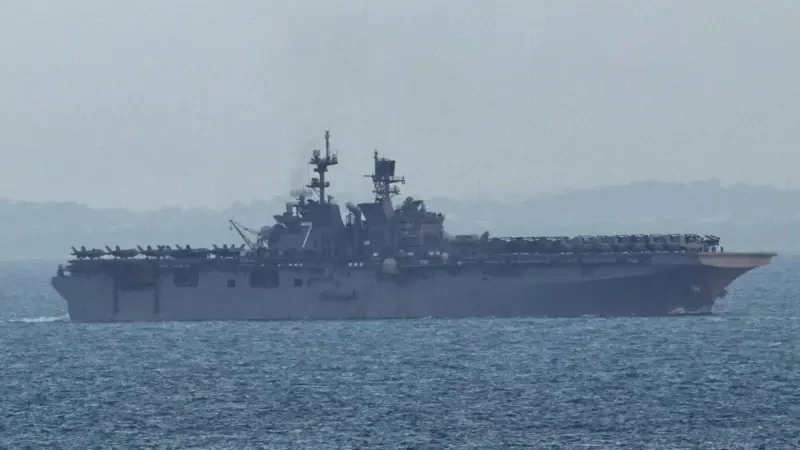
He said, 'This could start with carrier-based attacks on Iranian air defense systems, missiles, and mines, making it easier for US Marines to attack by helicopter and landing craft to neutralize threats, secure airfields, or destroy weapons depots. Meanwhile, airborne troops could parachute in to seize mainland areas or support allies.'
According to him, primary actions might involve capturing islands like Kharg, where US Marines landing would face defenses like landmines, and they might be ordered to destroy military bases and oil infrastructure.
'This could cause significant human casualties and be economically devastating for Tehran,' he said.
Other operations could involve helicopter-borne assaults, where members of the 82nd Airborne could parachute or rappel down to target missile batteries, fast boats, or command nodes on the Hormuz coast.
Ian Lesser, a distinguished fellow at the German Marshall Fund of the US, told Al Jazeera that the currently deployed US forces represent an existing threat, which is currently more useful as a deterrent and bargaining chip.
He added that there is no possibility of a large-scale invasion like the one conducted in Iraq because that would require a much larger and differently prepared force.
'In terms of large-scale conventional operations or forces prepared for occupation, politically and practically, it is almost impossible,' he said.
- What types of ground actions might occur?
Several options are being discussed, including seizing strategic islands in the Gulf and the Strait of Hormuz, or removing Iran's uranium stockpile.
Christopher Featherstone, an Associate Lecturer in Politics and International Relations at York University, told Al Jazeera that any military operation would be targeted and limited, rather than a full-scale invasion.
'This could be an operation to seize strategic assets like Kharg Island. The resources moved to the region (Marines and the Army's 82nd Airborne) are very effective but not enough to easily capture a large area,' he said.
He added, 'I also see it as a swift and hard strike. Trump likes short and attention-grabbing actions, so a targeted operation is the most likely option for him. However, I think a full-scale invasion would be surprising.'
Phillips suggested that if the US were to seize Kharg Island, the US Army's 10th Mountain Division (a major infantry division) would likely be used to hold the island.
'The US usually uses them primarily for holding captured ground. They were used in Somalia, and they were among the first major units deployed to Afghanistan in 2004-2005,' Phillips said.
'To advance deeper or further inland requires armored vehicle/tank support, which we have not seen in the news yet. Also, it incurs very high risk and economic cost,' he added.
According to analysts, the most likely options are:
- Kharg Island
On Sunday, Trump also told the Financial Times that capturing Kharg Island, located north of the Gulf, was a possibility. 'Maybe we take Kharg Island. Maybe we don't. We have many options,' Trump said.
'This might mean we have to stay there (on Kharg Island) for some time,' he added.
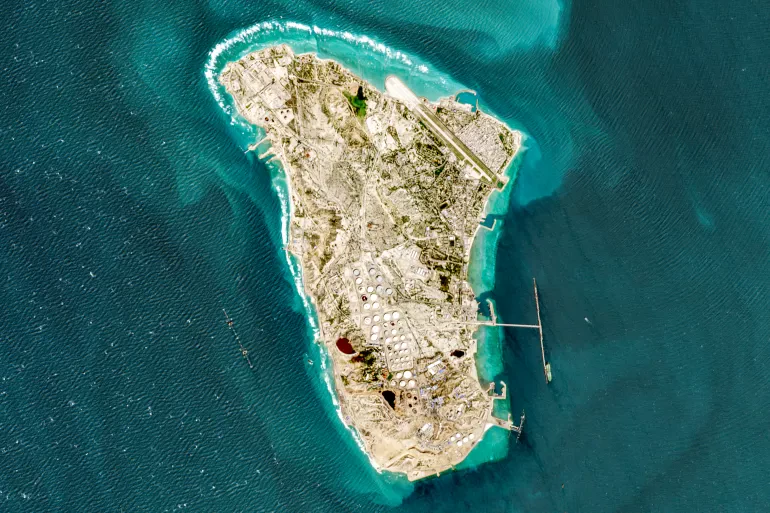
On March 14, Trump stated that US forces had bombed military locations on Kharg Island and warned that if Iran continued to block the Strait of Hormuz, other critical oil centers in the region could be targeted next.
Iran's Parliament Speaker Ghalibaf said on Wednesday, 'Any regional country supporting such an action will be responded to by attacking its critical infrastructure.'
- Qeshm Island
Qeshm Island is located in the Strait of Hormuz and is considered by analysts to be the ultimate strategic objective for the US Marines being deployed to the Strait.
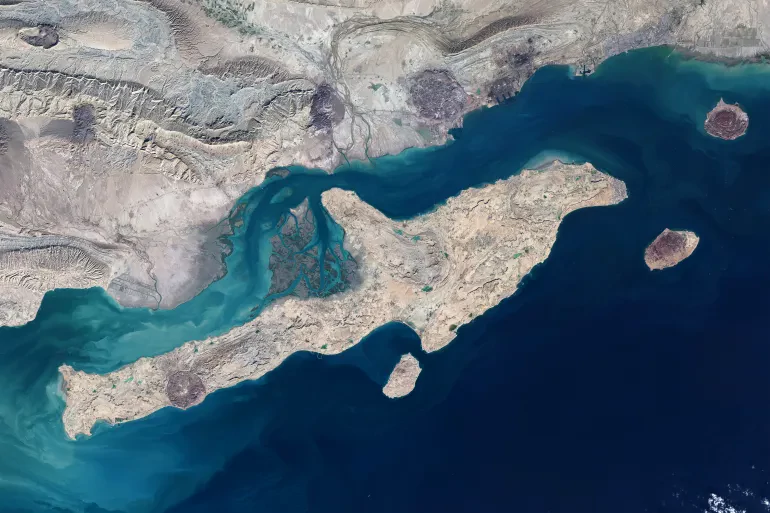
In an interview with Al Jazeera on March 17, retired Lebanese Brigadier General Hassan Joune described surprising Iranian capabilities housed within an underground missile city on Qeshm. Joune stated that these vast networks are designed with the sole purpose of controlling or closing the Strait of Hormuz.
The US has already targeted this island. On March 7, one week into the war, a US airstrike hit a water desalination plant on the island, cutting off fresh water supply to 30 surrounding villages. Tehran called the attack an open crime.
- Uranium Stockpile
Another potential operation the US military might undertake is sending its forces to sites where Iran stores enriched uranium.
According to media reports over the weekend, Trump is understood to be considering a military operation to extract about 450 kilograms of uranium from Iran. This would be a complex mission requiring the deployment of US forces inside Iran.
According to the International Atomic Energy Agency, Iran's enriched uranium stockpile as of June contained 440.9 kilograms of material enriched up to 60 percent, which is not far from weapons-grade levels.
This specific news has been automatically translated by AI. As a result, there may be some inaccuracies or language errors.







-(2)_QJLjKxR87n.jpg)