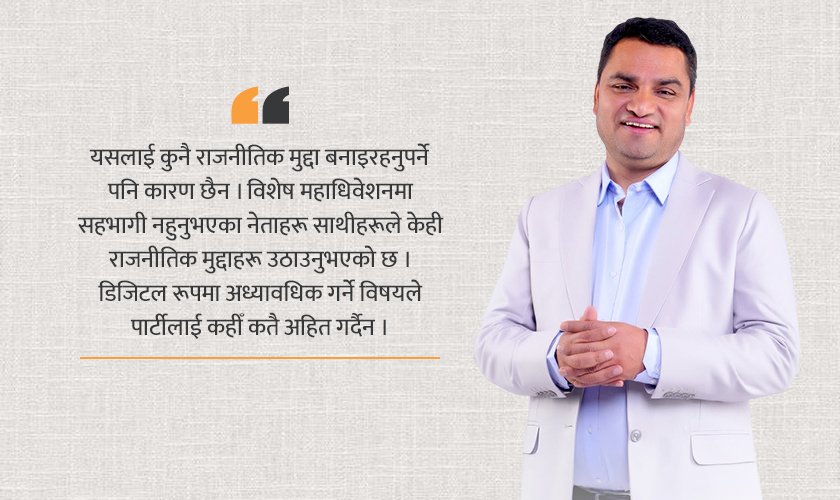
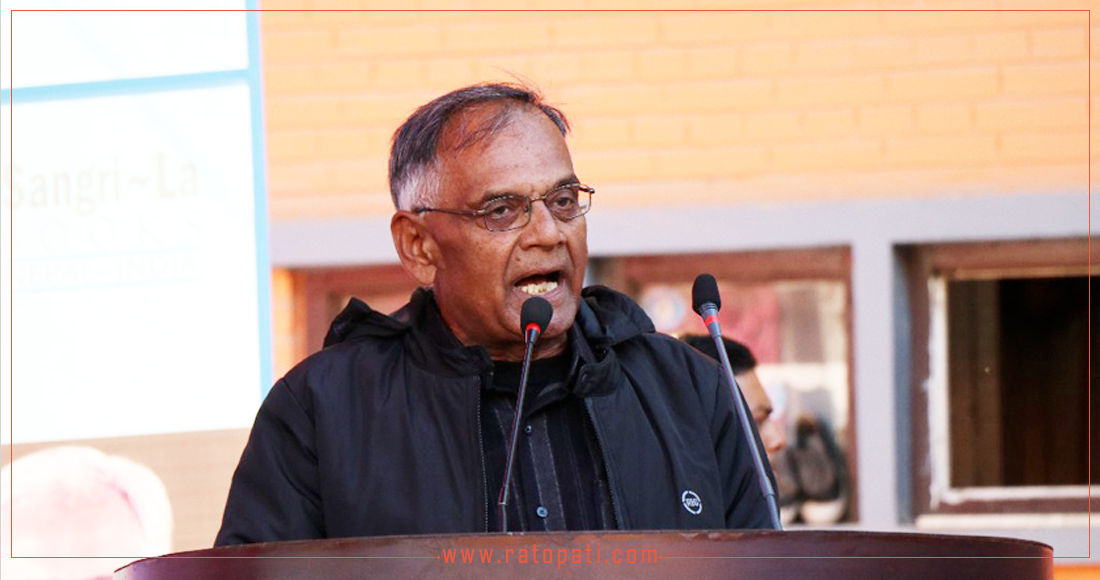
Congress Leader Outlines 8-Point Reform Agenda for Party and Nation Post-Election


The Nepali Congress stands at a distinct and extremely sensitive juncture in Nepali politics. While paying heartfelt tribute to all known and unknown immortal martyrs who sacrificed their lives to nurture the sapling of democracy on Nepali soil from the revolution of 2007 until today, the time has come to seriously contemplate the epochal responsibility of protecting the democratic system and freedom achieved through their sacrifice.
A new political course has been set for the country following the recent general and provincial elections. The enthusiastic participation and commitment shown by citizens in democracy and the electoral process is the most beautiful aspect of democracy. The Nepali Congress extends its heartfelt congratulations and best wishes to the new leadership that has received a mandate to govern for the next five years in a facilitated manner through this election. It is our sincere hope that this government successfully completes its term by addressing the spirit of the Constitution, the democratic sentiment, and the current younger generation's hunger for good governance.
Through this address, I intend to bring some serious issues I raised in the party's Central Working Committee meeting, the future role of the Congress in national politics, and the future blueprint for transforming the party's internal life into public debate among the mass media and millions of friends across the country.
1. Moral Accountability: The Beginning of Political Culture
Following the results of the House of Representatives election held on Falgun 21, 2082, I submitted my resignation to the leadership of the Nepali Congress on Falgun 3 itself. This resignation was not the product of haste or a desperate state of mind. It was merely the highest practice of accountability, or moral responsibility.
Those elected and the 147 candidates who competed know well how we had to face the adverse situation when we went into the election without holding a special General Convention. While the extent of damage caused to the party by the tendency not to campaign or cooperate for the party's official candidates during the election will be reviewed, as the leader who commanded an election campaign, it was my political duty to take full moral responsibility for the defeat or the failure to achieve the expected results.
In politics, ethics are higher than position. When I resigned, I did not prioritize what the external commentary might be. I was only concerned about those honest and dedicated workers of the party who worked day and night carrying the party flag even in extremely adverse conditions. My resignation entered the Central Committee as per the provisions of the statute.
The Central Committee held intensive discussions for two days and decided that the current leadership should fulfill the responsibility until the next General Convention. Although my expectation was that the resignation would be accepted and a new culture initiated, in a democratic party, the institution is bigger than the individual. The Central Working Committee is bigger than me, and the General Convention is bigger than the Central Committee. Therefore, respecting the decision of the Central Committee, I have brought this chapter to a close here. The final verdict on the election and the evaluation of the leadership will now be decided by the hall of the upcoming 15th General Convention.
2. Role of a Strong and Responsible Opposition
The election has entrusted the Nepali Congress not with the keys to the government, but with the dignified responsibility of the main opposition in the Parliament. In a democracy, the role of the opposition is in no way less important than that of the government. Moreover, when the government is overwhelmingly strong numerically in the Parliament, the role of the opposition must be even more vigilant, strong, and responsible.
We made a promise to the people during the election: in the next five years, we will increase the pace of good governance, development, and service delivery by three to four times. The people did not give us the mandate to do this work while in government, but they gave us the mandate to continuously monitor the government to walk this path while in opposition. Therefore, we will not back down from our promise.
Our role in the opposition will be constructive. We will fully support and encourage the government when it takes the right steps on the path of national development and good governance. However, where the government's pace slows down, where the rights of citizens are curtailed, our strong pressure and relentless questioning will arise. We also promised that we would not let the country fall into the vortex of any accident or extremism. The Nepali Congress will play the role of the primary guardian to save the country, which has repeatedly suffered from political instability and conflict in the past, from any kind of political accident and to neutralize extremism.
3. Resolve for Good Governance: The Need for a Frank Review of 35 Years
The general public has high expectations from the new government, especially in the area of good governance. There has been much talk about good governance; now, frank action is needed. We have clearly stated that the next five years must be a new chapter of good governance and development. However, while charting the path forward, a new chapter cannot begin by completely forgetting the past or granting impunity for past crimes.
Therefore, the Nepali Congress clearly puts forward this proposal: Immediately form a high-level and empowered 'Asset Investigation Commission' to investigate the assets of all individuals who held public office during all government periods formed from the government of 2048, following the historic mass movement of 2046, up to today in 2082. Any asset acquired illegally through the misuse of public office, corruption, or undue benefit must be confiscated. The Nepali Congress will fully support and monitor the new government's announcement to form such a commission within its first hundred days.
It is true that the country has made great strides in political revolution and change during this 35-year period. But during this same period, there was also extreme misuse of governmental power. The exploitation of the state treasury by those in public office has led to extreme public disillusionment today. Tea stalls to street corners are filled only with discussions of scandals. Whether it is the Giribandhu Tea Estate land scam, the Lalita Niwas government land misappropriation, the wide-body aircraft procurement case, or the issue of the immense money found at a certain leader's house on Bhadra 24—none of these scandals should now remain merely subjects of political bargaining or accusations and counter-accusations. The clear stance of the Congress is: all these incidents must be investigated legally, impartially, and deeply. The truth must be revealed. Anyone involved in corruption, regardless of their party or position, must bear the burden of their actions. The Nepali Congress will not compromise with anyone regarding strict action against the guilty without any prejudice concerning the abuse of authority and policy corruption.
4. Cooperative Fraud: Protecting the Sweat of the Citizen
Another burning and serious issue rising nationwide today is cooperative fraud. Today, thousands of ordinary citizens, who saved a few pennies in cooperatives from their lifelong sweat and sacrifice, are forced to weep on the streets. The lamentations of the victims echo from Maitighar Mandala to various streets across the country.
Cooperative fraud is not a simple financial misappropriation; it is a serious economic crime against ordinary poor and middle-class citizens. Anyone found involved in this must be brought under the legal purview immediately. During the investigation, it should not matter whether the guilty person is in power or in opposition, which party they belong to, or what position they hold. But punishing the guilty is not enough; the primary responsibility of the state is to return the lost money of those poor citizens with interest.
The new government must immediately intensify the investigation into the cooperative fraud case and guarantee the return of the victims' savings. The Nepali Congress is ready to fully cooperate with the government in this task and will not hesitate to launch strong protests both on the streets and in the Parliament if there is any delay.
5. Constitutional Amendment and Electoral System Reform
The parliamentary practice of the past few years has exposed a serious reality—the current electoral system makes it almost impossible for any single political party to secure a clear majority. The compulsory situation of forming coalition governments every time has fostered extreme political instability, policy deviation, and the dirty game of power interests in the country. Serious disillusionment with this electoral system has arisen among the general public.
Therefore, the time has come for serious reform in the electoral system. However, changing the electoral system means amending the Constitution. Constitutional amendment is not something that can or should be done solely by the desire or majority of one party; it requires broad national consensus. Therefore, the Central Working Committee of the Nepali Congress must immediately form a 'Constitution Amendment Study and Suggestion Committee.' This committee will conduct an in-depth study on how to make the electoral system stable and people-oriented, as well as how to correct other flaws observed during the implementation of the Constitution, and provide concrete suggestions to the party. Based on those suggestions, the Nepali Congress will take the initiative to build a national consensus with other political parties.
6. Party's Internal Life and Organizational Strengthening
To fulfill these responsibilities of national politics, the Nepali Congress itself needs to become strong, consolidated, and transformed from within. We must conduct a frank and objective review of the last election in all 165 constituencies. Where is our organization strong? Where did we fail? What are the reasons for internal sabotage? We cannot move forward without dissecting all these issues.
Extreme disillusionment prevails in the country today, especially among the younger generation. The Nepali Congress must have the strength to overcome this disillusionment. For this, we must make our programs and agendas youth-oriented and extend the organization to the villages, neighborhoods, and the doorstep of every house.
For this organizational renaissance, I propose that a clear schedule (calendar) for the 15th General Convention of the Nepali Congress be passed by this very Central Committee:
• Starting from Baisakh 1, 2082: Launch a grand campaign for the distribution and renewal of party active membership. This process must be entirely 'online' so that any democracy-loving citizen, whether residing at home or abroad, can easily obtain Congress membership. This will make the party tech-friendly and transparent.
• Shrawan 6, 2082: Complete ward conventions simultaneously across the country.
• Shrawan 12, 2082: Complete municipal level conventions.
• Shrawan 23, 2082: Complete Provincial Assembly regional conventions.
• Shrawan 30, 2082: Complete House of Representatives regional (district level) conventions.
• Bhadra 6 and 7, 2082: Complete all district conventions.
• Bhadra 15 and 16, 2082: Complete conventions of all seven provinces.
• Bhadra 24, 25, and 26, 2082: Grandly conclude the historic 15th Central General Convention of the Nepali Congress in the federal capital, Kathmandu.
Approving this clear schedule today and moving forward will remove the confusion prevailing in the party ranks and inject a new organizational energy down to the grassroots level.
7. From Cadre-Based to Mass-Based Party and the Concept of Lateral Entry
The world of politics is changing rapidly. The traditional style of yesterday cannot lead today's generation. The Nepali Congress must now be transformed from the confines of a limited cadre-based party to an open mass-based party based on the entire populace.
The unhealthy competition of existing factions and sub-factions within the party must be transformed into ideological deliberation and managed appropriately. Furthermore, a matter I have put forward with great importance is the provision of 'Lateral Entry.' It is not necessary that only those who have carried bags throughout their lives should enter politics. 'Lateral Entry' is a legal provision to easily grant entry into the party leadership to capable individuals who have proven their expertise and excellence in various professional fields such as economy, technology, health, education, diplomacy, and infrastructure. Only when such experts join the party can the party draw a clear blueprint for modern state governance, and the country can fully utilize their expertise.
8. Establishment of a Leadership Academy
Finally, to sharpen the party ideologically and strategically, it has become absolutely necessary to establish an empowered and well-resourced Leadership Academy within the Nepali Congress. This academy will regularly provide theoretical, practical, and technical training to thousands of party workers, representatives of sister organizations, and our elected representatives at the local, provincial, and federal levels. This will contemporaneously enhance the leadership capacity, policy-making knowledge, and public service skills of our leaders and workers.
Conclusion:
The Nepali Congress is not just a political party; it is the heartbeat of Nepal's democratic movement. Just as this party provided unprecedented leadership in overthrowing the Rana regime, Panchayat, and monarchy in the past, today it is necessary for it to provide the same level of revolutionary leadership to establish good governance, eradicate corruption, and open the door to economic prosperity.
Only by starting accountability from oneself, vigorously raising the agenda of good governance, and strengthening the internal structure of the party through a clear schedule for the General Convention and modern concepts, can we hand over a vibrant and trustworthy Congress to the coming generations. I am fully confident that the Central Working Committee will hold a judicious discussion on these serious proposals and make concrete and historic decisions in the interest of the party and the nation.
Jai Nepal !
(Edited excerpt of the address made at the Nepali Congress Central Working Committee meeting)
This specific news has been automatically translated by AI. As a result, there may be some inaccuracies or language errors.