Wildfire Risk Rises in Myagdi Amid Dry Spell, Human Negligence Cited as Primary Cause

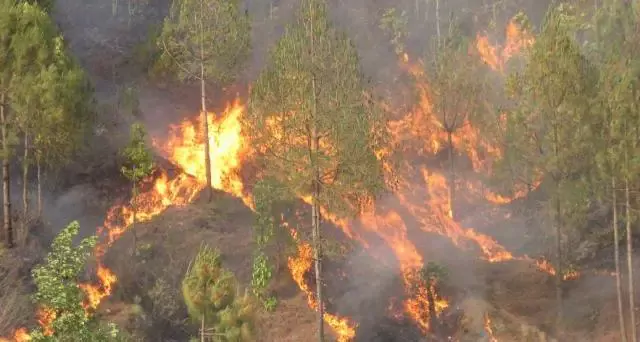
Myagdi. The risk of wildfires has increased in Myagdi with the onset of the dry season. The indiscriminate use of fire has heightened the danger of forest fires. Fire incidents lead to the destruction of forests, wildlife, medicinal herbs, and the environment. Basanta Keshav Adhikari, Chief Divisional Forest Officer of the Division Forest Office, stated that 96 percent of wildfires were found to be caused by human negligence.
“The risk of forest fires has increased due to the practice of setting fires to encourage grass growth, illegal hunting, and the indiscriminate use of fire,” he said. “Fires are set for clearing land for cultivation, to scare away predatory wildlife, for wildlife hunting, to conceal forest crimes, or due to grudges against forest employees or neighboring Forest User Groups.”
Wildfires occur most frequently in the months of Falgun, Chaitra, Baisakh, and Jestha (mid-February to mid-May). Trees, medicinal herbs, wildlife, and bird habitats are destroyed by these fires. In previous years, human casualties occurred while extinguishing these fires. Myagdi ranks 30th among Nepal's 77 districts in terms of wildfire risk.
Data from the Division Forest Office shows that in the fiscal year 2079-80, 790 hectares were damaged in 102 locations; in 2080-81, 890 hectares in 145 locations; and in 2081-82, 805 hectares in 115 locations were damaged by forest fires.
There is a tradition among herders to set fire to forests and cliffs, believing it promotes better grass growth. Hunters also start fires to drive away wildlife and birds. Forest Officer Chandramani Sapkota stated that the process of collecting damage reports from wildfires has begun in the current fiscal year.
He mentioned that a district-level wildfire prevention and control action plan has been developed in collaboration with security agencies, administration, local levels, and Community Forest User Groups. Strategies have been formulated for both preventive measures to stop fires from starting and control measures to extinguish fires that do break out. Strategies are also in place to protect human and physical assets where possible.
Forest Officer Shantikumari Shahi stated that awareness programs have been conducted for forest users and at the school level, and necessary equipment for fire control has been provided to security agencies. According to her, preparations are underway this year to construct ponds in six community forests to collect water for fire control and to prevent wildlife from entering human settlements in search of water.
The district has 229,706 hectares of forest area. This comprises 36.76 percent forest, 1.85 percent shrubland, and 21.27 percent grazing land. There are 311 Community Forest User Groups.
This specific news has been automatically translated by AI. As a result, there may be some inaccuracies or language errors.

_kE6hmvuewe.jpg)