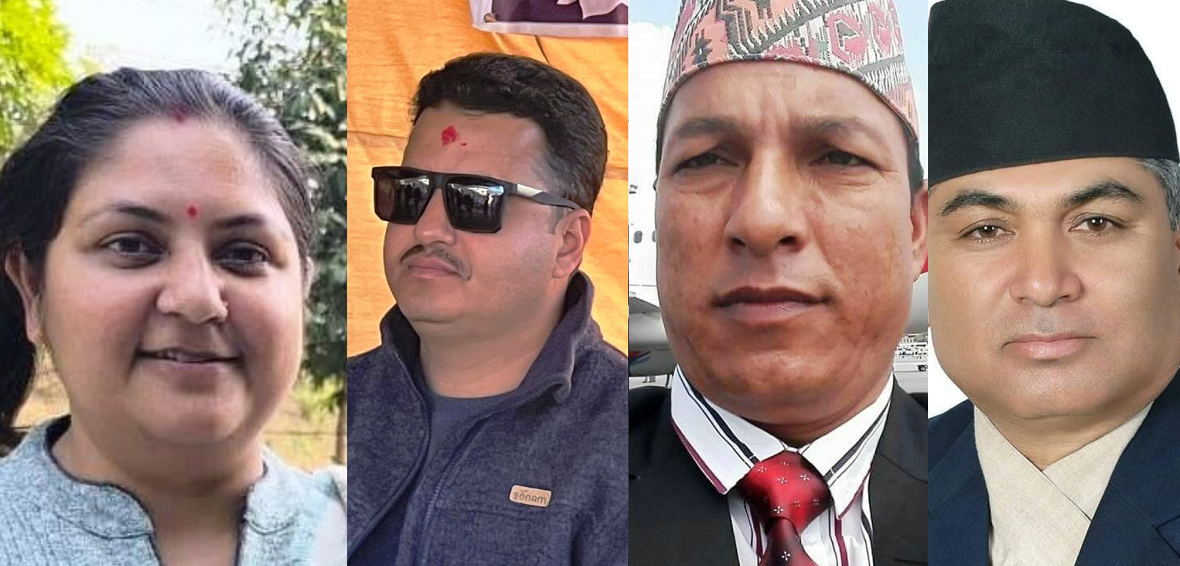
26-Year-Old KP Khanal of RSP Elected to House of Representatives from Kailali-2
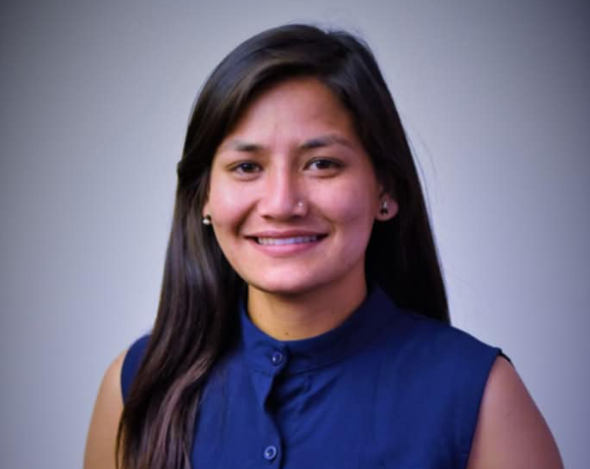

Dhangadhi. KP Khanal, 26, of Rastriya Swatantra Party (RSP) has been elected as a member of the House of Representatives from Kailali Constituency No. 2. He secured 19,057 votes.
Khanal, who has already garnered attention as a young social activist, will now be seen in parliament. He was born on Poush 27, 2056 BS, in Batlasen, Ramaroshan Rural Municipality, Achham.
Born as the eldest son to father Dhaniram Khanal and mother Manisha Khanal, he moved to Lamki, Kailali with his family at a young age.
KP's nature was slightly different even when he was in school. He started speaking on the radio from the time he was in Grade 6. At the tender age of 13, he used to host a program called 'Child Debate' on a community radio station in Lamki. Few would have imagined that the young boy speaking about children's rights and problems on the radio would one day speak in the nation's parliament.
After passing his secondary level education, poverty forced him to go to India. He headed to Mumbai, India, for employment. ‘At that time, after finishing SLC, I stayed in Mira Road, Mumbai for 2-3 months,’ he said, ‘I worked in a hotel there. I washed dishes, did manual labor. That was a big lesson in my life,’ he told Ratopati.
The pain of having to sweat in another country while Indian youths of his age were going to college kept pricking him. Eventually, the urge to do something in his own country brought him back to Nepal.
Upon returning to Nepal, while studying for his Plus Two, the hunger for social work awakened in him. Khanal became active in social campaigns during the 2072 BS earthquake and the country's blockade. After that, he moved to Kathmandu for higher education.
Frustrated by the dust and garbage in Kathmandu, KP decided to pick up a broom himself instead of blaming others. At the age of 17, he started the ‘Clean Kasthamandap’ campaign. The slogan was: ‘I will change, and my country will change.’
KP said, ‘Going from the Far West to Kathmandu is a big dream. Seeing the garbage there, I felt that instead of telling others, I should clean it myself.’
Initially, people called him crazy. They mocked him, saying, ‘Will Kathmandu become clean just because a young boy sweeps?’
KP says those words did not stop him. He mobilized then-Minister Lal Babu Pandit and even the Mayor of Kathmandu onto the streets, leading a cleanliness drive from Tinkune to Maitighar in Kathmandu with the participation of 1,700 people.
He states that this campaign was not limited to Kathmandu but spread across the country.
KP, who went viral on social media, gradually became known as the ‘Youngest Social Activist’. He was not limited to cleanliness drives. He had closely felt the plight of remote Bajura district in the Far West. Seeing the miserable condition of orphaned children in Budhiganga, Bajura, his heart ached. He thought, ‘I will build a house for them.’
Being a student with no income of his own, building an orphanage was an impossible feat. He appealed for help through social media. Nepalis living at home and abroad trusted KP's honesty. In no time, 5 million rupees were collected.
‘At that time, there were more than 19 orphaned children,’ KP said, ‘We built a four-block building within a year and handed over the keys from the hands of actor Rajesh Hamal.’
That organization, named Concern Bajura, has now become a safe haven for dozens of orphaned children. Khanal informed that the children there receive food, shelter, clothing, education, and affection.
KP did not hide indoors during the COVID-19 pandemic either. He launched the ‘Help for Needy’ campaign and went out to feed the hungry. He did everything from feeding patients' attendants at hospitals in Kailali and Achham to building toilets for 20 impoverished families. He carried oxygen cylinders and delivered them door-to-door to patients' homes.
KP's work, done at a young age, gained international recognition. He received the Youth Achiever Award under the ‘International Achievement Award 2024’ in Thailand. Similarly, he was honored with the ‘Youth Icon Award’ in India on the occasion of Mahatma Gandhi's 151st birth anniversary.
Within the country, he has already received prestigious honors such as the Social Service Ratna Medal and the National Youth Talent Award from the hands of the President. These honors made him more responsible.
Many people commented and criticized KP, who was established in social service, for suddenly entering parliamentary politics. ‘If social service is the work of applying balm to a wound, politics is the place to make policies so that the wound never occurs,’ he said.
The rise of Balen Shah in Kathmandu and the wave created by Rabi Lamichhane's National Independent Party across the country also influenced KP. Believing that instead of running away saying politics is dirty, one must jump into the well to clean it, he entered the electoral arena.
‘I didn't think that any caste, geography, or region would win,’ he says, ‘I was confident that change and vision would win.’
After deciding to contest the election, he visited village after village, held the hands of the people, and presented his agendas. ‘The boy who used to walk around ringing a bell on the street yesterday has reached parliament today; this victory is not mine, but it belongs to all those youths who want to do something in the country,’ he said.
KP, who is pursuing a Master's degree in Political Science from TU, plans to balance his studies and politics. He will speak not only as the voice of the youth in parliament but also carrying the dreams of the poor community like himself.
His parents are still workers who returned after working in India. ‘My parents lived in India for 15-16 years. I know the value of their sweat,’ KP said.
In parliament, he is preparing to be assertive on issues of education, health, and youth employment. He states that his main objective is the development of the Far West and improving the living standards of its people.
This specific news has been automatically translated by AI. As a result, there may be some inaccuracies or language errors.