GANDAKI PROVINCE GOVERNMENT BODIES FAIL TO AUDIT RS 4.41 BILLION DUE TO FIRE INCIDENTS

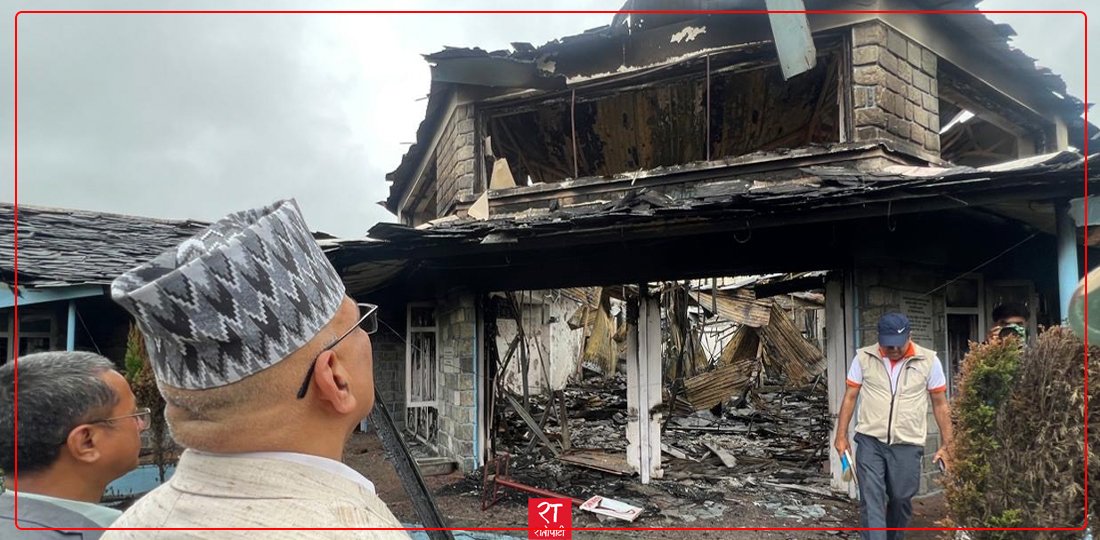
Pokhara. This year, an account of Rs 1.49 billion 66 million has gone missing from the vehicle section of the Transport Management Office, Kaski. The office could not provide details for auditing, citing that files were burnt due to the Jenji movement.
An audit of Rs 26 crore 51 lakh 53 thousand could not be conducted for the driving license section either. These two offices were the target of the movement on Bhadra 23 and 24. Another office that suffered the most damage is the Provincial Assembly Secretariat. This office, which lost many vehicles and physical structures, could not present an account of Rs 27 crore 93 lakh 36 thousand.
In the Provincial Assembly Secretariat, where most of the expenditure accounts were kept in files, even computers were burnt and destroyed. The Gandaki Province Science and Technology Foundation, which was already abolished, did not audit Rs 19 crore 82 lakh 39 thousand, and the Directorate of Tourism, Commerce and Consumer Interest Protection did not audit Rs 8 crore 85 lakh 87 thousand. An account of Rs 8 crore 6 lakh 71 thousand from the Ministry of Forests and Environment and Rs 1 crore 95 lakh 29 thousand from the Office of the Chief Attorney is in a state of disarray.
The reason for this amount not being accounted for is not the fault of employees or any public representatives, but the arson of the records kept by the office. Due to arson, nine major government bodies of Gandaki Province have not audited expenditures worth Rs 4.41 billion 11 lakh 35 thousand, according to the report of the Auditor General. The offices stated that they could not conduct audits because bills, vouchers, and records were destroyed during the movement.
The Auditor General has suggested that offices with billions in transactions should confirm their expenses through digital records and bank statements. The report mentions that the Auditor General could not ascertain where such a large sum was spent or not spent as it could not be studied. The Auditor General has concluded that the failure to audit such a large sum represents a serious financial risk and lack of transparency. The Auditor General has determined that due to the unavailability of government expenditure records and evidence, no constitutional scrutiny could be performed regarding the proper or improper use of that amount. It is stated in the report, 'Although the records for the current year could not be tested, it is seen that services and case records that have a long-term impact should be collected and updated.'
For its long-term solution, it has suggested making electronic record systems mandatory, not just relying on physical records. To prevent evidence from being completely destroyed by arson or other obstructions, it has been suggested to develop cloud-based data management and a robust internal control system. Similarly, it is mentioned that since the primary responsibility for keeping records safe lies with the respective office chief and accounting officer, they should be held accountable if records are destroyed. The Auditor General's suggestion is, 'Data stored in hard disks and storage devices connected to old and damaged information technology hardware should be secured and disposed of through auction, write-off, or transfer.' The report suggests that in the future, the record of their financial accountability should be made the main basis when appointing or assigning responsibilities to public office bearers.
This specific news has been automatically translated by AI. As a result, there may be some inaccuracies or language errors.




-(2)_QJLjKxR87n.jpg)