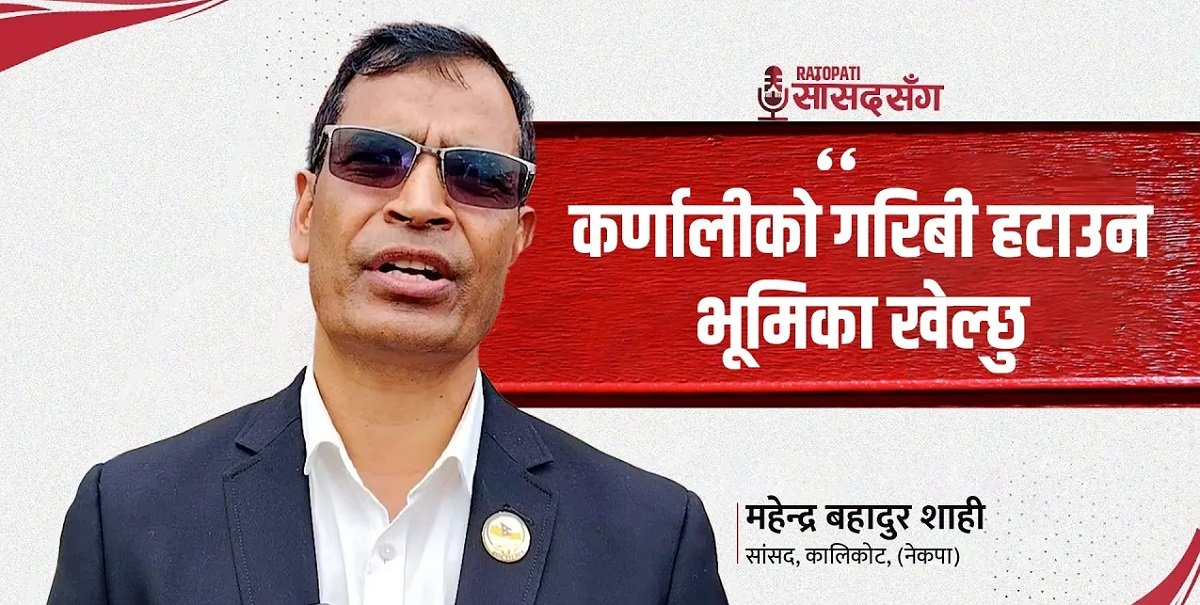
Mahendra Bahadur Shahi: The Politician Who Turns Risks into Victories in Karnali

Surkhet. Mahendra Bahadur Shahi is a political player in Karnali who possesses the capability to secure favorable outcomes even in risky situations. Whether during the armed conflict or while navigating the political crisis that arose during his tenure as Chief Minister of Karnali, he has consistently succeeded in overcoming challenges and turning circumstances to his advantage.
This time, the House of Representatives election was also a significant challenge for him.
On one hand, he faced candidacy against his former colleague, Netra Bikram Chand 'Biplav' led Maoist's candidate, while other political parties questioned his development record in Kalikot. On the other hand, the initial rebel candidacy by his own party leader, Jeevan Budha, caused a split among the cadres. Although Budha withdrew his candidacy following Prachanda's directive, there was still apprehension about whether he would receive internal support from the Budha faction.
Shahi himself was quite worried and defensive due to all these developments.
The continuous accusation leveled against him by other political parties in Kalikot was that despite winning elections repeatedly and becoming Chief Minister and Minister, development in Kalikot did not occur.
When Biplav started his election campaign, on the very first day, he commented on Mahendra, calling him a 'loafer'. Biplav stated, 'The major development projects here, I don't see anything other than the development we did after the 2064 election. This Karnali corridor was built by us; these loafers built nothing,' Biplav told Mahendra.
Similarly, Biplav claimed to have initiated the work on the Khulalu Bridge to Kotbada Airport. After Biplav initially called Mahendra a 'loafer', accusations and counter-accusations ensued between the Biplav and Mahendra Shahi factions in Kalikot.
It seemed the competition in Kalikot was between Mahendra and Biplav. Biplav's group put forward agendas such as Mahendra's failure to achieve anything in the district and merely occupying space, alongside raising ethnic agendas. Biplav hoped that the majority of the Dalit community in Kalikot, which has a large Dalit population, would vote for him. Other political parties also entered the electoral field against Mahendra by adopting agendas similar to Biplav's team.
However, amidst such challenges, Mahendra not only secured an easy victory but also prevented Biplav from entering the competition. He succeeded in preserving his legacy in Kalikot.
Shahi, who was a candidate from the Communist Party of Nepal (CPN), won the election with 11,338 votes.
His competitor, Nagendra Bahadur Shahi 'National' of UML, received 10,352 votes. Nagendra had also lost to Mahendra in the 2079 election.
Likewise, Harsh Bahadur Bam of the Congress received 7,133 votes, while Biplav was limited to fourth place, securing only 4,599 votes. His humiliating defeat came as he could not even compete against a junior leader.
The Leader Who Always Turns Risk into Victory
The 2070 election was also risky for Mahendra Bahadur Shahi. Biplav, considered the top leader in Kalikot, had left the main party along with Biplav in 2069, expressing dissatisfaction with Prachanda, before his parliamentary term ended.
Biplav, who won the election in 2064 with nearly 27,000 votes, was considered a major leader not just in the district but across Karnali. After the top leader left the main party in Kalikot, which was considered a base area of the Maoist war, there was confusion among the cadres. Mahendra, at that time, was staying away due to dissatisfaction with the integration of the People's Liberation Army.
Prachanda brought Mahendra into mainstream politics to save the base area in Kalikot. Mahendra, who had successfully fought major fronts across the country while in the People's Liberation Army, only rose in party politics after that.
Mahendra, who won the second Constituent Assembly election in 2070 amidst the Maoist split, became the Minister of Energy in Sher Bahadur Deuba's government. At that time, he gained prominence by registering an impeachment motion against Lokman Singh Karki, the Chief Commissioner of the Commission for the Investigation of Abuse of Authority, which was also a very risky move on his part.
In 2074, he moved to the Provincial Assembly and became the Chief Minister of Karnali. In the 40-member Provincial Assembly, 20 seats are enough to form a single-party government. UML had 20 seats alone, while Maoist had 13. However, according to the central coalition, Mahendra became the first Chief Minister of Karnali with the support of UML. UML leader Yam Lal Kandel was unhappy. Then, the two parties merged to form the CPN.
That is why he brought a no-confidence motion against Shahi multiple times.
Kandel's actions led the dispute within the then CPN to its peak, and Shahi's power came under threat. At that time, he emerged as a clever player in parliamentary politics by saving his position by making UML MPs 'floor cross'. He also succeeded in bringing the Congress to his side. He served as the Chief Minister of Karnali for 3 years, 8 months, and 12 days. As per the agreement, he handed over power to Congress's Jeevan Bahadur Shahi.
Within the Maoist party, Mahendra emerged as an influential leader in Karnali after Janardan Sharma and Shakti Basnet. Currently, Sharma has formed a separate party, Pragati Shila Loktantrik Party (Pragatik).
The Maoist party currently exists under the name Communist Party of Nepal. Mahendra is now known as a confidant of Prachanda and is considered an influential leader of the CPN in Karnali.
He formally emerged in politics in 2048 BS and joined the People's War conducted by the then Maoists in 2052 BS.
During the People's War, he played parallel roles in party organization and guerrilla warfare, and at that time, he served as the military in-charge of Kalikot district, leading the People's Liberation Army there.
He led military operations in Western Nepal from Butwal to Darchula. Shahi, who rose through the ranks from Ward Commander, Squad Commander, Platoon Commander, Company Commander, Battalion Commander, Brigade Commander, to Division Commander, chose the political front during the army integration.
Votes Received by Mahendra in Past House of Representatives Elections
2079 House of Representatives
Mahendra Bahadur Shahi: 23,727 (Winner)
Nagendra Shahi (UML): 16,718
2070 House of Representatives
Mahendra Bahadur Shahi (Maoist): 10,984
Bhupendra Bahadur Shahi (Congress): 7,759
This specific news has been automatically translated by AI. As a result, there may be some inaccuracies or language errors.