The Historical and Cultural Significance of Holi in Mithila

The historical boundary of Mithila (Tirhut), which was a prosperous kingdom in the Treta Yuga, is found to be bordered by the Himalayas in the north, the Ganges River in the south, the Mahananda (Darjeeling) River in the east, and the Sadaniira (Gandaki) River in the west.
Currently, the heritage of the Mithila kingdom is found in the region from Saptari to Parsa in Nepal's Madhesh Province, and from Morang-Sunsari in the Koshi Province. In India, it includes districts like Madhubani, Darbhanga, Sitamarhi, Muzaffarpur, Samastipur, Vaishali, Begusarai, Saharsa, Madhepura, Supaul, Purnia, Araria, Katihar in Bihar, and the divisions of Tirhut, Darbhanga, Munger, Koshi, Purnia, and Bhagalpur. The Santhal Pargana division (Deoghar, Dumka) of Jharkhand state is also considered culturally part of Mithila.
Mithila culture is an ancient, original, and rich cultural tradition. Maithili language, Aripan (rangoli), songs, and seasonal festivals are synonymous with Mithila. Festivals such as Chhath, Sama-Chakeva, Navratra, Judsheetal, and Faguwa (Holi) are celebrated with great enthusiasm in Mithila. The festivals prevalent in Mithila are connected to devotion and collective celebration.
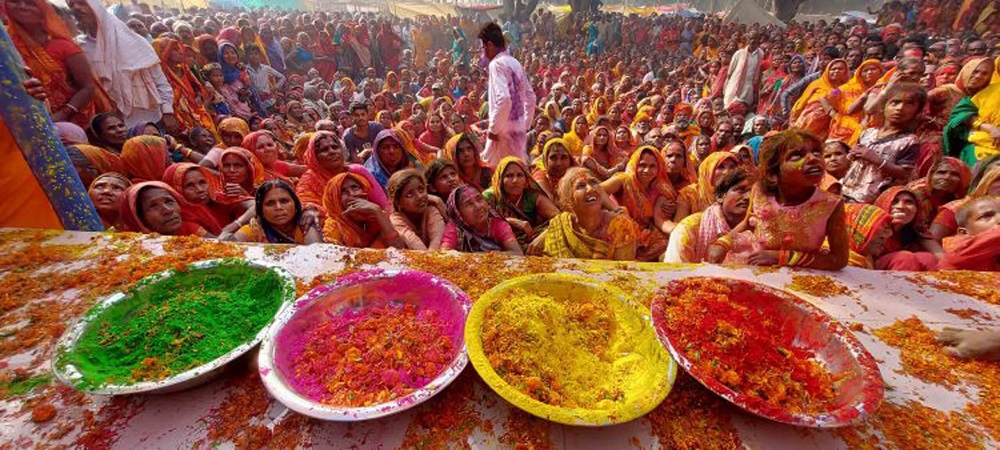
Holi is a festival celebrated at the end of Phalgun and the beginning of the spring season on Chaitra Krishna Pratipada. Holi is a unique symbol of devotion and victory celebration. During this festival, people burn Holika as a symbol of devotion and celebrate by playfully sprinkling colors and 'abir' (colored powder) on each other in various ways.
According to the legend of Lord Narasimha's incarnation, Holika, endowed with unburnable power, sat in the blazing fire holding Prahlad in her lap. However, Holika herself was reduced to ashes by the fire, while Prahlad emerged unharmed from the fire. Lord took the Narasimha avatar to inspire the event of Holika Dahan.
There are many mythological narratives regarding the origin of the Holi tradition in Mithila. But it is clear that this is an extremely ancient festival. In Mithila, Holi is called 'Faguwa'. Here too, this festival is celebrated with folk songs and colors, just like in other regions.
This is a festival celebrating the victory of truth over falsehood. Holi begins with the burning of Holika. The next day, people celebrate Holi by applying colors and 'abir' to each other, dancing, and singing. They eat delicacies such as sweets, Malpua, and meat. The relationship between Holi and food is very close. In Mithila, non-vegetarian dishes are also prepared on the day of Holi. Malpua is the most central and mandatory dish of Holi.
Malpua is cooked by frying a mixture of rice flour, sugar, banana, and milk in ghee. On the day of Holi, Bhang (cannabis preparation) is mixed with sweets like milk, 'khuwa' (condensed milk solids), lassi, 'peda' (milk sweet), Jalebi, etc., and consumed, which further elevates the joy of the celebration. These elements complete the festival of taste alongside the colors of Holi. Holi promotes friendship, love, and brotherhood. People enjoy teasing others by saying, 'Bura Na Mano Holi Hai' (Don't mind, it's Holi).
The history of the Fagu festival begins with the worship of spring and the god of love in spring, Kama Deva. Therefore, this celebration is observed as Madanotsav or Vasantsotsav. Madanotsav is a festival that highlights the character of Kama Deva in Shiva-Parvati. Vatsyayana saw unity in love and desire, just like color and water. Over time, Madanotsav began to be celebrated as a festival symbolizing that devotion. Vasantsotsav delights us with the beauty of nature throughout our youth.
The beauty of nature has the capacity to please humans and heal all their wounds. Since human nature is influenced by natural beauty, the tradition of celebrating nature's festival began in ancient times and has continued in the form of Madanotsav or Vasantsotsav.
This also includes a ritual to pacify the demoness Holika. From Basant Panchami, piles of wood are gathered in the field and burned on the last day of the year, Phalgun Purnima. This is called burning Holika or burning the 'Samvat' (year). Both the last day of the previous year and the first day of the coming year are included in this festival. This festival, celebrated as Vasantsotsav in ancient times, is later found to be called Fagu, Faguwa, Holi, or Hori through stories of Prahlad, Krishna, Holika, Dunda, etc. Holika Dahan is performed on Phalgun Purnima, and Holikotsav is celebrated the next day. Holi is a popular festival of the spring season.
Phalgune Purnimayam Tu Dagdha Bhavati Holika.
Pashchat Pratah Samutthaya Holikotsavah ।।
Holi was celebrated in ancient times under the names Vasantsotsav and Madan Mahotsav. Madan Mahotsav is Madanotsav. This ancient festival was celebrated from Chaitra Shukla Dwadashi to Chaturdashi. This festival included fasting, worship of Kama Deva, songs, music, dance, and staying awake all night. Both men and women participated in this festival and enjoyed themselves in gardens, etc. Holi is also known by the names Vasantsotsav, Madanotsav, Rangotsav, and Faguwa.
Fagu, which excites everyone with the fervor of natural beauty and colors, is a colorful festival of joy and delight. The Fagu festival, a colorful celebration of harmony, beauty, and colors, is a natural source of new consciousness, equality, and harmony, where people forget discrimination based on caste, untouchability, small/big, rich and poor, and immerse themselves in the same color.
There is also a popular saying in Mithila regarding Holi: 'Je Jiwe Se Khele Phag' (Whoever lives, plays Phag). On the occasion of Holi, a 'Murkha Sammelan' (Fools' Conference) is organized in Janakpurdham and some other places for collective humor and banter. Mithila folk songs are found to be composed for festivals like Madhushravani, Sama-Chakeva, Holi, and Fagu.
The folk songs sung during Holi in Mithila are considered very devotional, entertaining, cultural, and natural. Holi has a unique originality in Mithila. As this is a time of leisure after the agricultural work is finished, Holi serves as a means of entertainment. In Mithila, Holi is considered to have started from Magh Shukla Panchami (Shree Panchami). To express the enthusiasm that comes with the end of winter and the arrival of spring, people gather in groups and start singing Falguni, Jogira, etc., to the rhythm of the Damphu and Jhyali drums. No matter how many colors and 'gulal' are applied during Holi, there is one thing without which this festival is considered incomplete, and that is—Holi songs.
Holi devotional songs are specially composed in the context of the 'Phagu' game of Lord Gaurishankar, Sitaram, and Radha-Krishna. The lyrics of these devotional songs include phrases like 'Shiv Math Par...' and 'Mithila Me Ram Khelathi Hori...'. There are also social harmony songs for Holi, which help in forgetting old grudges and re-establishing brotherhood. There is a tradition of singing 'Horaiya' during Fagu. Horaiya songs are sung collectively by gathering at mathas (temples), chautaras (public resting places), dalans (verandas), and public spaces.
Jogira is the most popular and entertaining song of Horaiya, which mixes satire, jest, and moral teachings. The refrain 'Jogira Sararar...' is repeated at the end of every line. That is why this refrain is called Jogira.
Shiv Math Par Sohai Laal Dhwaja
Shiv Math Par, Sohai Laal Dhwaja. Shiv Math Par....।।
Kaun Ke Sohe, Hari–Piri Churiyaan,–2
Kaun Ke Sohe, Bhasm Gola. Shiv Math Par....।।
Gauri Ke Sohai, Hari–Piri Churiyaan,– 2
Shiv Ke Sohe, Bhasm Gola. Shiv Math Par....।।
Kaun Shikhar Par Gauri Biraje,– 2
Kaun Shikhar Par Bam Bhola. Shiv Math Par....।।
Uttar Shikhar Par Gauri Biraje,
Dakshin Shikhar Par Bam Bhola. Shiv Math Par....।।
Meera Ke Prabhu Giridhar Nagar,– 2
Harike Charan, Chit Mora. Shiv Math Par....।।
Almost every year, many songs related to Holi are released in the Hindi, Bhojpuri, and Nepali film industries. But an old song by Amitabh Bachchan always overshadows the new Holi songs. There is one song by Amitabh Bachchan without which the festival of Holi feels incomplete, and that song is—'Rang Barse Bheege Chunar Wali Rang Barse'.
This specific news has been automatically translated by AI. As a result, there may be some inaccuracies or language errors.