South Asian Nations Face Geopolitical Competition and Economic Crises, Defense Spending Fluctuates

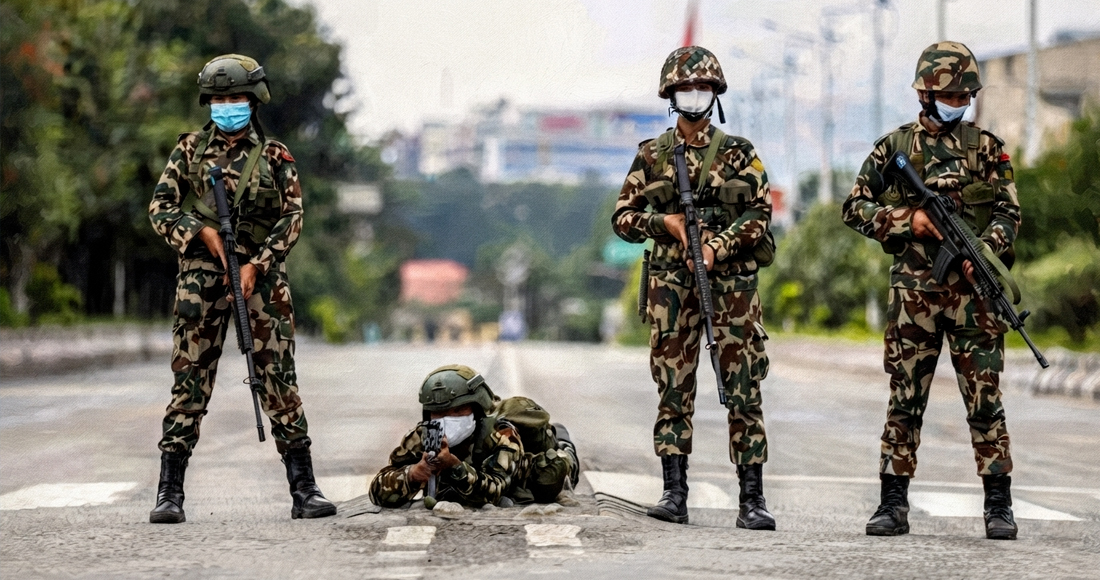
Kathmandu. In recent years, South Asian countries have been caught in intense geopolitical competition and internal economic crises. With economic crises, fluctuations have been observed in the defense spending of various countries.
According to a study on South Asian security conducted by the Observer Research Foundation (ORF), which conducts research and studies in the security sector for the Indian government, countries in this region are under dual pressure to maintain emerging and developing economies, military modernization, and internal economic stability.
In South Asia, apart from India, Pakistan spends the most on defense, while the Maldives spends the least. Nepal spends more on security than the Maldives. According to a study by ORF, Nepal spent $0.43 billion on defense in 2018, and subsequently, spending in this category has continuously increased.
In 2019, Nepal allocated $0.39 billion for security, which increased to $0.43 billion in 2020. It then decreased to $0.41 billion in 2021, and reached $0.42 billion in 2022 and 2023. An allocation of $0.44 billion was made for 2024 and 2025.
Nepal's security spending is used for internal security, disaster management, and United Nations peacekeeping operations. ORF states that Nepal remains distant from geopolitical military competition.
Pakistan's defense spending has seen significant fluctuations over the past 8 years. Pakistan's defense spending, which was $11.4 billion in 2018, shrunk to $7.91 billion in 2023. Pakistan appears to be forced to cut its military spending due to extreme economic crisis, lack of foreign exchange reserves, and high inflation.
However, it is projected to increase again to $10 billion in 2025, posing a challenge for Pakistan to manage internal security challenges and regional geopolitical balance.
Similarly, Bangladesh has continuously increased its defense spending from 2018 to 2022 under its military modernization plan 'Force Goal 2030'. The budget, which was $2.53 billion in 2018, reached $4.32 billion in 2022. However, due to the impact of COVID-19 and the global economic recession, Bangladesh has also made some cuts in defense spending in 2023 and 2024. Its security spending is projected to reach $3.51 billion in 2025.
Sri Lanka's economic crisis in 2022 has directly impacted its security budget. Sri Lanka's budget, which was $1.8 billion in 2018, increased to $1.16 billion in 2022. It reached $1.39 billion in 2024.
On the other hand, official and reliable data on Afghanistan's formal defense spending has become unavailable since the Taliban's return in 2021, indicating political transition and international isolation. It spent $1.8 billion in 2018, which increased to $1.96 billion in 2019. In 2020, that spending increased to $2.01 billion. However, it fell to $1.88 billion in 2021.
Maldives has seen an increase in security spending since 2021. It was $0.09 billion in 2021, and reached $0.10 billion in 2022 and $0.11 billion in 2022 and 2023.
- Nepal's Situation in South Asia
ORF's study mentions that South Asian countries are experiencing more internal stability compared to the past. Some time ago, South Asia was plagued by civil wars, rebellions, and internal conflicts. Nepal, Sri Lanka, and Afghanistan were victims of civil war. In Bangladesh, the army continues to sideline democracy, while Bhutan and Maldives are facing new difficulties in democracy.
_jd5kA54gqj.jpg)
Therefore, assessments and calculations of national security in South Asian countries are changing. The security spending of all countries is increasing. While external and internal threats are similar in these countries, this is also seen in Nepal's case. According to ORF, this is why these countries are being forced to become more outward-looking.
Apart from Pakistan, India has been a major security partner for other countries. ORF states that India continues to provide defense equipment, assist in capacity building, provide loans for defense sector modernization and infrastructure, install radar systems, exchange intelligence information, and conduct maritime surveillance, joint patrols, and operations.
India is institutionalizing these activities through platforms like the Colombo Security Conclave and the Information Fusion Centre-Indian Ocean Region. It is claimed that debates on national security in South Asia are influenced by India. While India has a significant influence on Pakistan's security calculations, Afghanistan has used India to balance against Islamabad.
The study mentions that due to the internal politics of Bangladesh, Nepal, Sri Lanka, and Maldives, excessive dependence on India has become an important aspect of their national security. In recent times, South Asian nations are leveraging the India-China competition to promote their interests, especially in economic aid and infrastructure development.
_qLPdkZOSfy.jpg)
- Security Threats to Nepal
The study mentions that Nepal's national security is undergoing transformation amidst changes in global geopolitics. Nepal is said to be in a sensitive geopolitical location between two emerging powers, India and China, whose economic and military capabilities are expanding.
The increasing competition between the United States and China, the strategic importance of the Indo-Pacific, and the competition between India and China in South Asia have increased Nepal's geopolitical relevance, the study states. Similarly, Nepal's internal political instability, non-aligned foreign policy, and economic weaknesses have complicated the country's external relations.
According to ORF's study, the deteriorating relationship between India and China will affect Nepal's security environment. It is mentioned that Nepal faces risks of strategic over-dependence, transit vulnerabilities, and entanglement in the competition of superpowers, rather than direct military threats.
_fWwfamNdiE.jpg)
- Nepal with America, China, and India
According to the study, Nepal joined China's BRI to diversify transit and reduce dependence on India's transit routes. It expanded cross-border electricity trade with India and Bangladesh and expanded infrastructure cooperation with India under New Delhi's 'Neighborhood First' policy.
The acceptance and parliamentary ratification of the MCC agreement with the United States showed Nepal's interest in engaging with Western partners for development financing. These engagements show Nepal's strategy to maximize economic opportunities. However, it can be understood that security risks are equally present within these strategies.
Nepal has so far avoided joining security mechanisms led by major powers. Nepal's recent decision to withdraw from the US State Partnership Program (SPP) is welcome. Similarly, while engaging economically and diplomatically with China, Nepal has not formally supported China's Global Security Initiative (GSI) from a strategic perspective. Despite China's repeated requests to join, Nepal has not agreed.
The study mentions that Nepal's decision not to join the US SPP and its reluctance towards China's GSI reflect Nepal's strategic autonomy. The study asserts that Nepal seeks economic assistance, development financing, and limited defense cooperation from these countries.
This specific news has been automatically translated by AI. As a result, there may be some inaccuracies or language errors.