Nepal's Economy Faces Paradox: Strong External Indicators Clash with Domestic Stagnation, Chamber President Warns

Kathmandu. The country is immersed in elections, with only a few days remaining until they are held. However, the economy is currently navigating a serious paradox.
Foreign exchange reserves have surpassed NPR 3.2 trillion, and over NPR 1.1 trillion in investable funds (liquidity) are piled up in banks. Thus, external indicators are strong.
While foreign exchange reserves are at a historic high and liquidity is abundant in banks, the domestic market is sluggish. Industries have contracted to 40% capacity.
Business sentiment is at its lowest ever. The sluggish economy appears somewhat active now, but only due to election-centric activities.
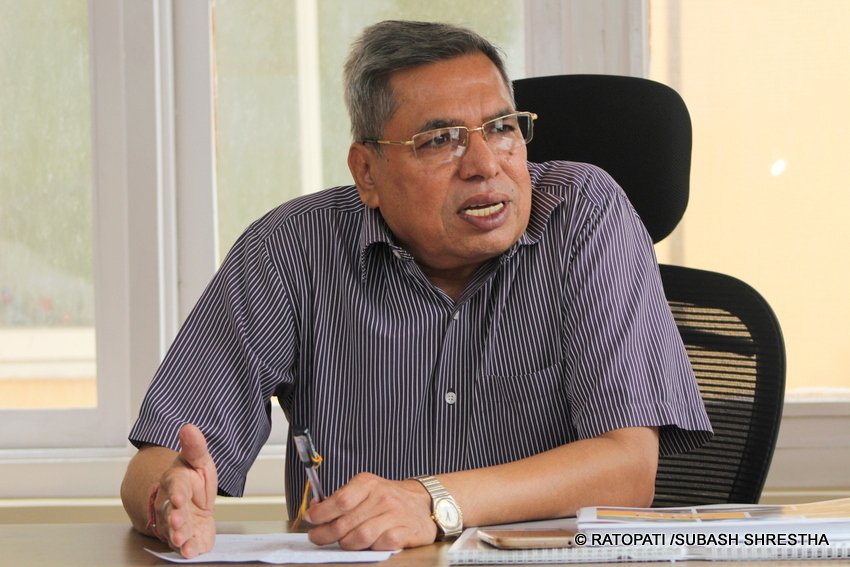
Why hasn't the economy been stimulated? Why is the private sector not investing? We discuss the gap between political parties' manifestos and reality, along with other contemporary issues, in this edited excerpt of an interview conducted by Anish Mijar for Ratopati with the President of the Nepal Chamber of Commerce, Kamlesh Agrawal:
- How do you analyze the current state of Nepal's economy?
– Nepal's economy is in a highly paradoxical state. The external economy is extremely robust. Foreign exchange reserves have reached nearly NPR 3.2 trillion, which is sufficient to cover imports of goods and services for about 17.5 months. Furthermore, over NPR 1.1 trillion in investable funds (liquidity) is accumulated in the banking sector. Bank lending interest rates have also dropped to a single digit.
However, the domestic economy is completely stagnant. The morale of the private sector, which contributes 81%, is extremely low. There is no demand in the market. Government revenue collection is not meeting targets. The status of capital expenditure remains dismal even seven months into the current fiscal year. Despite strong external indicators, the domestic economy has failed to pick up momentum. The failure to stimulate the domestic economy is the biggest problem right now.
The economy was gaining good momentum after the promulgation of the new constitution. However, stagnation has been observed in the economy for the last few years. Where and how did this stagnation begin?
– There was enthusiasm in the economy after the new constitution was promulgated in 2072 BS. Nepal achieved an average high economic growth rate of 7.7% for three consecutive fiscal years: 2073/074, 2074/075, and 2075/076. If tourism and energy had been further promoted then, a growth rate of up to 8.5% would have been possible. But in 2076 BS, the Covid-19 pandemic struck, contracting the global economy by nearly 20%.
Developed countries introduced stimulus packages ranging from 5% to 10% of their Gross Domestic Product (GDP). The Government of Nepal had no money. Therefore, the central bank injected about NPR 240 billion into the market through concessional loans using the banking sector's own liquidity. This boosted the economy for a short time. We achieved a growth rate of 5.8% in the fiscal year 2078/079.
But the problems started afterward. Remittances decreased due to Covid, and foreign exchange reserves began to decline. Fearing that Nepal might become like Sri Lanka, the government and the central bank introduced extremely stringent and contractionary policies. It appears that these very stringent policies have brought the economy to its current stagnant state.
Are you suggesting that the harsh policies and import restrictions adopted by the government and the central bank at that time have shaken the very foundation of the economy even today?
– Absolutely. The biggest blow from the contractionary policy was felt in bank interest rates. Bank interest rates were raised overnight. While international markets increase interest rates by only 25 to 50 basis points, in our case, the rate was increased by 350 basis points in just six months. Fixed deposit interest rates reached 13-14 percent. The premium charged on loans was increased from 0.5 percent to 4 percent.
Businesses that had taken loans at single-digit rates had to pay double-digit interest. Not only that, policies like import restrictions and working capital loans created further problems. The base rate was sharply increased to raise interest rates.
This had a direct impact on the market. Businesses could not pay their bank installments and interest. More than 150,000 entrepreneurs were blacklisted. Real estate transactions collapsed by 50 percent. The stock market, which had reached 3200 points, fell to 1800. The decline in these sectors halted capital formation.
The government imposed restrictions on the import of many goods, claiming it was to save foreign currency. However, imports did not stop due to the open border. Instead, smuggling increased, leading to a loss of government revenue.
The cooperative sector became troubled after the real estate and stock markets declined. Small and medium-sized industries shut down. The manufacturing sector dropped to 40% capacity. Capital flight from Nepal during these times is also seen as a reason for the persistent stagnation.
Has this failure of the economy led to increased frustration among the youth and the Gen Z movement?
– You have said something very true. The economic growth rate, which was 5.8% in the fiscal year 2078/079, suddenly dropped to 1.86% in 2079/080. It was only 3.3% in 2080/081, and the projection for 2081/082 was 4.4%. It is still around that level.
Fifty-seven percent of the country's workforce is young. When the economy contracts, job creation does not happen. When they cannot find employment and see no future in the country, the youth are either forced to go abroad or take to the streets. The main reason for the Gen Z movement is economic stagnation and lack of employment.
The then-government formed a High-Level Economic Reform Suggestion Commission and prepared about 440 suggestions, including structural reforms in fiscal and monetary policies. But the implementation of these suggestions was delayed. The youth are seeking good governance and employment, which was not possible due to the unstable policies of the last 5-7 years.
There is liquidity in the banks now. Interest rates have decreased. Yet, why is the private sector hesitant to increase investment?
– Investment is not just about having money in the bank; the most important factors are morale and investment security. Today, the private sector is seeking assurance of security.
Just as foreign investors seek Bilateral Investment Promotion and Protection Agreements (BIPPA), domestic investors are seeking investment promotion and security policies. The main issue is political and policy instability. Over the past 7 years, we have experienced instability in economic policy, a lack of competent management, and an extreme shortage of an investment-friendly environment.
The government has failed to spend on capital projects. Infrastructure work is stalled. When the private sector, which should be driving the entire economy, is weak, new investment cannot come in, no matter how good the external indicators are.
Elections are due in a few days. Political parties are promising dreams of 7 to 10 percent economic growth and an economy size of NPR 100 trillion in their manifestos. As the President of the Chamber and a businessman, how do you view this?
– It is positive that political parties are talking about 7 to 10 percent economic growth in their manifestos. We have achieved 7.7 percent in the past, so this is not impossible.
However, the economy does not grow just by writing it in the manifesto. To achieve a NPR 100 trillion economy, an investment of about NPR 137 trillion is required over the next 10 years. This is not possible with domestic capital alone. Foreign investment is mandatory. For that, policies to attract foreign investment are necessary.
What are our policies and regulations like for bringing in foreign investment? We still haven't provided a clear hedging policy. Tax rates are not competitive; for example, GST is lower in India. Country rating work is just beginning, and the One Window Policy is still not effective. As long as an investment-friendly environment is not created, the figures in the parties' manifestos will remain confined to paper.
Therefore, we must utilize the hydropower sector to make our products competitive. It's not just about selling electricity abroad. Domestic manufacturing industries should be provided electricity free of cost or at heavy subsidies, up to 20 percent. Only then will our industries recover and employment increase.
What expectations does the private sector have from the new government and political leadership to be formed through the elections? Will there be political stability after the upcoming elections?
– The private sector is always optimistic. We continue to invest and create employment even in the most difficult circumstances. Our first and mandatory condition is political stability.
Our expectation is that the elections will bring political stability to the country. With political stability, economic policy stability also follows. The government to be formed must prioritize the economy and create a private sector-friendly environment.
The suggestions given by the commission must be implemented verbatim. If political parties repeat the mistakes of the past and ignore the economic agenda, we cannot say that youth movements like Gen Z will not happen again. The country needs results now, not just talk.
This specific news has been automatically translated by AI. As a result, there may be some inaccuracies or language errors.