Political Parties Diverge on Interpretation of Recent Protests Ahead of Election

Kathmandu. As the election date of Falgun 21 approaches, major political parties are divided into three factions regarding the perspective on the 'Jeevanji' (a likely reference to a specific protest/movement) protests that occurred on Bhadra 23 and 24. One faction is led by CPN-UML, while the other is led by the Rastriya Swatantra Party (RSP). The Nepali Congress and the Communist Party of Nepal (CPN) have taken a stance distinct from both of these factions.
The division among political parties and their leaders concerning the unimaginable loss of life and property and the issues of change during the Bhadra 23 and 24 protests is influenced by their respective understandings and self-interests.
CPN-UML, which led the government during the Jeevanji movement, views the movement and the resulting damage as the result of a foreign 'conspiracy' and plan. On the other hand, the RSP, led by Rabi Lamichhane, interprets it as the public awakening against misgovernance and corruption, signifying a popular revolution leading to change. In this situation where there is no consensus among parties on how to view the Jeevanji movement, the RSP has indirectly declared that it will claim credit for the change. However, the RSP is also attempting to shift the blame for the violence, suggesting that the same person was responsible for shooting children and burning Singha Durbar.
“There is an attempt to spread confusion here, and some people associated with us are being accused of setting the country on fire,” said RSP Chairman Rabi Lamichhane. “I want to clarify again—the first shots were fired targeting the chests and heads of young children in school uniforms, and only then did the structures burn.”

Lamichhane admits that the burning of structures was wrong. “But shooting should not have happened, people should not have been killed. That is where it went wrong,” Lamichhane stated.
The debate over who burned Singha Durbar continues even now. “Even today, people ask who burned Singha Durbar. Singha Durbar was burned by the one who turned Singha Durbar into a den of corruption and shot children. That is who burned Singha Durbar,” Lamichhane said on Friday in his constituency, Chitwan. “If that Singha Durbar had not been a den of corruption, children in school uniforms would not have gone out demanding good governance.” Lamichhane claims that the group, the people, and the caste responsible for burning Singha Durbar and shooting the children are the same. This statement by Lamichhane targets the Congress, UML, and CPN, which led the government in the past.
Meanwhile, CPN-UML has so far been unable to accept the movement as a genuine protest. It views the Falgun 21 election as a battle between those who want to burn the country and those who want to build it.
UML Chairman KP Sharma Oli describes the Jeevanji movement and the Falgun 21 election as a great war between 'building the nation or burning the nation'.
“This election is between those who burn the country and those who build it,” Oli has repeatedly said over the past six months. “The public cannot possibly side with those who burn the country.”

As UML, Congress, CPN, and RSP go to the people, the leaders are campaigning with the issues and agendas they have put forward. In one sense, the understanding of the Jeevanji movement appears to be RSP versus UML.
The Nepali Congress and the Communist Party of Nepal (CPN) hold a different perspective from UML and RSP. Both Congress and CPN label the viewpoints put forth by UML and RSP as extremist tendencies. Congress and CPN argue that the events of Bhadra 23 and 24 must be viewed and analyzed in different ways.
According to Congress and CPN, 19 innocent children died in Baneshwor on Bhadra 23 due to the weakness of the then-government, and on the 24th, individuals, groups, and forces seeking to benefit from the instability used the incident to create anarchy and cause great damage to the country.
Congress and CPN are approaching the public by interpreting the events of both days as two extremes. Congress President Gagan Thapa and CPN Chairman Prachanda, among others, have labeled the interpretations of the Jeevanji movement by UML and RSP as 'extremism'. They argue that if both extremes gain dominance, it will not benefit the nation, and they are appealing to the public to choose the middle path for resolution and development.
“The government murdered 23 Jeevanji youths. We were the first to protest the murder of Jeevanji and demand the government's resignation,” former Prime Minister Prachanda has repeatedly stated. “The next day, we called a meeting of opposition parties and protested the government's repression.”
According to Prachanda, the government's arrogance and domineering attitude have not been reviewed to date, and that tendency still persists.
“On Bhadra 24, the state property, party offices, and leaders' houses were burned; that is another extremist tendency,” Prachanda said. “Neither of these is the tendency of the Nepali heart. I appeal to defeat both these tendencies.”
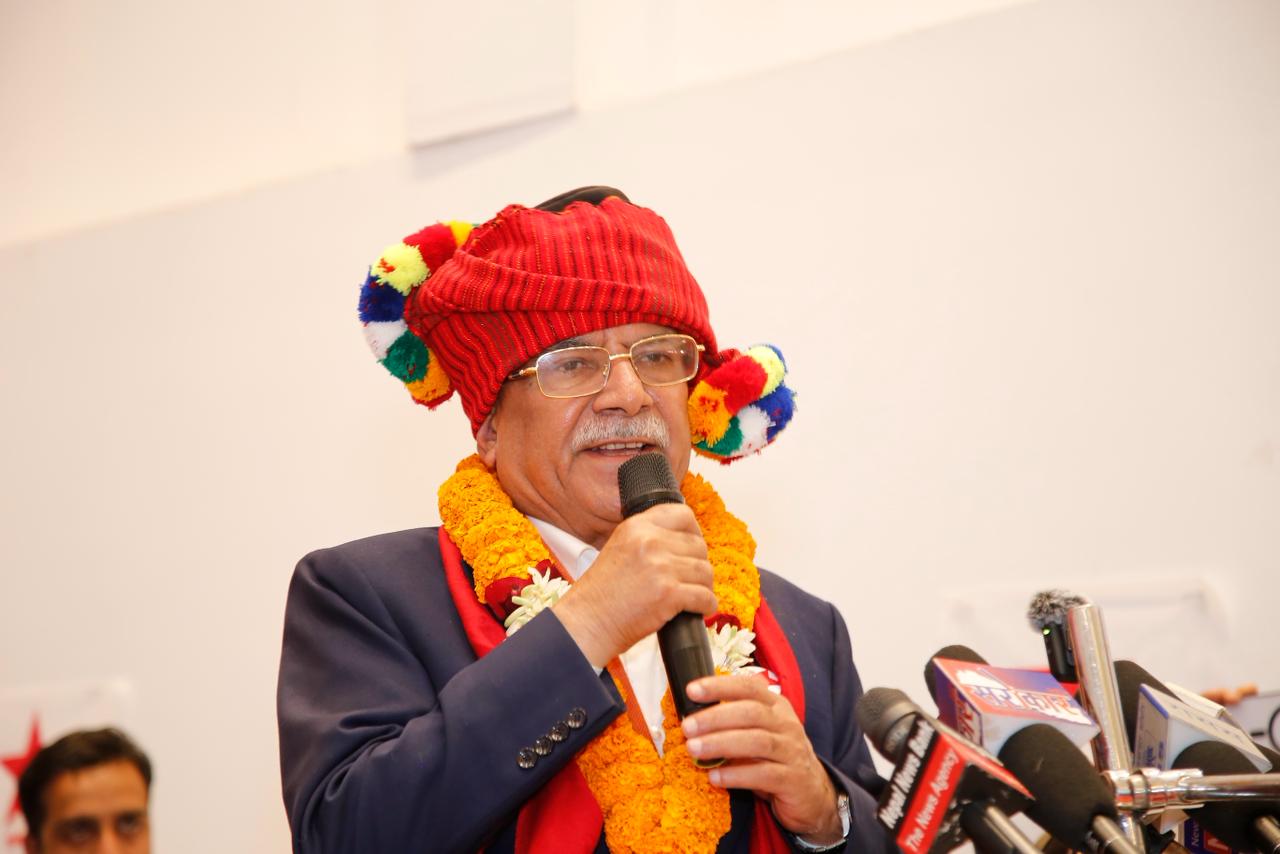
Prachanda's call is for the public to defeat both tendencies currently visible and ensure the victory of the Communist Party of Nepal in the Falgun 21 election.
There is not much difference in the expression and perspective on the Jeevanji movement between Prachanda and Congress President Gagan Thapa.
Addressing an election rally in Kaski on Friday, Chairman Thapa clarified the party's stance on the Jeevanji movement and the election, stating that the Falgun 21 election is taking place under specific circumstances.
“The election is happening two years later. Why is this election happening two years later?” Thapa countered, asking. “We must not forget that dozens of unarmed youths were killed for this election to take place. Mothers' laps have become empty, and Singha Durbar has burned. Along with this, a lot of public property was damaged.”

Chairman Thapa expressed concern that the outcome of this election could nurture two types of extremism. “The result after the election carries the danger of nurturing two types of extremism. One extremism is that which devalues the events of Bhadra 23 and 24. It says that never happened. It calls it merely a conspiracy. It does not see the participation of youth there. It does not see that dissatisfaction was expressed.”
“There is also another dangerous extremism, which takes advantage of the opportunity to have Singha Durbar burned,” Chairman Thapa said. “And another dangerous extremism is one that takes advantage of the opportunity to have Singha Durbar burned. It also escapes from jail when the opportunity arises. We saw both these extremes yesterday, and they can emerge tomorrow as well.”
He stated that the country needs to be managed during these five years, and this must be done within the framework of laws and regulations, not by targeting anyone. “Nepal cannot afford any kind of conflict now,” Thapa said. He also claimed that the Congress-led government formed after the election would work to deliver results.
This specific news has been automatically translated by AI. As a result, there may be some inaccuracies or language errors.