Political Showdown Looms in Dhankuta Ahead of February 21st Elections
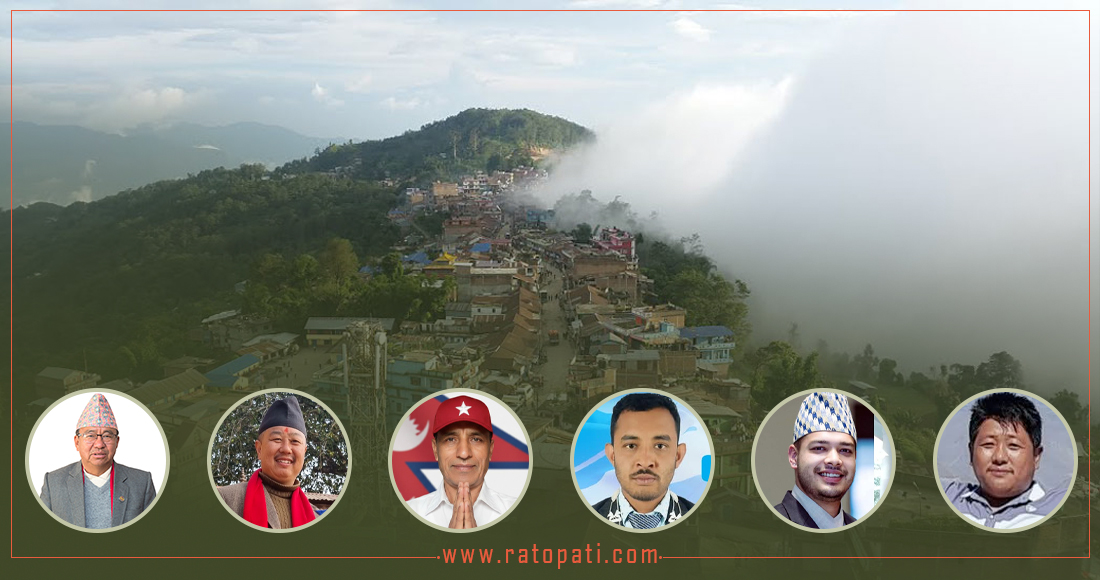
Biratnagar. Political fervor is escalating in Dhankuta, known as the 'Queen of the Hills,' mirroring the national trend. The upcoming House of Representatives election on February 21st presents an unpredictable contest between Dhankuta's old political legacy and emerging forces.
Dhankuta is the birthplace of astute politician Surya Bahadur Thapa, who served as Prime Minister five times. Following his demise, the legacy of the Rastriya Prajatantra Party (RPP) he established in Dhankuta is now merely a chapter in history. While the RPP exists, it lacks competitive strength.
It is impossible to discuss politics in Dhankuta without mentioning Surya Bahadur Thapa, born in Muga village. From his appointment as Chairman of the Advisory Assembly in 2015 until his last breath in 2071 BS, Thapa remained central to Nepali politics. He served as Prime Minister five times, acting as a crucial advisor to Kings Mahendra, Birendra, and Gyanendra during their crises.
He first became Prime Minister in 2022 BS, directly selected by King Mahendra. After securing victory for the Panchayat system using policies of appeasement, coercion, and division during the 2036 BS referendum, King Birendra handed him the reins of power for a second time. Even after the advent of multi-party democracy, he returned to the Prime Ministerial chair in 2054 BS with the support of the Nepali Congress and again in 2059 BS during King Gyanendra's direct rule.
Many recall that the modern Dhankuta of today is built upon the foundation of what Surya Bahadur Thapa achieved as Prime Minister for the district. It was through his initiative that Dhankuta was made the administrative headquarters of the Eastern Development Region. The construction of the Dharan-Dhankuta road, the Pakribas Agricultural Research Center, Dhankuta Multiple Campus, and the establishment of various government offices transformed Dhankuta into a developed hub in the hills.
However, after his passing, the influence of the RPP in Dhankuta gradually began to wane. After Thapa's death, his son, Sunil Bahadur Thapa, attempted to carry the RPP banner. However, in 2077 BS, he defected to the Nepali Congress with his entire faction. With the group carrying Thapa's legacy merging into the Congress, the prominence of the RPP in Dhankuta came to a complete halt.
As the legacy of the Thapa clan weakened, the political leadership focus shifted to the CPN-UML. The then-Maoists, who defeated both the RPP and UML in the first Constituent Assembly election of 2064 BS, failed to sustain their victory. In the second Constituent Assembly election of 2070 BS, candidates from the RPP and UML won again. UML has won the subsequent two elections consecutively.
Rai, who won in the 2074 and 2079 elections, enters the field this time with increased confidence. He states, 'There is no real competition in Dhankuta this time; I will win easily and directly.' He outright dismisses the opposition's claim that internal disputes within the UML and the controversy surrounding the general convention will affect the election results. He argues that UML's strong organizational structure and his past development work are the main pillars of his victory. CPN-UML leader and Koshi Province Minister Indra Mani Parajuli stated that allowing intra-party struggles to manifest in external competition is like burning one's own house to warm oneself, emphasizing that all grievances have been set aside for the party to unite and contest the election.
To challenge Rai, the Nepali Congress has put forward District President Dinesh Rai. The main strength of the Congress lies in the former RPP faction led by Sunil Thapa, which carried Surya Bahadur Thapa's legacy. Congress candidate Dinesh Rai asserts that the people will choose Congress this time for change and an end to misgovernance in Dhankuta. The arrival of the Sunil Thapa faction has significantly boosted the organizational strength of the Congress. Furthermore, Rai claims his victory is based on the allegations of genocide leveled against the UML and the criticism the party faces for going to the people without leadership change. 'I will win in Dhankuta, which was previously considered a UML stronghold,' stated Congress candidate Rai. 'The youth leadership promoted by Congress and agendas like free education and health have been well-received by the people.'
There is another interesting aspect to this election. A contest is taking place between two old colleagues who started their political careers in the same organization. Rajendra Rai of CPN-UML and Dharma Raj Paudel of the Communist Party of Nepal were once colleagues working in the same committee.
In 2049 BS, when Paudel was the Chairman of the District Development Committee, Rai was a member. Now, Paudel is challenging Rai's legacy. Paudel, who is contesting as a candidate from the CPN formed after the merger of the then-Maoist Centre and Unified Socialist, is contesting after nearly 18 years. He was defeated by Hari Raj Khewa of the then-Maoists when he contested on a UML ticket in the first Constituent Assembly in 2064 BS. He claims he will win this time. 'I alone possess the roadmap for the systematic development of the district; I have entered the field to practice politics of integrity,' he said. He claims his competition for victory this time is more against the Congress than the UML.
Meanwhile, Dinesh Bhandari is contesting on behalf of the Rastriya Swatantra Party (RSP). Bhandari represents the spirit of the Gorkha Janayuddha movement and the aspirations of the new generation. Capitalizing on the widespread dissatisfaction among voters towards the old parties, the RSP claims it will establish itself as the leading force. 'The old parties have only used Dhankuta as a vote bank; we have come to restore its former administrative and educational prestige,' Bhandari stated.
This election, following the era of Surya Bahadur Thapa, will determine the future political direction of Dhankuta. Will the UML save its legacy and secure a hat-trick for Rajendra Rai? Or will the Congress seize victory? Or will Dharma Raj Paudel create a new history by defeating his old colleague? Or will RSP candidate Bhandari surpass all others? That remains to be seen after the election on February 21st.
Looking at Dhankuta's electoral history, the main competition has always been between the UML and the Thapa family (RPP/Congress). In 2070 BS, Sunil Thapa of the RPP defeated Rajendra Rai of the UML. In 2074 BS, Rajendra Rai, supported by the Left Alliance, defeated Sunil Thapa by a margin of 10,459 votes. In 2079 BS, Rajendra Rai defeated Sunil Thapa by a narrow margin of only 1,397 votes.
In Dhankuta, 118,425 voters will have to choose one among 17 candidates this time. For this, 166 polling stations have been designated across 119 polling centers.
- Who are the Candidates?
For the House of Representatives seat in Dhankuta, the candidates include Rajendra Kumar Rai from UML, Dinesh Rai from Nepali Congress, Dharma Raj Paudel from the Communist Party of Nepal, Dinesh Bhandari from Rastriya Swatantra Party, San Bahadur Rai from Shram Sanskriti Party, Aitaraj Limbu from Janata Samajbadi Party Nepal, and Bibhatsu Thapa from Rastriya Prajatantra Party.
Other candidates include Uttam Sakhakarmi from Nepal Workers' and Peasants' Party, Prem Bahadur Thapa from Aam Janata Party, Balkumar Tamli from Sanghiya Loktantrik Rastriya Manch, Nishan Rai from Janata Samajbadi Party, Rabin Kumar Rai from CPN (Maoist Centre), Shaligram Rai from Rastriya Parivartan Party, Sagar Rai from Mongol National Organization, and independents Mankumar Yonjan, Jitendra Rai, and Lakpa Tamang.
This specific news has been automatically translated by AI. As a result, there may be some inaccuracies or language errors.

_s4UAz3GPxQ.jpg)