Nepal's Political History: A Tragic Epic Written in Blood, Demanding a Shift from Sacrifice to Progress

Nepal's modern political history is not merely a list of events; it is a tragic epic written in the ink of blood. When we look back to around B.S. 1997, four brave souls chose the nation over themselves to pierce the harsh darkness of the Rana regime.
Shukraraj Shastri, Dharmabhakta Mathema, Dasharath Chand, and Gangalal Shrestha sacrificed their lives. That sacrifice was an initial tremor that shook the sleeping Nepali consciousness for the first time. At that time, the state and the people stood face-to-face. This event is preserved more in social memory than in written records. It made clear that the state itself was the enemy of the people at that time.
The response to dissent was not dialogue, but hanging and firing squads. Thus, the conflict between the state and the people was established in Nepal's political history. The sad part is that a tradition was laid down from that point where 'change' and 'blood' began to be considered synonymous. The question of whose chair blood secures has always remained obscured.
Democracy with meager rights arrived in B.S. 2007. The democracy established through elections in B.S. 2015 was snatched away in B.S. 2017, less than two years later. The movement of 2036 was launched for the restoration of democracy. This was the first major explosion where the suppressed civic consciousness surfaced from within the autocratic circle of the Panchayat system.
Students, intellectuals, and conscious citizens desired to breathe the air of freedom. The movement was fundamentally peaceful and ideological, but the state's reaction, as always, remained repressive. There were baton charges, mass arrests, and firing. To this day, concrete government statistics for those killed are unavailable.
Facts about dozens injured and some martyrs are buried in the shadows of history. The movement paved the way for a referendum but left a serious question—must the state always resort to violence to fulfill the demands of its citizens? The lesson taught by 2036 was that the ruling power only talks of reform after seeing blood on the streets. This legitimized 'street violence' in Nepali politics.
The People's Movement of 2046 is portrayed as a 'successful movement' in Nepali politics. The Panchayat collapsed. Multi-party democracy arrived. The door to people's rights opened. But its price was not cheap. Shots were fired from the streets of Kathmandu to the plains of the Terai. Due to the lack of official figures, an estimated more than one and a half dozen citizens were killed.
Although we gained multi-partyism, a dangerous message was institutionalized alongside it: that bloodshed is normal for change. Leaders declared from stages, 'The martyrs' dreams have been fulfilled,' but in reality, the dreams of the martyrs' families were buried beneath the shiny cars and palaces of those same leaders. After 2046, the devaluation of the word 'martyr' began. Blood started to be seen as a 'shortcut' route to power.
Thus, the monarchy, which ruled for over 240 years, fell due to the blood of thousands. A republic arrived. But was this the Nepal the martyrs envisioned?
When the achievements of 2046 did not significantly change the lives of the common people, the Maoist insurgency emerged. This war, which began on Falgun 1, B.S. 2052, became the bloodiest chapter for Nepali society until the peace accord of Mangsir 5, 2063.
According to official statistics, more than 17,000 people were killed. About 1,300 went missing. Millions were displaced. In the war, both the state and the rebels chanted slogans of 'liberation' and 'justice,' but the common citizens paid the highest price. In the movement of 2062/063, more than 25 people sacrificed their lives.
Thus, the monarchy, which ruled for over 240 years, fell due to the blood of thousands. A republic arrived. But was this the Nepal the martyrs envisioned? The war ended, politics entered the mainstream, and a constitution was drafted. But the wounds of the victims did not become the state's priority. The value of blood dissolved in the closed rooms of power and compromise.
In the post-conflict period, the Madhes movement began. This was the voice of historically marginalized communities. Between 2063 and 2065, more than 30 people were killed. Most deaths occurred from security forces' bullets. Some demands were incorporated into the constitution, but here too, blood seemed to carve the future path more than dialogue.
The incident in Gaur, Rautahat, on Chaitra 7, 2063, is a deep stain on Nepali politics. 27 people were brutally murdered. Bodies were dumped in open areas. Politics was seen as a tool to dehumanize the public. No judicial conclusion has been reached for this massive massacre to date. The accused are still active in the political arena.
Similarly, the Tikapur incident of 2072 created another deep wound. In the Tharuhat movement, 7 security personnel and one minor lost their lives. Polarization increased across the country. Ironically, individuals once convicted are now changing political parties and occupying centers of power. When impunity becomes institutionalized in politics, no one fears playing with blood. Those who once sought definitions for politics and crime now redefine crime as politics when their interests align.
After the constitution was promulgated, the country gained a political system. The public expectation was that political parties would now focus on development. However, political parties engaged more in emotional rhetoric than reality. They started accusing and counter-accusing each other. Their rhetoric changed depending on whether they were in power or in opposition. Despite all this, according to World Bank and UNDP data, Nepal has achieved significant milestones in the last 30 years.
These achievements began around 2048, but mainly occurred between 2072 and 2082. The road network has increased from 14,000 kilometers to 100,000 kilometers. This is a revolution in Nepal's connectivity, linking the rural economy to the market. The number of schools and the literacy rate have increased. Health posts and hospitals have opened in every municipality. Health has improved.
Only 10 percent of the population had access to drinking water; now nearly ninety percent of citizens have access. Electricity has reached nearly 95 percent of the country, which was once in darkness. The HDI value has increased from 0.460 to 0.620. Nepal has left the tag of low human development and entered the category of medium human development. Poverty has dropped from 42 percent to 17 percent.
However, the population engaged in agriculture has decreased from 65 percent to 27 percent. Managing the workforce migrating away from the agricultural sector appears to be the main challenge ahead. To say that nothing happened in the last 30 years is factually incorrect. There may be some bad individuals in politics. Those who desire instability may have overlooked the development achieved and spread negative messages.
A Maoist leader once said, 'We prepared the youth to die in the war. Youth who left their homes do not understand science; if they are not developed emotionally, they will not be ready to die.'
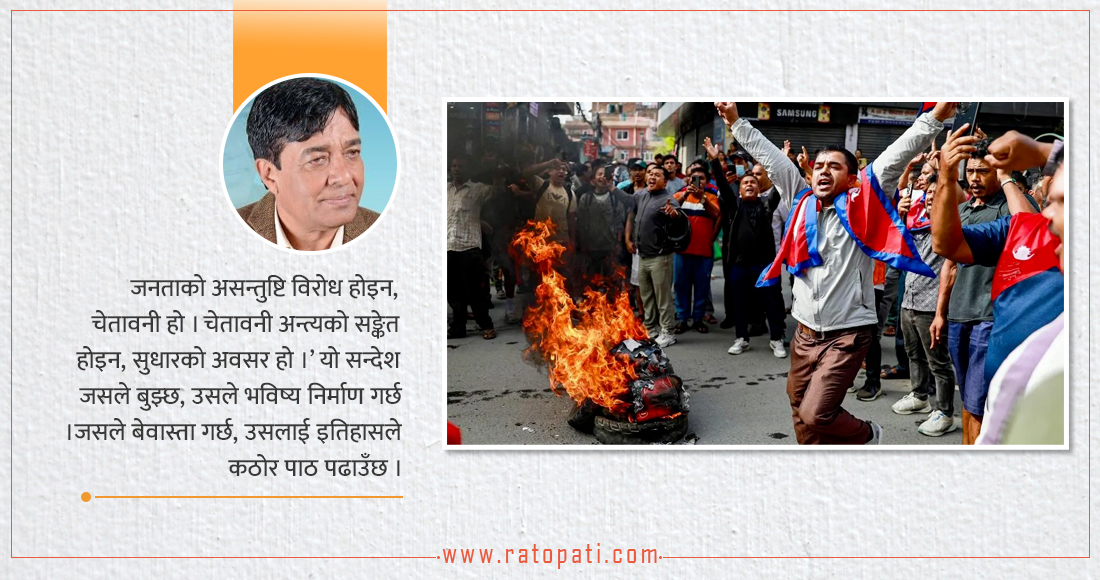
But the incident in Bhadra last year narrates the reality from a different angle. In those days, those who heated up the streets, those who spread agitation in the name of rebellion, those who incited crowds to the point of life-threatening situations, remained safe behind the scenes themselves. It was the helpless youth who were put forward—those who were carried away by emotion, lost in slogans, and pushed into the crowd before understanding politics—who became its victims.
The same Maoist leader said, 'We prepared the youth to die in the war. Youth who left their homes do not understand science; if they are not developed emotionally, they will not be ready to die.' This same psychology was seen used in the Bhadra agitation. Innocent school children were incited emotionally and used as political weapons. Plans are made in closed rooms, but the death is borne by the helpless youth on the streets.
The common youth were the ones throwing stones, clashing with the police, and ultimately facing bullets. But those who made the decisions and reaped the benefits remained at a safe distance. In the name of the death of 19 people, 57 more lives were lost. Who did this and why? Not much investigation into this is found. The commission of inquiry and the future will tell what the objective was behind this rebellion.
Now, as the elections of Falgun 21 approach, some political parties are using those incidents of Bhadra as their election agenda. Those who sent the youth to the streets are now chanting slogans as the 'voice of the victims.' What irony is this? Parties are campaigning by pasting posters of the deceased youth. They seek votes by displaying the pictures of those dead youths.
In the days to come, we must recognize those who trade in blood. The need of the hour is 'leadership that teaches to build the nation by sweating, not leadership that teaches to shed blood.'
They do not mourn the death of those youths; rather, they covet the sympathy that death brings for votes. They have made blood a subject of bargaining for political gain. As elections near, there is an attempt to divert the public's attention from development and good governance by talking about blood. This game of using blood as 'fuel' for politics must stop now.
A wrong narrative has been established in Nepali politics—that nothing happens without sacrifice. But why must the sons of the poor always be the ones to sacrifice? The children of leaders remain safe, while the children of the people die for rights. Nepali youth should no longer be 'shields'; they must become 'discerning.' If the country had been built by the politics of stones and bullets, Nepal would be the world's most prosperous nation today. But here, only graves have multiplied; the value of human life has not increased.
In the days to come, we must recognize those who trade in blood. The need of the hour is 'leadership that teaches to build the nation by sweating, not leadership that teaches to shed blood.' Before getting carried away by the excitement of speeches and throwing away lives on the street, one must think—does this sacrifice change the future of my family and country, or does it only secure someone's chair?
The time has come when politics that climbs to power by shedding blood should not endure. History may be written in blood, but the future of the nation is built only by planning, vision, consciousness, development, and peace. The Bhagavad Gita states—one must rise above the crowd seeking truth.
Chanakya Niti states, 'Truth is not always popular, but one should not abandon truth for popularity.' Science says, 'Truth is determined not by popularity, but by evidence and testing.' Therefore, it is best not to follow the crowd in search of truth, but to choose the path of conscience, courage, and reality. Politics conducted by selling the names of martyrs can never build a just society. The Nepal of tomorrow should not be a 'country that keeps adding martyrs,' but a 'country of happy and prosperous citizens.'
This specific news has been automatically translated by AI. As a result, there may be some inaccuracies or language errors.