
Nepal's Real Estate Sector Shows Revenue Growth in First Seven Months of Fiscal Year 2082/083

Kathmandu. After a long period of sluggishness, real estate transactions have returned to normal. Data from the first seven months of the current fiscal year (2082/083) indicates this trend.
According to the monthly statistics published by the Department of Land Management and Records, revenue collection from real estate transactions has increased by NPR 2.25 billion.
In the first seven months of the current fiscal year (Shrawan–Magh), revenue collected from real estate transactions totaled NPR 26.96 billion. This compares to NPR 24.71 billion collected during the same period in the previous fiscal year (2081/082).
The revenue collection from real estate transactions in the first 7 months of the current fiscal year has increased by NPR 2.2547 billion. This revenue growth rate is 9.12 percent higher than last year. Transactions from Shrawan to the end of Magh show encouraging improvement in the real estate sector.
Data from land revenue offices across the country shows a sharp increase in transactions in Magh this year compared to Magh last year.
According to the department's data, 153,920 real estate-related activities (deeds and other transactions) took place nationwide in Magh of the current year. In contrast, this figure was only 132,031 in Magh last year. This means there were 21,889 more transactions in Magh this year compared to last year.
However, transactions in Magh appear slightly lower compared to the previous month (Poush). While there were 162,877 transactions in Poush, the number decreased by about 8,900 in Magh. A slight slowdown was observed in Magh compared to Poush due to the winter season and seasonal effects.
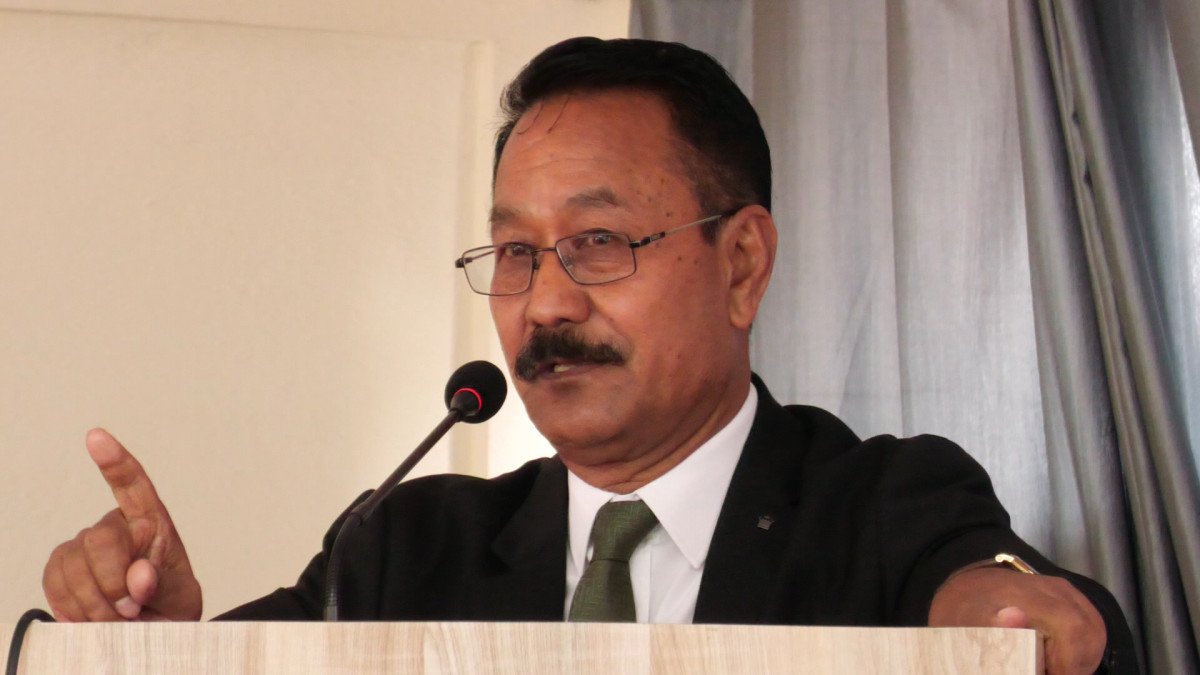
Bishnu Ghimire, Chairman of the Nepal Land and Housing Development Federation, stated that real estate transactions have gradually been improving recently. He analyzed that the market has become dynamic, especially after the ban on land demarcation (kitta-kat) was lifted.
Transactions saw a major decline during the festival season (Ashoj–Kartik). Transactions in Ashoj, which exceeded 100,000 last year, dropped to 79,000 this year. However, the market appears vibrant since the beginning of Mangsir, which helped compensate for the initial deficit, resulting in positive overall results for the 7 months.
Chairman Ghimire mentioned that real estate transactions are on the rise despite the government's strict measures. Ghimire said, 'I had previously stated that the market would grow once land demarcation opened. That is gradually happening now,' Ghimire stated, 'The fact that NPR 5.01 billion in revenue was collected in Magh alone, despite the government's tightening, shows the positive aspect of this sector.'
Ghimire complained that despite signs of market improvement, businesses and the general public are facing hardships due to banking policies. He noted that even though investable funds (liquidity) are accumulating in banks, it is difficult to obtain loans due to the cumbersome process of proving sources of income.
Ghimire said, 'Although the central bank has increased the limit for home loans, its justification is not apparent because of the inability to prove sources of income. In the current situation, even a serving secretary of the government, showing their salary, cannot get a loan exceeding NPR 3 to 4 million.'
Chairman Ghimire emphasized the need for flexibility in loan disbursement to make the real estate business more organized and dynamic. He suggested that banks should recognize self-declared income for loan applicants seeking up to NPR 30 million in housing loans.
'If a person takes a loan of 30 million to buy or build a house, the market would be much better if loans were granted based on self-declared income without scrutinizing the source of income,' he said.
Ghimire also mentioned that the upcoming elections would somewhat affect the market, stressing that regardless of which party forms the government, real estate transactions must be organized and integrated.
Highest Revenue in Poush, Lowest in Kartik
According to the department's data, the highest revenue from real estate transactions in the first seven months of the current fiscal year was collected in the month of Poush. Revenue exceeding NPR 4.2522 billion was collected in Poush alone. Similarly, due to the festival season, revenue collection in Kartik was the lowest, at only NPR 2.7040 billion.
In the last month, Magh, revenue collection reached NPR 3.8724 billion, which is slightly lower than in Poush.
Monthly Revenue and Transaction Details
An increase in overall real estate transaction volume and revenue collection is observed in the first seven months of the fiscal year 2082/083. Looking at the total transactions from Shrawan to Magh, the transaction volume this year (2082/083) has increased by 10,349 compared to the previous year. There were 856,290 transactions in the first 7 months of the current fiscal year, whereas there were 845,941 transactions in the same period last year.
The first four months of this year (Shrawan to Kartik) saw lower real estate transactions compared to the same months last year, but a sudden surge was observed starting from Mangsir. Transactions were higher than the previous year in Mangsir, Poush, and Magh.
Notably, Poush saw the highest number of real estate-related activities this year with 162,877, which is about 22,000 more than in Poush of the previous year.
There was a significant drop in transactions during the festival season (Ashoj–Kartik). Transactions in Ashoj, which exceeded 100,000 last year, dropped to 79,000 this year. However, the market appears vibrant since the beginning of Mangsir, which helped compensate for the initial deficit, resulting in positive overall results for the 7 months.
Monthly Comparative Details (Shrawan–Magh)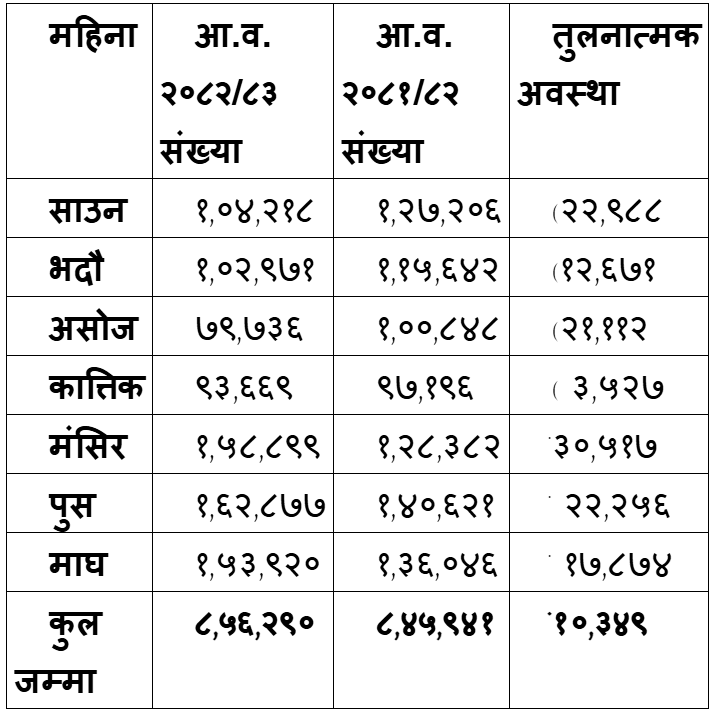
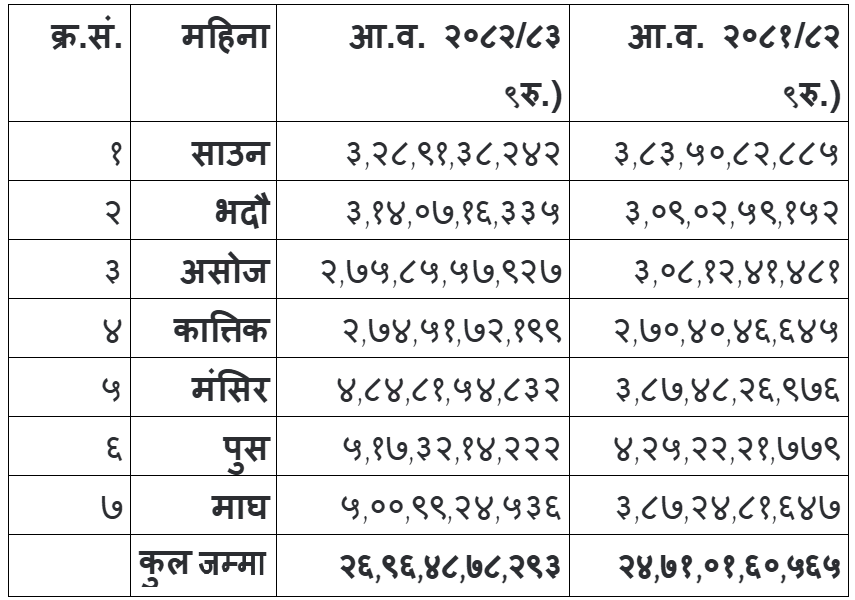
A similar trend is seen in revenue collection. In Shrawan, revenue collected from real estate transactions was NPR 3.835082885 billion.
In Bhadra, it was NPR 3.0902590152 billion, in Ashoj NPR 3.081241481 billion, in Kartik NPR 2.704046645 billion, and in Mangsir NPR 3.874826976 billion.
The highest revenue was collected in Poush, amounting to NPR 4.252221779 billion. In Magh, revenue slightly decreased to NPR 3.872481647 billion.
Comparative Details of Real Estate Revenue Collection (Shrawan–Magh)
Transaction Surge in Kalanki, Improvement in Bhaktapur and Lalitpur
Looking at real estate transactions in the federal capital Kathmandu Valley, the biggest leap is seen in the Kalanki Land Revenue Office.
At the Kalanki Land Revenue Office, only 2,344 real estate transactions occurred in Magh last year. This year, in Magh, this number has more than tripled to 7,436. Transactions in this office increased by 5,092 in one year. However, compared to 8,015 in Poush, there is a slight decrease in Magh.
At the Chabahil Land Revenue Office, there were 1,864 transactions in Magh last year, increasing to 2,284 in Magh this year. Transactions here increased in Magh compared to Poush (2,216).
The increase in transactions at the Kalanki Land Revenue Office is also attributed to all landowners under its jurisdiction needing to establish new records for their land.
During the 'Genji' agitation on Bhadra 23 and 24, the Land Revenue and Survey Offices in Kalanki were set on fire. Since all documents under that office were destroyed, new records are being established.
At the Bhaktapur Land Revenue Office, transactions increased from 3,146 in Magh last year to 3,687 this year. A slight decline is observed here compared to 3,892 in Poush.
At the Lalitpur Land Revenue Office, Lagankhel, transactions increased by 487 from 3,098 last year to 3,585 this year.
At the Chabahil Land Revenue Office, there were 1,864 transactions in Magh last year, increasing to 2,284 in Magh this year. Transactions here increased in Magh compared to Poush (2,216).
In Dillibazar, transactions increased from 1,156 last year to 1,352 this year. In Sankhu, transactions increased from 1,044 last year to 1,330 this year.
Terai Districts: High Pressure of Transactions in Nepalgunj and Inaruwa
Data shows that real estate transactions have flourished significantly in major cities of the Terai region outside Kathmandu. Transaction graphs are particularly rising in Nepalgunj, Banke, and Inaruwa, Sunsari.
The statistics from Nepalgunj, Banke, are quite interesting. Only 2,319 transactions occurred there in Magh last year. However, this number has reached 5,819 in Magh this year. Transactions increased by 3,500 in one year. This indicates high demand for real estate in Nepalgunj, the center of Western Nepal.
Overall analysis suggests that transactions have increased in major urban areas across the country—Kathmandu, Pokhara, Chitwan, Nepalgunj, Biratnagar, Jhapa—compared to Magh last year. The increase of over 22,000 transactions and rising revenue in Magh this year compared to Magh last year shows increased investor morale in the real estate sector.
At the Bhadrapur office in Jhapa, one of the highest transaction areas in the country, there were 6,648 transactions in Magh last year, compared to 6,644 this year. Transactions here appear stable.
In Inaruwa, Sunsari, transactions increased from 4,402 in Magh last year to 4,709 this year. Transactions here increased in Magh compared to Poush.
In Belbari, Morang, transactions increased from 3,930 in Magh last year to 4,550 this year. Transactions increased by 620 here.
In Janakpur, the capital of Madhesh Province, transactions increased from 3,029 last year to 3,131 this year.
At the Chitwan Land Revenue Office, transactions increased by nearly 1,000 from 2,758 last year to 3,729 this year. This data signals that the real estate market is heating up in Chitwan as well.
Sudurpashchim and Other Urban Areas
In Dhangadhi, the main center of Sudurpashchim, real estate transactions increased from 2,737 in Magh last year to 3,266 this year.
The real estate market has also improved in Pokhara, the tourist city of Kaski. Transactions increased from 2,457 in Magh last year to 3,178 this year.
Market Shifting from Bearish to Bullish
Overall analysis suggests that transactions have increased in major urban areas across the country—Kathmandu, Pokhara, Chitwan, Nepalgunj, Biratnagar, Jhapa—compared to Magh last year. The increase of over 22,000 transactions and rising revenue in Magh this year compared to Magh last year shows increased investor morale in the real estate sector.
Although transactions in Magh appear slightly lower than in Poush, this may mainly be due to seasonal reasons. However, the fact that transactions increased in Magh compared to Poush in some locations like Inaruwa and Chabahil confirms that the market is dynamic.
Data shows that Kalanki in Kathmandu and Nepalgunj and Inaruwa in the Terai have emerged as new 'hubs' for real estate transactions.
This specific news has been automatically translated by AI. As a result, there may be some inaccuracies or language errors.

-(2)_QJLjKxR87n.jpg)