Kathmandu Valley Chokes Under Thick Smog as Air Quality Reaches 'Unhealthy' Levels

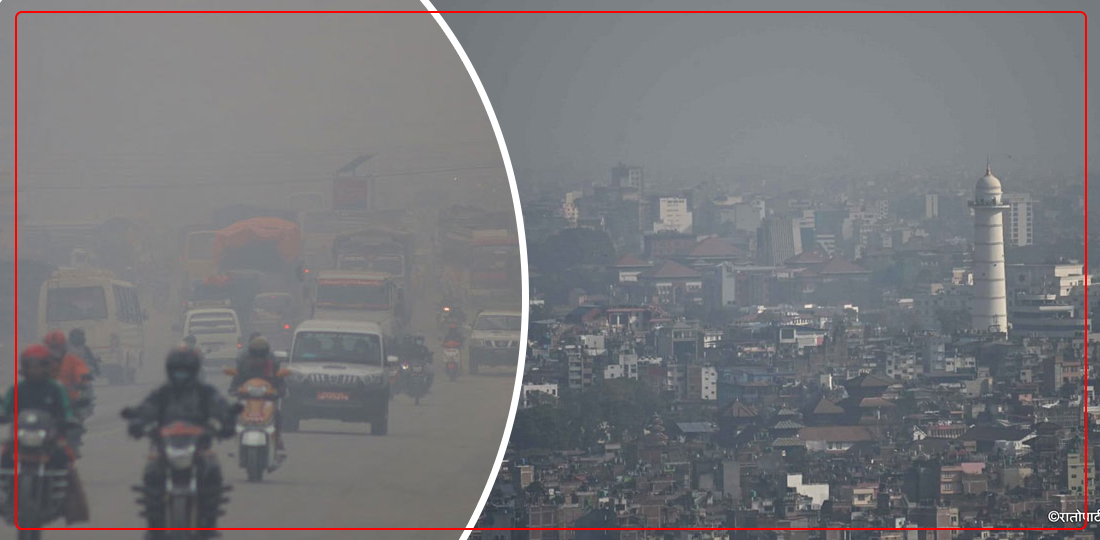
Kathmandu. The sky over the Kathmandu Valley has been covered by thick and hazy smog for the past few days. Although this problem increases with the onset of winter, it is now beginning to take the form of an annual public health crisis, appearing as a normal seasonal process.
According to public health and environmental experts, the air quality here is many times more polluted than the safe standards set by the World Health Organization (WHO), making it unfit for breathing. Health experts have warned that the ultra-fine dust particles and harmful chemical elements mixed in the air are causing serious and irreversible damage not only to the human respiratory system but also to the heart, brain, and overall physical health.
The situation appears very alarming when looking at the patient load in major hospitals in the valley recently. Due to the direct effects of pollution, there is an increase in difficulty breathing, chest congestion, nasal and throat allergies, and sudden exacerbation of problems for chronic asthma patients. According to Chest Specialist Dr. Raju Pangeni, while air pollution causes immediate problems like colds, throat infections, and itchy eyes, its long-term effects are even more frightening.
Prolonged exposure to polluted air significantly increases the risk of fatal diseases such as lung cancer, heart attack, and stroke. Children, the elderly, and pregnant women are particularly at high risk from this pollution.
The Air Quality Index (AQI) monitoring system for Kathmandu's air quality has shown alarming statistics recently. Until Wednesday noon, the air pollution in the Kathmandu Valley was measured at 192 AQI, which falls into the 'unhealthy' category from a health perspective. The pollution, which was 175 AQI on Sunday, rose to 192 on Tuesday. On Wednesday, it slightly decreased to 181 AQI. According to the Department of Environment, this rate is either stable or increasing rather than decreasing, forcing the residents of the valley to breathe toxic air.
According to Gyanraj Subedi, Director General of the Department of Environment, the main natural reason for this increase in pollution is the prolonged lack of rainfall and slow wind speed. Because it has not rained and the wind has not blown, the pollutants present in the lower layer of the atmosphere have not been able to disperse easily.

The unique geographical structure of the Kathmandu Valley further complicates this problem. According to Prof. Dr. Regina Maskey, who holds a Ph.D. on air pollution, the Kathmandu Valley's structure is like a bowl, surrounded by high hills on all sides. This geographical structure obstructs the natural flow of air.
Especially during winter, wind speed is very low, preventing fresh air from entering the valley and preventing the polluted air generated inside the valley from escaping. Because the hills trap the pollution, the valley becomes like a 'pollution pit.' During the summer months, the wind blows fast and there is monsoon rain, which washes away the pollution, but the dryness and stagnant air of winter cause this problem to persist for weeks. Prof. Dr. Maskey argues that the fine particles (PM 2.5 and PM 10) floating in the air remain in the atmosphere until it rains.
In addition to natural causes, human and industrial activities also play an equally significant role in polluting Kathmandu. Smoke emitted from industries, factories, and brick kilns operating within the valley, along with dust raised by rapid development construction works, are the main sources. Furthermore, toxic fumes from old vehicles and hazardous gases released from burning waste continuously degrade air quality.
According to Director General Subedi, not only local pollution but also cross-border pollution negatively affects the air quality in the valley. The situation becomes more dire when smoke from forest fires in neighboring countries or the Terai region, and industrial smoke, enter the valley via air currents.
According to Disaster Management Expert Dr. Dharmaraj Upreti, only an AQI from zero to 50 is considered good or safe for health (green signal). A level between 51 and 100 is considered cautionary (yellow signal), while a level between 101 and 150 directly affects respiratory and heart patients. A level between 151 and 200 is considered unhealthy for all citizens, which is where Kathmandu currently stands. If this level reaches 201 to 300, it is considered 'very unhealthy,' and a level above 300 is viewed as 'extremely dangerous' or a public health emergency.

- Policy Exists, But Implementation Lags
The government has introduced the 'Air Quality Management Action Plan, 2076' for managing air quality in the Kathmandu Valley. According to this action plan, if the AQI exceeds 300, the government is mandated to officially declare it a 'disaster.' In such a situation, emergency measures must be taken to reduce pollution, including a complete ban on open waste burning, accelerating the use of brooms and vacuums for street cleaning, and issuing public notices for citizens, especially vulnerable groups, to stay safe. However, despite formulating policies, the government has shown little interest in their implementation this year, as in previous years.
'The government should not just make policies; it must also focus on implementation. It has become like a yearly schedule, but the government seems unconcerned,' said activist Jyoti Baniya. She stated that the government is not serious even about the fundamental right of the general public to breathe clean air. She expressed dissatisfaction, saying the government is still working with a mere formality.

Experts say that even the current level of 192 AQI is very challenging for health, and it is already late to take precautionary measures.
The National Environmental Policy, 2076, also outlines a clear strategy for mitigating air pollution. Under this policy, the goal is to prepare and implement national standards to prevent pollution from water, air, soil, noise, and radioactive emissions. The government plans to map pollution risks in major cities and industrial areas and establish quality monitoring centers for continuous observation. However, while policies and action plans are excellent on paper, their effective implementation is always questioned.
Given the current situation, with little possibility of immediate rainfall, the level of pollution is expected to increase further in the coming days. The Department of Environment has advised relevant agencies to adopt sustainable and environmentally friendly development measures and to control industrial emissions.
This specific news has been automatically translated by AI. As a result, there may be some inaccuracies or language errors.