Coalition Governments in Provinces Face Crisis Amidst Political Maneuvering

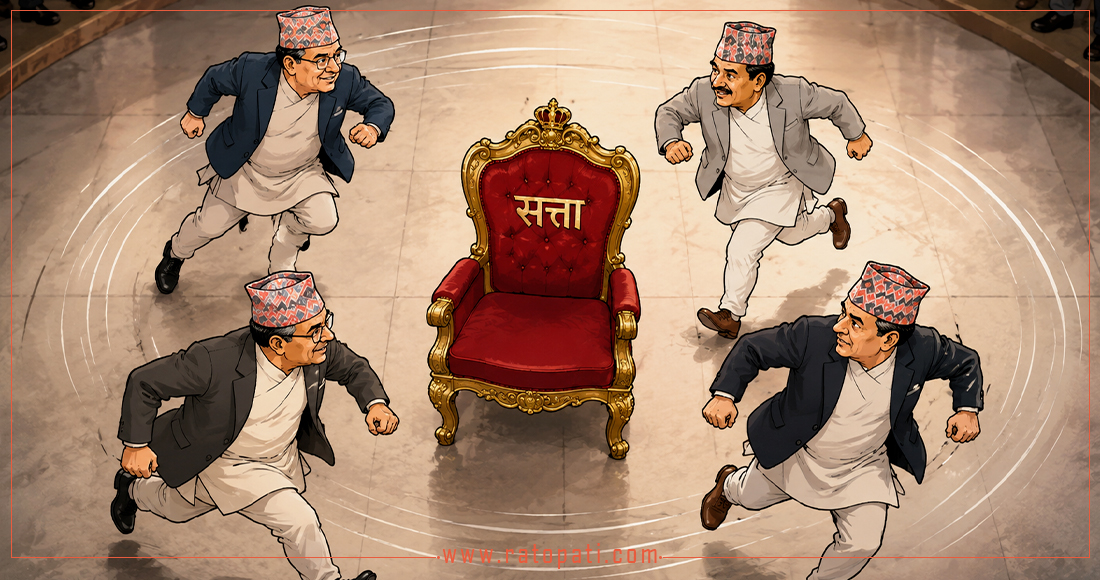
Janakpurdham. Until the Janji movement, there was a coalition of Nepali Congress and CPN-UML at the center. The same coalition also took power in the provinces. Although the coalition government at the center collapsed due to the Janji movement, the same coalition was continuing in the provinces.
Currently, the coalition of Nepali Congress and CPN-UML is in crisis in most of the provinces. In some provinces, that coalition has already broken, while in others, they are waiting for instructions from the center.
There is a situation where local level elections must be held in Baishakh. Although the term of the Provincial Assembly is until Mangsir 084, discussions are ongoing about the option of holding the Provincial Assembly elections along with the local level elections. In this situation, political parties, intellectuals, and civil society leaders are interpreting the change in power equations in the provinces to form governments according to their own interests as an extreme example of lust for power.
They have commented that while Rastriya Swatantra Party (RSP) is raising the agenda of abolishing the Provincial Assembly, the old parties continuing the same dirty game of power will further fuel the RSP's agenda.
Parmeshwor Sah, a leader of the Nepali Congress in Madhesh Province, said that although government changes are natural, the way governments are being changed now has further disappointed the public. He said, 'This instability has arisen because no party has a majority in the provinces. If there was a majority, this situation would not have arisen.'
He emphasized that while the game of majority is common in parliamentary practice, everyone should work to strengthen federalism, which came about after great sacrifice by the Madhesi people. He said, 'Madhesh has made great sacrifices to bring federalism; it cannot be abolished just because a particular party brings an agenda to abolish it.'
Bal Kishor Yadav, Chairman of the Madhesh Province of Janata Samajwadi Party, said that just because the coalition between Congress and UML is in crisis, the government cannot be left in a vacuum. He expressed the view that the political situation in the provinces has worsened due to the major parties.
Yadav said that one should not 'adventure' in politics and that the public is further disappointed due to the old parties.
He clarified that RSP's agenda of abolishing the Provincial Assembly is spoken only for its own interests, and although his party is a major party in Madhesh, it is fulfilling its duties from the role of opposition.
Surendra Rai, a central member of the Nepali Communist Party, complained that the country has reached this situation because the politics of Congress, UML, and Maoists are centered on power rather than for the people. He said, 'The old parties could not do anything. Now Balen is leading the country. He has to work according to the mandate given by the people.'
Expressing disgust towards the old parties, he accused Congress and UML, who have been alienated from federal power, of trying to play the game of forming and collapsing governments in the center and now in the provinces.
Local leader of UML, Babusaheb Yadav, said that the country has reached this situation due to lust for power. He said, 'The organization is tarnished due to the leaders at the center, and even ordinary workers have become tarnished.'
He said that making someone a minister and then changing the cabinet within 2-4 days without allowing them to work has further spread disappointment in federalism. Accusing Congress of causing the current change of provincial government, he claimed that if these parties do not mend their ways, they will be swept away from the provinces after the next election, just as they have been ousted from power at the center.
Meanwhile, intellectuals, professionals, and civil society leaders in Madhesh have said that the old parties are repeatedly engaged in the game of toppling and forming governments according to their own interests, which is having a negative impact on the public.
Intellectual Dr. Prof. Shailendra Narayan Mallik of Janakpur-10 said that such problems are arising in the provinces because the parties always want to remain in power. He said, 'RSP received up to two-thirds of the popular vote not because of the party, but due to the popularity of one person's work. The old parties should learn from this.'
Mallik stated that the public voted for RSP across the country to make him Prime Minister after seeing the work Balen did for the city's development as the Mayor of Kathmandu. 'If the old parties do not change their desire for power and dominance, they may face the same fate as the Congress and other parties in India, which are on the verge of extinction,' he said.
Local social worker Nawalkishor Karna said that the citizens' perception of federalism is changing due to the old parties. He said that while the old parties have always focused on power politics, they have once again initiated a move to change the government, which will help establish the agenda of abolishing the Provincial Assembly.
This specific news has been automatically translated by AI. As a result, there may be some inaccuracies or language errors.