NEPSE Restructuring Report Public; CEO Discusses Modernization and Technical Challenges

_kJWnyPQo5K.jpg)
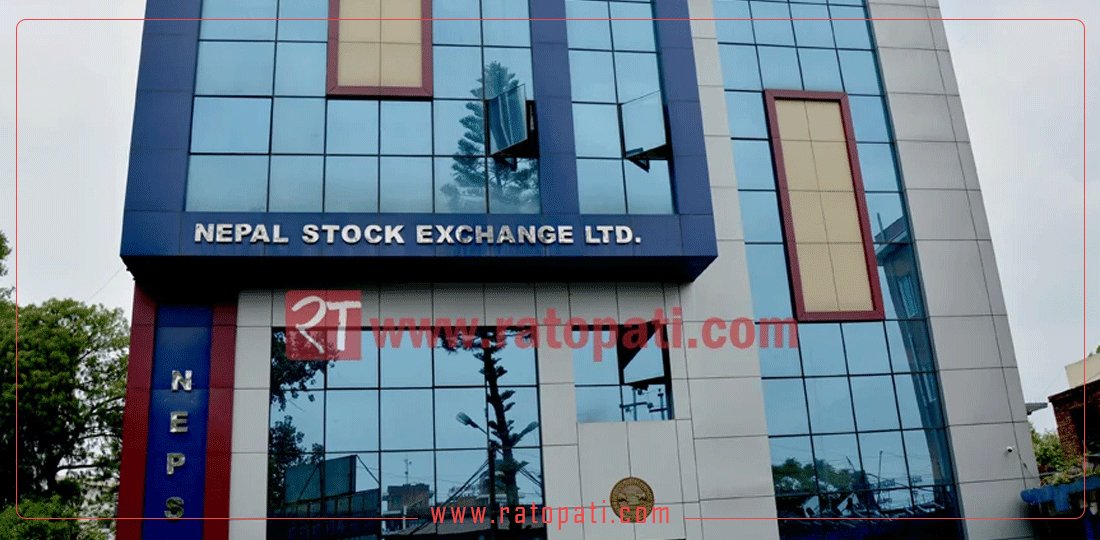
Kathmandu. The report submitted by the suggestion committee regarding the restructuring of the Nepal Stock Exchange (NEPSE) has been made public, which is the eighth study report concerning NEPSE's restructuring.
Finance Minister Rameshwor Khanal had formed a committee on Mangsir 2 last year to study and submit suggestions necessary for restructuring NEPSE, aiming to finalize the long-pending issue of NEPSE restructuring.
The five-member study committee, chaired by former Chairman of the Nepal Accounting Standards Board, Prakash Jung Thapa, submitted its suggestion report to Finance Minister Khanal on Poush 28. The NEPSE Restructuring Suggestion Committee has mentioned the issue of capital increase and investment expansion.
This is an edited excerpt of an interview conducted by Anish Mijar for Ratopati with NEPSE's Chief Executive Officer Chudamani Chapagain regarding the implementation of the report, the steps taken by NEPSE to modernize, make technology-friendly, and transparent the stock market, which is considered a mirror of the economy, and the future course of action.
- What is your opinion on the report regarding NEPSE restructuring?
– In recent decades, major stock exchanges around the world have transformed themselves from government or semi-government ownership to corporate and commercial formats.
From the New York Stock Exchange to the Bombay Stock Exchange, they have made themselves competitive in the global market through institutional reforms and state-of-the-art technological transformation.
In Nepal too, restructuring NEPSE has become an essential necessity, not an option, with the objective of making the capital market sustainable, secure, and trustworthy in the long run.
The Government of Nepal has been prioritizing the restructuring and divestment of NEPSE through its budget statements for the past few years. In continuation of this policy, we view the report submitted by the high-level committee formed as positive and timely.
The report outlines a roadmap not only for structural change but also for how to make NEPSE professionally competent.
_op7LC1RbYe.jpg)
Today, there are more than 5 million Demat account holders in Nepal. The increasing number of investors, their awareness, and their reliance on technology make it impossible to operate the market with outdated technology. As the size of the capital market expands, its risk management capacity must also increase proportionally. Therefore, we wholeheartedly respect the government's move to bring in a strategic partner and change its ownership structure in line with international practices.
NEPSE will be established as a dynamic financial institution, free from the procedural hassles typical of a government body. The NEPSE leadership is fully committed to implementing this as per the government's directives and suggestions.
- Recently, problems were observed in the TMS operated by brokers. What is the plan for addressing the problems and technical strengthening? How do you view the recurring issues?
– TMS is the main bridge connecting investors and the market. Even the smallest technical issue seen here directly affects investors' assets and trust.
Therefore, we have taken the recent technical problem with utmost seriousness. There can be no excuse for technical delays or systemic failures in the capital market.
We have taken immediate action as soon as the problem arose. Written clarification has been sought from the concerned brokers and the vendor providing TMS services. NEPSE has formed a high-level technical investigation committee. This committee is deeply studying the system's log files, network traffic, and software architecture.
We are preparing to take strict action once the committee's report is available. If negligence is confirmed on the part of the service provider or the broker, not only will a fine be imposed as per the rules, but the qualification of such vendors may also be questioned in the future.
We are now setting minimum technical standards for TMS. This will mandate aspects such as backup systems, disaster recovery, and real-time monitoring. NEPSE's objective is to ensure an environment where investors can trade confidently without any technical interruptions.
- What is your role regarding the restructuring of NEPSE and bringing in a strategic partner through divestment by the government?
– NEPSE is primarily owned by the Government of Nepal and the Nepal Rastra Bank. Changing its ownership structure and bringing in a strategic partner depends entirely on the policy decision of the Government of Nepal. In this process, NEPSE's role will be that of a facilitator and implementer.
Once formal directives and procedures are received from the government for implementation, NEPSE will adopt a highly transparent and professional process to make the necessary preparations.
The entry of reputable global stock exchanges or international financial institutions proficient in technology as strategic partners will bring significant changes to NEPSE's technical and managerial capabilities.
In this process, we will keep data security, national interest, and investor confidence at the center. NEPSE's mechanism is ready to implement the government's policy guidance.
- As CEO, after taking charge, you spoke about institutional governance and making NEPSE professionally governed and transparent; what work has been done in this regard?
– My core mantra since taking responsibility has been institutional governance. Where there is good governance, discipline and investor trust are automatically established. Making the internal work culture professional is my first priority.
In the past, there were certainly challenges in work performance due to some political/social movements in the country and internal demands of employees regarding bonuses.
But as the leadership, I ensured that there was not a second of interruption in NEPSE's service delivery. Despite internal disputes, we moved forward with the market operation uninterruptedly.
The monitoring system has been further modernized to prevent insider trading and abnormal fluctuations in the market. Practices of real-time information disclosure have been initiated to discourage listed companies from hiding or delaying information.
Designated channels have been established to promptly listen to and address investor grievances. The directive for technical security audits of brokers is in its final stage. Now, the software system of every broker will be regularly tested for security.
The regulation for a separate trading platform for small and medium-sized companies has been prepared and sent to the Securities Board. This will help startups and small industries in capital mobilization.
- The procedure for providing two ISIN numbers to companies other than banks and financial institutions is stalled at the Board. Why is this delayed?
– I wish to clarify this in my capacity as the Chairman of CDS and Clearing, rather than just the CEO of NEPSE. ISINs are provided internationally for the identification of securities. In Nepal, the practice is to provide ISIN numbers to banks and financial institutions according to their capital structure.
_I5CzhgvJWd.jpg)
We believe that applying this arrangement to other companies will bring further clarity to the market. However, after differing opinions arose among various market stakeholders on this matter, we prepared a draft of a clear ISIN directive and sent it to the Nepal Securities Board. As the Board is a regulatory body, it is likely studying the overall interest of the market and the legal aspects. We are awaiting the Board's decision.
Once the decision is made by the Board, it will further streamline dematerialization and the settlement process in the market.
- What challenges have you observed while working at NEPSE, and what are the plans for the future?
– There is no point in working where there are no challenges. I always say this. Every problem has an expiry date. Problems arise and they are also solved. The main thing is the leadership's patience and intent. My intent is always focused on the interest of NEPSE and the security of investors.
Work is underway regarding refining the current system or moving to new technology. Education programs will be conducted across the country to spread capital market knowledge to investors in rural areas.
Currently, our market is heavily dependent on banks and hydropower. Special incentive programs will be introduced to bring companies from the manufacturing, cement, tourism, and service sectors to the market.
- What is being done to expand the capital market and bring manufacturing industries to the market?
– The reform of the capital market is not possible through the efforts of just one person or one institution. It requires the collective effort of the Government of Nepal, the Ministry of Finance, the Securities Board of Nepal, NEPSE, CDSC, and brokers. We are all wheels of the same chariot.
To attract manufacturing industries to the capital market, we are facilitating the provision for them to issue shares at a premium price. The entry of real-sector companies will diversify the market and reduce risk.
NEPSE is working with 100% commitment on its part. We are moving forward with the goal of making Nepal's capital market one of the best and most transparent markets in South Asia, in collaboration with all relevant bodies.
This specific news has been automatically translated by AI. As a result, there may be some inaccuracies or language errors.
_OpOYENSORc.jpg)