Supreme Court Demands Original Evidence in Case Against Rabi Lamichhane Over Dropped Charges


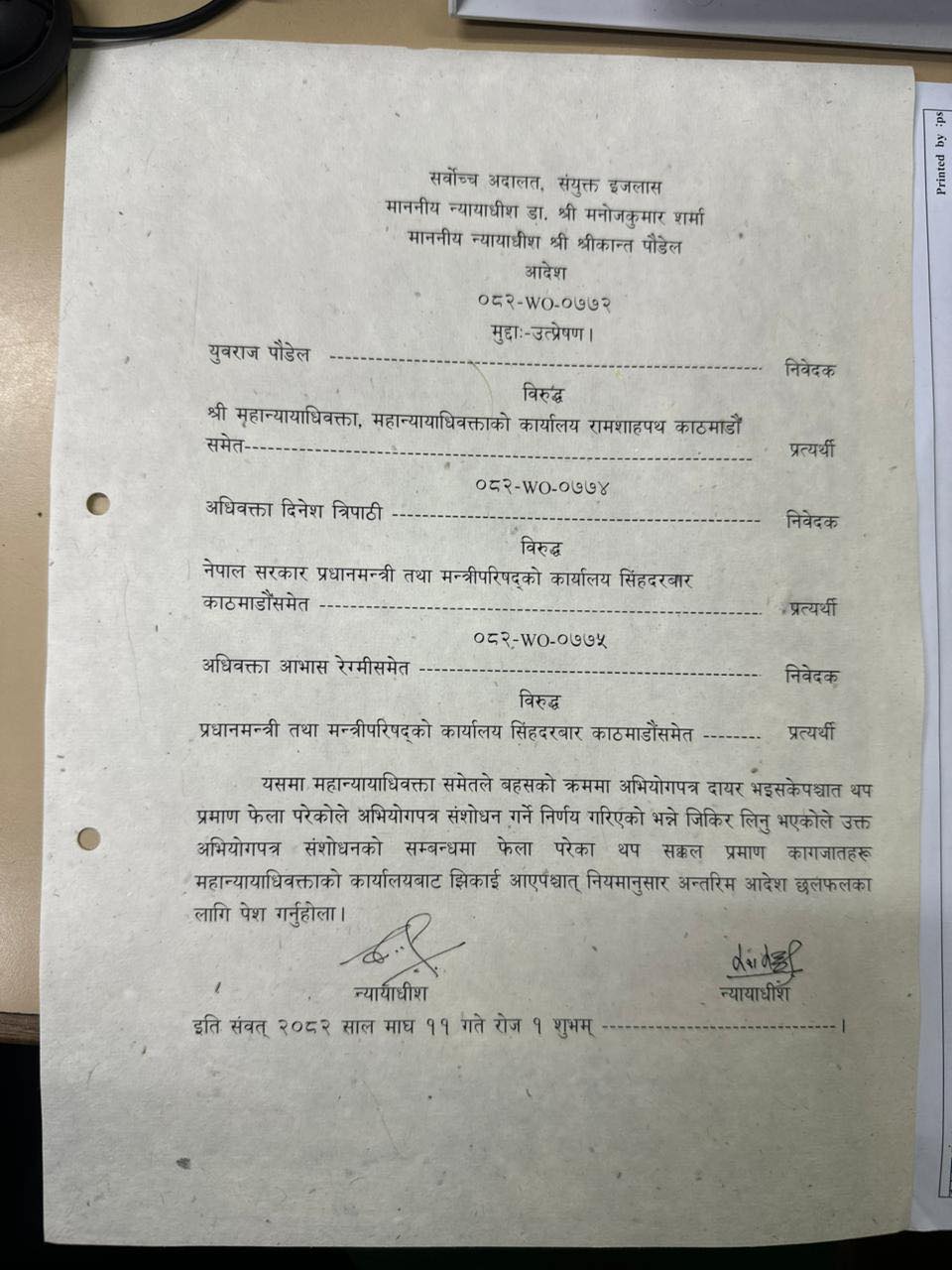
Kathmandu. The Supreme Court has ordered the summoning of the "original evidence" that served as the basis for the Attorney General's Office's decision to drop or amend the charges of "money laundering" and "organized crime" filed against Rastriya Swatantra Party Chairman and former Home Minister Rabi Lamichhane.
Hearing the case on Sunday, a bench comprising Justice Manojkumar Sharma and Justice Shrikanta Paudel ordered the summoning of the original copy of the "additional evidence" used to justify the amendment of charges against Rabi. Although the decision copy from the Attorney General's Office has already reached the bench, the court has specifically demanded the original documents of the new evidence claimed to have been the basis for the decision to amend the charges.
The Muluki Criminal Procedure Code, Section 36 (1), stipulates that if, after a case has been filed in court, additional evidence is found, necessitating an amendment to the initial claim, the relevant government lawyer, with the approval of the Attorney General, may apply to the concerned court of the initial level, stating the reasons, to amend the indictment.
Sub-section (2) of the same section mentions that if an application is filed under sub-section (1) and the contents are deemed appropriate, the court may order an amendment to the indictment. However, the decision by the Attorney General's Office does not clearly state what "additional evidence" was found in the case of organized crime and money laundering against Lamichhane that necessitated the amendment of charges. The phrase "if additional evidence is found" in Section 36 (1) is generally understood to mean that the offense or penalty can be added, not reduced.
- Arguments of the Petitioner and the Government Side
Senior Advocate Dinesh Tripathi, representing the writ petitioners, argued that amending someone's indictment based on political influence is a serious violation of the rule of law. He told the bench, "In the eyes of the law, no one is superior or inferior. The Attorney General taking a selective decision to withdraw or amend the case contrary to the precedents established by the Supreme Court is a violation of the law itself."
Law student Ayush Badal, echoing the arguments of Senior Advocate Tripathi, also demanded that the decision of the Attorney General's Office be overturned.
Following the petitioners' arguments, Attorney General Savita Bhandari (Baral) informed the bench that she made the decision to amend the case to ensure the return of the victims' money. "Your Honor, they talk about the country being put on the grey list, but I made this decision to ensure the victims receive their money," she told the bench. "The decision to amend the case was made because sufficient evidence to proceed with the original filing was not apparent."
The question has arisen whether the Attorney General's Office's decision to withdraw the money laundering and organized crime charges against Lamichhane is contrary to the precedents set by the Supreme Court. Legally, the Attorney General's Office does not have the authority to directly withdraw an indictment.
Nevertheless, Attorney General Bhandari has already directed the concerned District Government Attorney's Offices to amend the two charges related to money laundering and organized crime, connected to cooperative fraud, which had already been heard and preliminary orders issued by the courts in Kaski, Rupandehi, Kathmandu, and Parsa districts. However, since a writ petition regarding this matter is currently pending in the Supreme Court, the District Government Attorney's Offices have not yet submitted applications to the respective courts to amend or withdraw the cases.
This specific news has been automatically translated by AI. As a result, there may be some inaccuracies or language errors.
_wNIRIr8xqE.jpg)
_wqJwwAzuWG.jpg)

_Mks4af4WAR.jpg)