Did 1.4 billion Chinese achieving poverty alleviation cut into Washington’s cake?

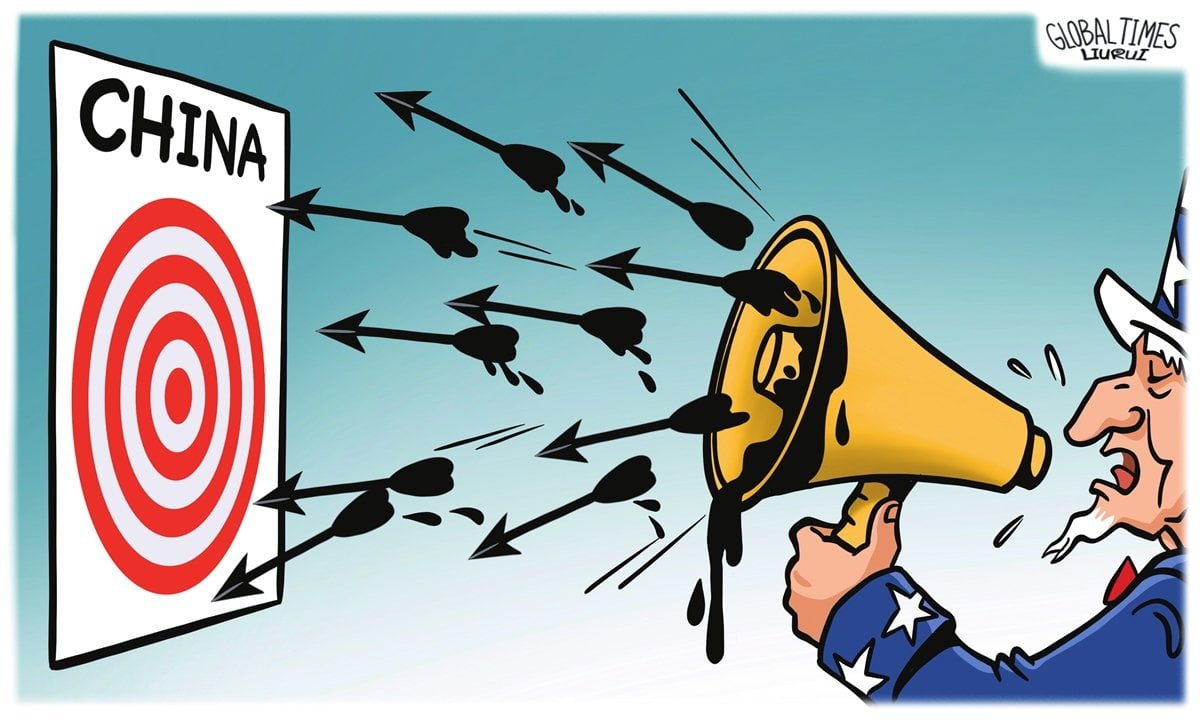
The hopeless fault-finder. (Illustration: Liu Rui/GT)
These days the People's Republic of China is celebrating its 75th anniversary. Over the past 75 years, China has grown from a poor and backward country to the world's second-largest economy, with about one-sixth of the world's population escaping poverty.
However, as China continued to rise, the US' attitude toward China has changed dramatically. Be it the "China threat" narrative or the "China challenge" theory, US politicians have become increasingly anxious about China's development. This anxiety has turned into slander and attempts to portray China as a force threatening global development.
Recently, a former American government official claimed that China aims to impose its ideology on the rest of the world, posing an unprecedented threat to the US.
Over the past few years, many US politicians have stressed the threat of China. But what exactly has China's development taken away from the US?
When China was still a poor and backward country, the US never worried about China's ideology "threatening" the world. However, as soon as China achieved economic takeoff, US politicians began exaggerating China's "ideological threat."
Over the past 75 years, if China's ideology had been detrimental to development and harmful to its own and the world's progress, China would not be standing so proudly before the US today. China's development demonstrates that its ideology contributes to global growth, as proven by its achievements.
Even though China has become the world's second-largest economy, its per capita GDP is still far below that of the US. In 2023, China's per capita GDP was about $12,720, while the US was about $76,000, nearly six times higher. China must continue to advance steadfastly on its chosen path of development.
In 2020, the US Strategic Approach to the People's Republic of China (May 20, 2020) read, the CPC has "accelerated its efforts to portray its governance system as functioning better than those of what it refers to as 'developed, Western countries.'" Based on this assumption, then such competition should contribute to global development. Indeed, only through such competition can we show that human development is a diverse process. Every country has the right to choose its own path of development.
Isn't it good for humanity if more countries develop through self-reliance like China? China has always adhered to the principle of non-interference in other countries' internal affairs and has never attempted to export its ideology to other countries. However, China has proven that a country can achieve economic takeoff and social progress without copying Western models.
This successful approach has shaken the long-held discourse power and dominance of the West, especially the US, thus posing a significant challenge to the US' global strategy.
Suppose the development model and path advocated by the US are no longer the only correct ones. In that case, the foundation of its global strategy and influence will be shaken.
When some US politicians claim that China's ideology poses a threat, they are actually making excuses for Washington's hegemonism. The "rules-based international order" in the mouths of American politicians is actually an order where the US makes the rules and other countries obey. Any country that attempts to challenge this order, regardless of its intentions, will be labeled an "ideological threat."
China has chosen a suitable path for itself and achieved great success. This success should not be a reason for demonization. If Washington cannot accept and recognize a prosperous and stable China and tries to set China as an opponent or even an enemy of the US, that would be a huge threat to world peace and development.