
'Donkey: Sapana Ko Kalbato' Explores Illegal Immigration and Human Struggle

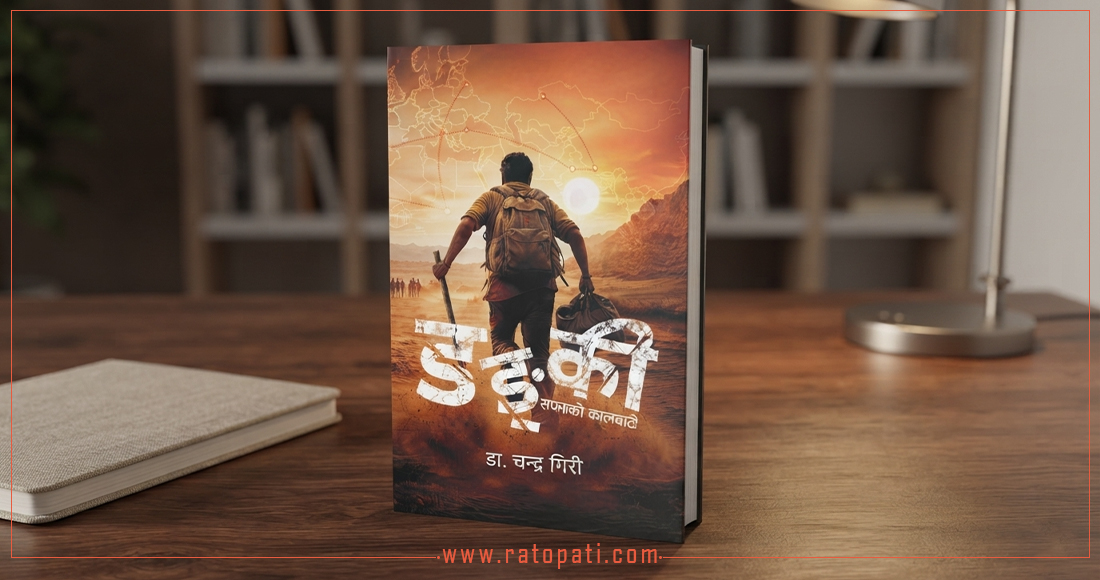
The purpose of literature is not just to tell a story, but also to express the inner workings of time. The permanence of a work lies not in the thrill it creates, but in the depth of the questions it raises. By this measure, Dr. Chandra Giri's 'Donkey: Sapana Ko Kalbato' emerges as a distinct intervention in contemporary Nepali fiction.
It does not merely tell the story of illegal immigration; it dares to encompass global inequality, the dream-psychology of Nepali youth, the paradox of modern civilization, and the struggle for human existence within a single narrative.
'Donkey' itself is a symbol. Though not the name of a route, it is essentially the name of a helplessness born out of deprivation. It is a symbolic expression of the perilous journey undertaken towards foreign lands after the death of opportunity in one's homeland. Thus, in this novel, America appears more as a psychology than a geography. As critic and journalist Rajkumar Baniyan said at the book launch ceremony, 'America is not just a superpower country, it is a mentality,' and 'Donkey' is a work that reflects this mentality.
Reaching America is not the achievement in the work; the price paid to reach America is the main narrative. Viewed from this perspective, 'Donkey' is not a celebration of the growing obsession with America in Nepali society, but a ruthless examination of it.
The theme of 'Tallo Bato' (lower path) is not entirely new in Nepali literature. Earlier, Krishna Dharabasi's 'Tallo Bato' had already introduced this subject to literature. However, Dr. Giri's 'Donkey' has provided it with a much broader geopolitical context, authenticity of research, and density of experience. At the book launch ceremony, Krishna Dharabasi himself expressed that 'Donkey' was more authentic and lively than his own work. Such an admission from an established novelist is not mere praise; it is also respect for the depth of the subject matter, the diligence of research, and the credibility of the narrative. Therefore, there is no hesitation in considering 'Donkey' as one of the most mature, authentic, and sensitive works in the Nepali language on this subject.
The novel's core strength lies not in its plot but in its experiential truth. The author does not recount a list of events to the reader; they draw the reader along on the journey. The journey, which begins in Salkpur, Ilam, and passes through India, Russia, Spain, Brazil, Colombia, Panama, Costa Rica, Nicaragua, Honduras, Guatemala, Mexico, and finally reaches America, not only changes geography but also progressively tests the human soul, beliefs, and endurance. This journey is not just about crossing borders; it is also a difficult ascent from illusion to reality.
The most robust aspect of the work is its experimental craftsmanship. Fiction, travelogue, memoir, diary, and research are so intertwined that it is difficult to distinguish their separate boundaries. Deviating from the linear structure of traditional fiction, the author has made the journey the backbone of the story. At times, characters speak; at times, nature; at times, memory; and at times, time itself. This structural novelty gives 'Donkey' a distinct identity amidst the crowd of contemporary Nepali novels.
The linguistic aspect of 'Donkey' is another of its features: its simplicity. The language is not burdened by unnecessary ornamentation, yet it possesses a wonderful ability to create imagery.
In the novel's emotional structure, the 'Darien Gap' is not just a place, but the philosophical center of the entire work. There, the mask of civilization falls, and humans confront their primal existence. The struggle for survival amidst dense forests, swamps, hunger, the dread of death, and an uncertain future poses an uncomfortable question to the reader – how civilized is civilization, really? Why must humans undergo such an inhumane ordeal to achieve their dreams? This question transforms the novel from a mere account of an adventurous journey into a discourse on human existence.
The author's scientific background is clearly felt here. The description of nature is not for aesthetic appreciation; it is imbued with sensitivity towards ecology, environmental consciousness, and a vivid sense of geography. Forests, rivers, mountains, and deserts are not lifeless backdrops here; they are silent companions who suffer alongside the characters. Such a balanced fusion of literature and science is rarely seen in Nepali fiction.
Linguistically, another characteristic of 'Donkey' is its simplicity. The language is not weighed down by unnecessary embellishments, yet it has an amazing ability to create scenes. The author shows the reader scenes, narrates the environment, and makes them feel the pain along with the information of the events. This is why, while reading the novel, images remain in memory more than words. In the words of novelist Dharabasi himself, this work is such that once you start reading it, you cannot put it down, and you cannot keep it aside for months saying you'll read it later.
However, 'Donkey' also has some limitations. In some instances, the details of places, routes, and processes are so extensive that the narrative's momentum feels slowed down for a moment. Some characters emerge as impactful, but their psychological development remains relatively brief. In particular, there was potential for the author to delve deeper into the existential conflict, cultural struggle, and the true evaluation of dreams after reaching America.
'Donkey: Sapana Ko Kalbato' is not a story of reaching America; it is a story of what a person loses before reaching America.
But, these limitations seem minor in the face of the work's overall value. Because the main achievement of 'Donkey' is not its plot; it is its ideological starting point. It questions the deepening migration-psychology in Nepali society. It neither condemns the aspiration to reach America nor considers it the ultimate door to freedom. Rather, it asks – why does a young person find a perilous route thousands of kilometers away from their homeland more credible? This question encapsulates the novel's political, social, and ethical consciousness.
Another notable aspect of 'Donkey' is its human compassion. No character shines as a hero; all characters are ordinary people struggling with their own destinies. Their tears are private, but their suffering is collective. This collective suffering transforms the novel from an individual's journey into the history of a generation. In this sense, 'Donkey' is the invisible diary of Nepali youth – where every page holds dreams and dread, hope and deprivation.
Ultimately, 'Donkey: Sapana Ko Kalbato' is not a story of reaching America; it is a story of what a person loses before reaching America. It is more a test of the soul than a journey across borders. It does not show the reader America; it shows them the failure of their own society, their own state, and their own time. Good literature leaves behind more questions than answers. This is also the greatest success of 'Donkey' – it keeps the reader restless even after closing the book.
Therefore, 'Donkey' can be confidently considered a memorable work of contemporary Nepali literature, one that elevates the discourse on immigration, is built on a confluence of research, experience, and artistry, and can engage in a long dialogue with time.
This specific news has been automatically translated by AI. As a result, there may be some inaccuracies or language errors.



_3Po4PXPkov.jpg)
