23rd National Paddy Day Celebrated with 'Climate-Friendly Technology, Self-Sufficiency in Paddy, and Prosperity' Theme
Rice, the main food source for more than half of the world's population, is an important cereal crop. Nepal ranks 17th in the world in terms of rice production. In Nepal, rice cultivation can be successfully done at altitudes ranging from 60 to 3050 meters above sea level, and it is also known as the country that cultivates rice at the highest altitude in the world.
Archaeological evidence shows that rice cultivation began about eight to ten thousand years ago. Among the approximately 24 wild and cultivated species belonging to the Oryza genus, two main species are cultivated. Most of the world's rice falls under Oryza sativa, while the rice cultivated in West Africa falls under the species Oryza glaberrima.
Among the major subspecies of Oryza sativa, 'Indica', which has long grains, is suitable for tropical and subtropical regions, and is widely cultivated in South Asia including Nepal, India, and Bangladesh. Similarly, 'Japonica', which has short and long grains, is suitable for cold and temperate regions, and is widely cultivated in Japan, Korea, and parts of China. 'Javanica', which has tall plants and large grains, is found in Southeast Asia.
In the context of Nepal, rice is cultivated in two seasons: Chaite and Barkhe. Among these, the Barkhe paddy is predominantly cultivated. It is observed that 5.955 million metric tons of paddy are produced in an area of approximately 1.42 million hectares, with a productivity of 4.19 tons per hectare.
The agricultural sector accounts for 25.16 percent of the country's total GDP, and the annual growth rate of the agricultural sector in the total GDP is 3.28 percent, according to the National Statistics Office, 2082. For the fiscal year 2083/084, the government has allocated a budget of 46.92 billion rupees for the agriculture and livestock sector, of which 32.46 billion rupees have been set aside for the supply of chemical fertilizers.
Approximately 57.3 percent of the country's total population is engaged in agriculture. Rice, which ranks first among Nepal's major cereal crops in terms of area, production, and productivity, plays a significant role in food security. Rice, which is directly linked to poverty alleviation, food security, sanitation, and sovereignty in Nepal, also indirectly connects with our culture.
As the spring season's new sprouts arrive with the advent of summer, nature bestows upon us the great festival of 'Asar'. This is a great festival for farmers who toil the soil with their bare hands.
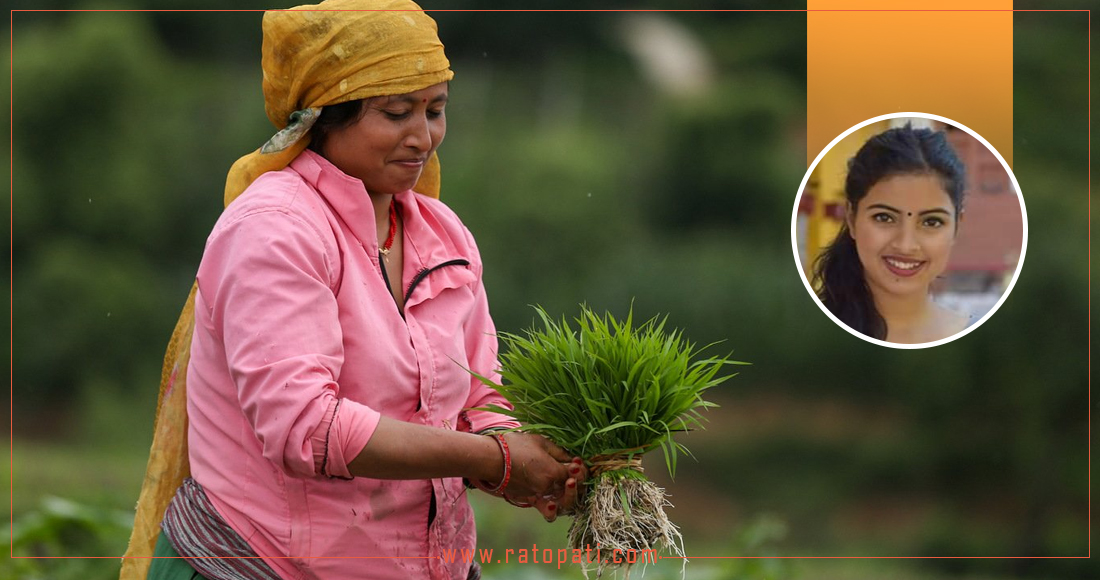
Although rice cultivation has been practiced in Nepal for about two to three thousand years, the government declared every Asar 15th as National Paddy Day in 2061 BS. Similarly, on Asar 15, 2083 BS, the 23rd National Paddy Day and Plantation Festival is being celebrated with the main slogan 'Climate-Friendly Technology, Self-Sufficiency in Paddy, and Prosperity'.
The government declared the celebration of Paddy Day every year to make the country self-sufficient in rice production, uplift the living standards of farmers, and promote exports by replacing rice imports. As the youth population is migrating abroad, arable land is becoming fallow. With the increasing rate of migration, villages are becoming empty. As people are increasingly attracted to foreign employment and urban development, arable land is now covered with bitterweed and pungent weed.
As the new sprouts of spring arrive with the advent of summer, nature bestows upon us the great festival of 'Asar'. This is a great festival for farmers who toil the soil with their bare hands. From huts to palaces, from the have-nots to the haves, from the proletariat to the capitalists – every Asar 15th reminds us of the great farmers who provide sustenance to all these classes.
Celebrating Paddy Day means to specially remember the importance of food, farmers, and food security, not just to present oneself in the guise of a farmer for a day.
Every year, as the drizzling rain beckons and the cuckoo's melodious song echoes, we should understand that Asar has welcomed us. The current trend of leaving one's own arable land fallow and subsisting on imported rice may not lead to a long-term food crisis.
If we fail to accept this unique time of nature, Asar will not forgive us in the future. All Nepalis who have left their villages for cities, and their countries for abroad, carry the warmth of their homeland in their hearts. Asar brings us back to our villages, reminds us of the soil, and enhances our proximity to nature.
Asar is also a very important month from the perspective of biodiversity. Today, due to imported and hybrid rice varieties, our indigenous rice varieties are on the verge of extinction. It is equally the responsibility of the state to conserve the indigenous rice varieties that have been overlooked. Rice is not only important in terms of food but is also closely associated with our culture. Varieties like Anadi, Jhinwa Basmati, Jumli Marshi, Pokhareli, Jethobudho, and Jarneeli have been used in our festivals and hospitality.
However, in recent times, as hybrid varieties are replacing them, the plantation of indigenous rice varieties in Asar is found to be very low. The National Agricultural Genetic Resources Center (Gene Bank), Khumaltar, is engaged in the collection, conservation, and promotion of indigenous rice varieties. Nevertheless, as indigenous rice varieties disappear at the farmer level, there is a fear that our very existence might be erased.
Agriculture is the first profession that humans adopted in the history of social development. The plow, yoke, hoe, and spade are being transformed by mechanization today. As the world dons the cloak of development, it is natural for our farming system to improve in a timely manner. However, even today, the alternative to food in the world is food itself.
The Bhagavad Gita, in its third chapter, verse 14, states:
Annabhavanti bhutani parjanyadannasambhavah.
Yajñadbhavati parjanyo yajñah karmasamudbhavah..
Meaning, all beings subsist on food. Food is produced from rain, and rain is produced from sacrifice (good deeds). In this verse, Lord Krishna clarifies the mutual relationship between nature, humans, and actions.
Celebrating Paddy Day means to specially remember the importance of food, farmers, and food security, not just to present oneself in the guise of a farmer for a day. Although paddy transplantation is taking place in most of the irrigated fields in the Terai, a large portion of arable land in the mid-hill districts remains fallow even in Asar.
Although the government has put forward the concept of collective farming through land consolidation of fallow land, it has not been fruitful. Due to the inability to attract the youth population to the farming profession, it seems very difficult to find real farmers in the coming days. It is a challenge for the middle-class youth to start an agricultural business from scratch.
As long as the farmer's sweat flows in the fields, the country's kitchen will not be empty. May the 23rd National Paddy Day and Plantation Festival 2083 inspire us all to be more responsible towards food, farmers, and agricultural culture.
Excessive rainfall, drought, and insufficient rainfall have created risks and uncertainties in the agricultural sector, which is evident everywhere. The agricultural sector, which is bearing the brunt of climate change, is also weakening the morale of entrepreneurs involved in agricultural enterprises. Programs such as crop insurance, subsidized loans at low interest rates, and grants based on current and capital expenditures are being implemented by government agencies, although they are not sufficient.
As the government imports a huge quantity of rice every year, there is no alternative but to improve the current farming system. By selecting climate-friendly varieties, using agricultural mechanization, and utilizing arable land to the maximum through collective farming, rice production can be significantly increased.
A tripartite collaboration between the state, the private sector, and farmers is necessary to reduce production costs, increase productivity, and make market management effective. Only by developing the agricultural sector as a respectable, dignified, and income-generating profession can the younger generation be attracted to this sector.
As long as the farmer's sweat flows in the fields, the country's kitchen will not be empty. May the 23rd National Paddy Day and Plantation Festival 2083 inspire us all to be more responsible towards food, farmers, and agricultural culture.
May our folk songs, Asare songs, traditional tools like the plow and yoke, and agricultural culture be preserved. Let there be a joint effort from the state, community, and farmers in the conservation and promotion of indigenous rice varieties. Happy National Paddy Day!
'Farmers are the soul of the nation, agriculture is our pride
Without working, there is no food, morning and evening!'
(Devkota is a Horticulture Development Officer working at the Agriculture Development Office, Dhading.)
This specific news has been automatically translated by AI. As a result, there may be some inaccuracies or language errors.