Bagmati Government Formation Efforts Intensify Amid Shifting Alliances

Makwanpur. With the change in the power equation at the center, efforts to form a new government in Bagmati Province have intensified.
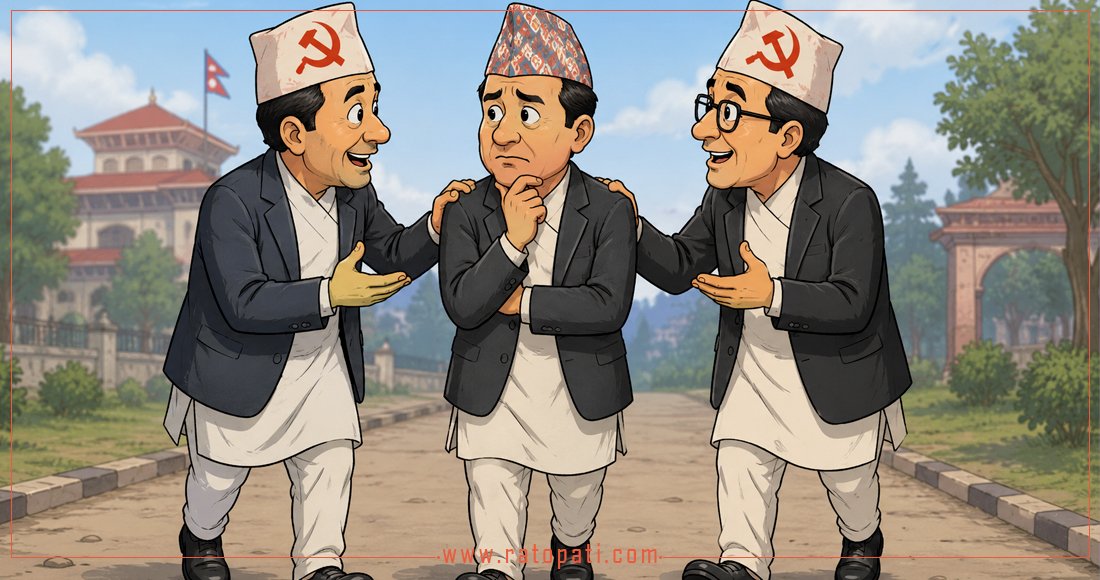
As no alliance is certain to achieve a comfortable majority, leaders from the Nepali Congress, Communist Party of Nepal (Maoist Centre), and CPN (UML) have become active in wooing smaller parties.
The Congress, which aims to continue the current government, and the UML and Maoist Centre, which are eager to form a government according to the new alliance, are in a race to bring smaller parties to their side. On Monday morning, UML leader Jagannath Thapaliya, Maoist Centre leader and former Chief Minister Shalikram Jammakattel, former minister Kiran Thapa, and Prakash Shrestha held discussions with Shailendraman Bajracharya, leader of the 'Our Nepali Party' (HaNePa), which has 2 lawmakers. In the discussion, UML-Maoist Centre leaders claimed that there was no possibility of a Congress-led government and urged Bajracharya to cooperate with them.
Meanwhile, the Rastriya Prajatantra Party (RPP), with 12 seats in the Bagmati Provincial Assembly, appears to play a decisive role in government formation. Leaders from the UML and Maoist Centre have been holding discussions with the RPP repeatedly. However, both parties are in a state of anxiety as the RPP has not given a clear answer so far. The UML and Maoist Centre leaders have become more apprehensive due to the RPP raising questions about the treatment they received during past power-sharing arrangements.
The situation, where the new alliance is compelled to include the RPP at any cost, seems to provide support to the Congress. The RPP is not part of the current government's arithmetic. According to an RPP lawmaker, the RPP is discussing future partnerships rather than the immediate crisis.
Meanwhile, the Nepali Congress also appears active in dialogues with smaller parties for the continuation of a government led by itself. The Congress has been in continuous dialogue with the RPP and Our Nepali Party. According to a Congress lawmaker, Congress leaders appear optimistic, claiming to have received a positive response from the RPP. He stated that information regarding the continuation of the government would be available in a few days after decisive talks. He also mentioned that the Congress has urged the Nepal Mazdoor Kisan Party (NMKP), which has consistently played the role of the opposition, to support the government.
In the 110-member Bagmati Provincial Assembly, 53 lawmakers are required to form a government out of the 104 currently present. The Congress has 36, the UML has 25 (including the Deputy Speaker), the Maoist Centre has 26, the RPP has 12, the NMKP has 3, and Our Nepali Party has 2 lawmakers.
According to the central equation, the UML and Maoist Centre together have only 51 seats, which is 2 seats short of a majority. Therefore, the support of the RPP or Our Nepali Party is essential for the new alliance.
The Congress, on the other hand, has initiated efforts to form an alliance without the Maoist Centre and the UML. The Congress is striving to form a government by securing 53 seats with an alliance including the RPP, NMKP, and HaNePa.
This specific news has been automatically translated by AI. As a result, there may be some inaccuracies or language errors.