
Saudi Arabia Imposes Controversial Skill Certification Program on Nepali Workers

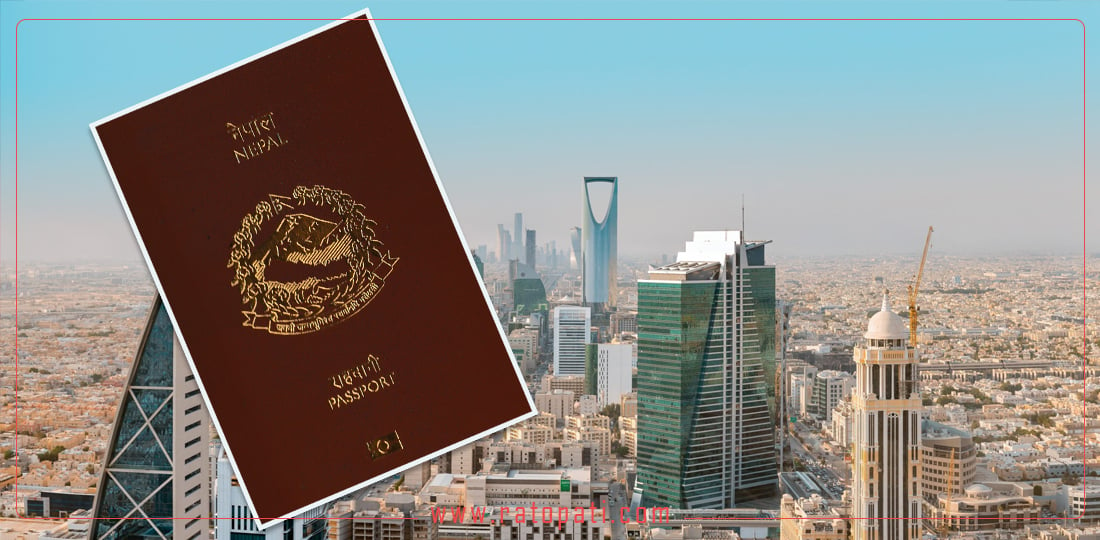
Kathmandu. Saudi Arabia has forcibly implemented the controversial Skill Certification Program (SVP) for Nepali workers.
Despite repeated requests from the Ministry of Youth, Labour and Employment and strong opposition from overseas employment entrepreneurs, Saudi Arabia has forcibly implemented the Skill Certification Program (SVP).
The Saudi Arabian side has sparked outrage in the field of overseas employment by starting to collect fees through private companies, disregarding diplomatic courtesy.
The ministry had formally requested the Saudi side not to implement this program immediately. The Saudi Ambassador had also committed to the minister during a meeting not to proceed with the program. Despite this, it has been revealed that the Saudi Embassy has secretly mobilized private companies and is pressuring manpower entrepreneurs to pay between 50 to 100 US dollars per worker.
Manpower entrepreneurs have informed that the Saudi side has moved forward with the program in a digital format, which the government had asked to be postponed. Currently, manpower entrepreneurs are being sent emails stating that they have to pay a fee of 50 US dollars (approximately 10,000 rupees) per worker to process those going to Saudi Arabia.
Dikk Bahadur Khatri, Chairman of the Nepal Association of Foreign Employment Agencies, said that the skill testing has started without coordination with the government amidst opposition from entrepreneurs. According to him, the program has been implemented in a way that imposes a huge financial burden on Nepali workers. He said, 'Saudi Arabia has moved forward with the process, disregarding the opposition of entrepreneurs and the request of the ministry. This process is outright fraud.'
According to Khatri, initially, this fee was said to be borne by the employer (employer pay model). He said, 'The ambassador had told the minister and us the same thing, but now manpower entrepreneurs are being pressured to pay dollars. This will ultimately be recovered from the workers' pockets. It has been forcibly implemented in a way that adds a huge financial burden to the workers. We cannot accept this.'
Chairman Khatri stated that although the program is said to be implemented as per the decision of the Saudi government, the amount collected in the name of skill testing from Nepali workers is not being deposited in the official account of the Saudi government but is being collected through a private company called Sai Vision Digital Pvt. Ltd. Samakhushi.
He said, 'If the Saudi government is to collect the fee, it should be through legal means via a bank, but here money is being collected in a private account, which is completely suspicious and illegal.'
Heap of Fees: An Additional Burden of Almost 30,000 Rupees to Go to Saudi Arabia
In addition to the SVP fee unilaterally imposed by the Saudi government, the list of fees that workers going to Saudi Arabia have to pay under various headings has become quite long recently.
Although a system of free visa and ticket is legally provided, in practice, workers have to spend a large amount of money just to start the process.
Direct fees that workers going to Saudi Arabia have to pay now include the forcibly added SVP (skill testing fee), which costs 50 US dollars (approximately 6,700 rupees) in the name of SVP. If they fail for the first time, there is a provision to pay the same fee again.
Similarly, medical examination costs 6,500 rupees, vaccination fee 3,500 rupees, GCC registration fee 10.50 dollars (approximately 1,400 rupees), Injazat registration fee 10.50 dollars (approximately 1,400 rupees), medical certificate fee 10.50 dollars (approximately 1,400 rupees), and biometric check fee, although officially 780 rupees, is being charged up to 3,000 rupees.
In addition to these direct fees, workers also have to contribute to police reports, orientation training fees, the Foreign Employment Welfare Fund, insurance, and the social security fund. When all these headings are added, a worker going to Saudi Arabia is forced to spend more than 30,000 rupees in additional fees alone.
The Rebellion of Asar 3 and the Current Silence
This dispute is not new. About a month ago, Saudi Arabia was preparing to inaugurate this program through Industrial Training Institute Nepal Pvt. Ltd. in Basundhara, Kathmandu. Saudi Ambassador Fahad Mohammad A. Imnikh himself was scheduled to attend the inauguration ceremony on Asar 3, but manpower entrepreneurs gathered in large numbers and protested, forcing the board with the Skill Certification Program written on it to be removed.
Following the strong protest from entrepreneurs, the ambassador did not show up, and a notice was posted that the program was postponed. Saudi Arabia, which remained silent for the following month, has changed its strategy and made the same process mandatory through emails and private companies, according to Chairman Khatri.
He also informed that some entrepreneurs are being forced to join this syndicate due to the embassy's insistence on not issuing labor visas without a skill test pass certificate, fearing the expiry of their medical reports.
What is Saudi Arabia's New Rule?
According to the notice issued by the Ministry of Human Resources and Social Development of Saudi Arabia, the Skills Verification Program has been implemented to ensure the professional competence of foreign workers entering the Saudi labor market.
According to this policy, workers must go to a designated testing center in Nepal before going to Saudi Arabia to test their skills. Under this arrangement, workers must upload their necessary certificates online through the Professional Accreditation Portal and register.
After completing the registration process, workers must select an approved testing center and exam date. The results of this test, which lasts about three hours, are expected to come within 24 hours to a week. If a worker fails the first time, they will be given two more opportunities. However, if they fail all three times, they will not be able to go to Saudi Arabia for employment.
The most objectionable aspect of this is that this test is mandatory even for simple jobs like loading and unloading goods, porters, cart pullers, and general construction workers. 'What skill test does a cart puller need? This is ridiculous and just a way to rob workers,' argue the entrepreneurs.
Workers have to pay a total fee of 100 US dollars (approximately 15,000 Nepali rupees) for the skill test. This fee is divided into two parts. The examination fee is 50 US dollars and the prior learning recognition (RPL) fee is 50 US dollars.
Ministry's Effort to Stop Through Diplomatic Initiative
Pitambar Ghimire, spokesperson for the Ministry of Youth, Labour and Employment, informed that the ministry has sent a letter through the Ministry of Foreign Affairs to the Saudi government requesting to stop the skill certification. He said that diplomatic efforts have been made through correspondence to stop it immediately, as it would impose an additional financial burden on workers and cause implementation problems according to the situation in Nepal.
He said, 'The Labour Minister first requested the ambassador during a meeting. After that, a letter has also been sent through the Ministry of Foreign Affairs for diplomatic initiative. Further details will be known once a response is received from the Saudi government. But the government is not silent. It is aware of this issue.'
Spokesperson Ghimire said that along with diplomatic efforts, preparations are being made to monitor which company and how the implementation process is being carried out in Nepal. He said that discussions have been held to monitor issues such as how the process started and how much fee is being charged.
He said, 'Skill certification must be done by a company recognized by CTEVT. The ministry will soon monitor whether it is done according to the standards, how workers are taking the policy, etc. The ministry is aware of issues that burden workers. The ministry is trying to stop it as much as possible.'
A new labor agreement between Nepal and Saudi Arabia was signed only last January. The agreement, signed in Riyadh between the then Labour Minister Rajendra Singh Bhandari and his Saudi counterpart, clearly states that any new decision or arrangement related to the recruitment process of Nepali workers will be discussed and agreed upon through a joint technical committee between the two countries before implementation.
However, the Saudi government has not held any formal discussion or agreement with the Government of Nepal while implementing this arrangement. By unilaterally designating an examination center in Kathmandu and starting the program without a single meeting of the joint technical committee, with 6 members each from both sides, has caused serious damage to the diplomatic courtesy between the two countries and the spirit of the labor agreement.
This specific news has been automatically translated by AI. As a result, there may be some inaccuracies or language errors.

_ke6hmvuewe_XLPTtgxmKE.jpg)