Cargo Rail Service Arrives in Biratnagar, Bringing Hope and Uncertainty

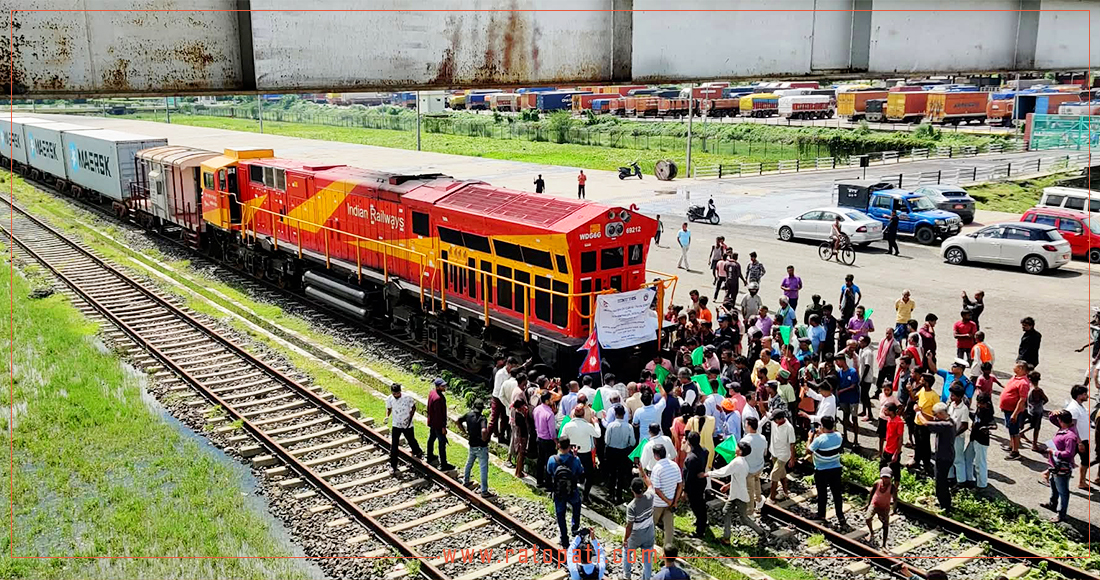
Biratnagar. The arrival of the cargo train from Bathnaha, India, to the Integrated Customs Checkpoint (ICP), Budhanagar in Biratnagar on Monday has brought enthusiasm to the business circles of Koshi Province.
Along with this enthusiasm, a question has also arisen – will this cargo rail service operate regularly?
_wcDJItrTOc.jpg)
The industrialists, businessmen, and customs agents of Biratnagar, who have closely observed past failed attempts and government indifference, appear divided regarding the continuity of this service. Some are fully optimistic, calling it legally and technically secure, while others, remembering past precedents, remain skeptical.
Devakinandan Sharma, President of the Biratnagar Customs Agents Association, is still not fully convinced about the regularity of the rail service. 'I am a bit doubtful. The railway was inaugurated in the past, but the service stopped afterward. Therefore, it is not yet a situation to be completely assured, but let's think positively.'
_rMzPlp0AJM.jpg)
According to Sharma, there is a significant lack of awareness among businessmen regarding the continuity of this service. He states that a liaison office is needed for this. 'We need a public relations office in the market to explain that this service is cheaper, faster, and quicker. If such an office is established, businessmen could directly interact with the public relations. Only then can the service gain continuity,' he said.
Pawan Kumar Sarada, Chairman of the Confederation of Nepalese Industries, Koshi Province, is confident that the cargo train will run regularly this time. 'I am confident that it will be regular. All the legal and policy obstacles have now been resolved. Earlier, the Indian government had only an agreement with Birgunj and did not prioritize Biratnagar. Our government also made a mistake in that, but now that both governments have recognized it, the way for goods to come directly from Kolkata port and in the future from other ports has opened up,' Sarada said.
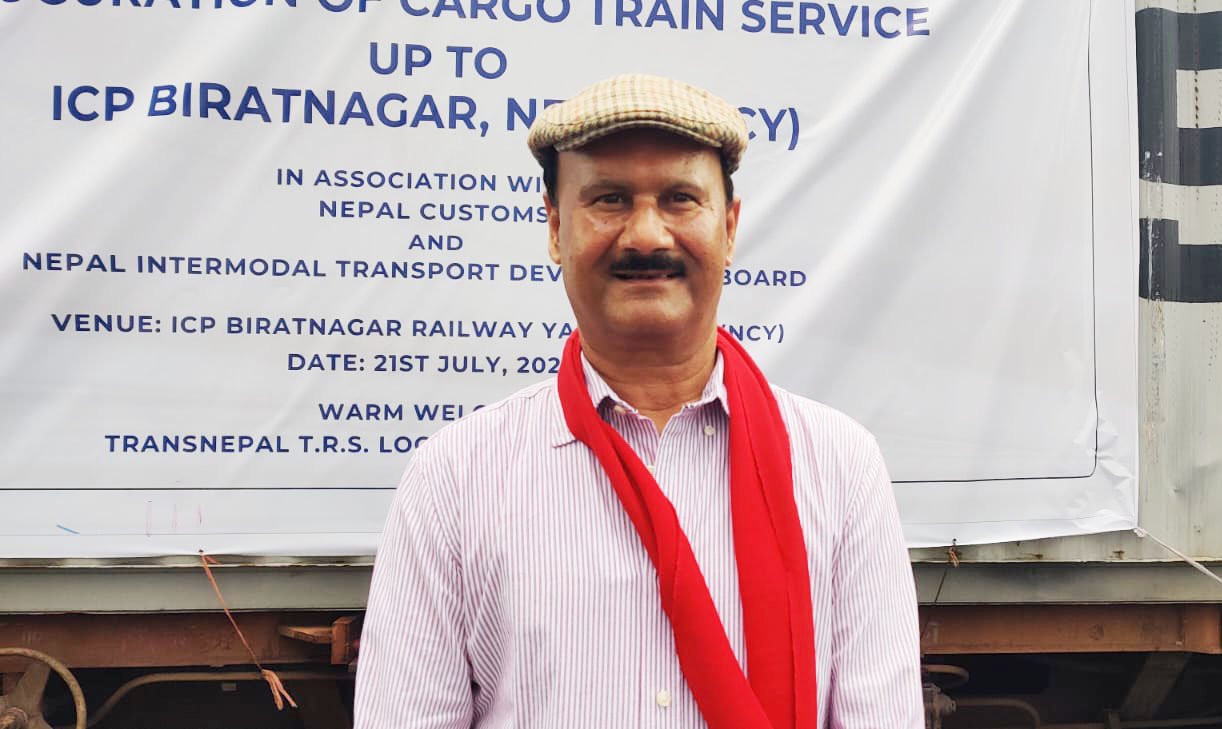
According to Sarada, even a 1 to 2 percent profit margin in the industrial sector is a significant gain. He claims that bringing goods by rail will save about 30 percent of the cost compared to road transport. 'When bringing goods by road, items ordered by Salt Trading, like sugar, would melt on the way, dust would get into the bags, and there was a risk of damage. But now, goods will come directly and safely by train. This will enable industries in Biratnagar to compete easily with industries in Birgunj and Bhairahawa,' he said.
_pYzmWg1hCk.jpg)
Rajendra Raut, Chairman of the Federation of Nepalese Chambers of Commerce and Industry, Koshi Province, believes that its regularity will depend on businessmen and infrastructure management. He emphasized the need for management based on the nature of the cargo. 'Our role is also important for this service to be regular. It depends on how businessmen utilize it. Two types of cargo come by train—bulk cargo and container cargo. Containers are directly loaded onto trucks and go, but sufficient yard and unloading facilities are needed inside the ICP to unload bulk cargo,' he said. He added that if that arrangement is not made, there is a risk of goods getting damaged and demurrage charges being high.
Raut clarified that along with infrastructure improvements, liaison offices of shipping lines should be opened at the Biratnagar border for trade facilitation. He argues that if imports can be made under CIF Biratnagar instead of CIF Kolkata, it would end a significant risk and legal hassle for businessmen.
_uk4ZcX98QS.jpg)
Umesh Shrestha, Chief of the Biratnagar Customs Office, claims that the cargo arrival this time is long-term, not temporary like in the past. He attributed this to strong bilateral legal efforts. 'This was not an ordinary task. It has been made possible through an amendment to the Nepal-India Transit Treaty via an LOI. The Indian Customs, Kolkata and Patna Customs, Indian Railways, and others have made tireless efforts. Therefore, there are no restrictions on the import of any goods now. This service will continue,' Shrestha said.
According to Shrestha, the arrangement of shipping lines and the electronic cargo tracking system between Nepal and India means that goods will now arrive directly in Biratnagar without physical inspection by Indian customs. He claims that in the future, bringing goods directly from Visakhapatnam port will reduce cumbersome paperwork and significantly cut down the import costs for Koshi Province.
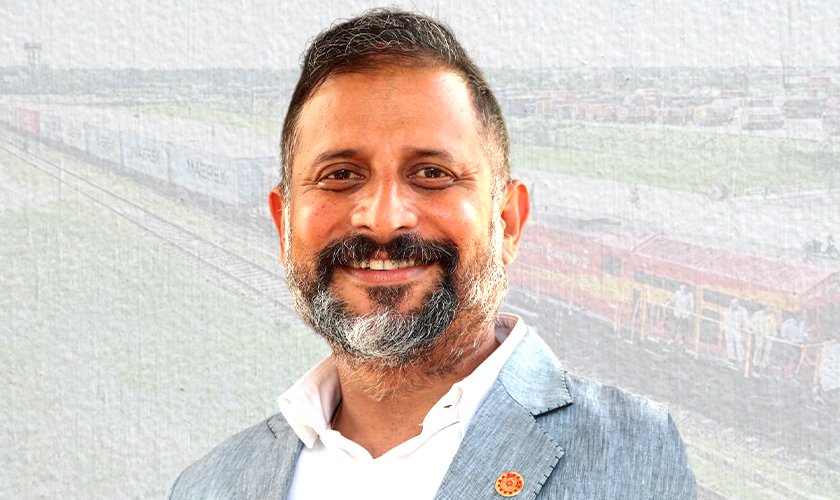
'Mainly, bringing bulk items offers significant benefits. Not only time but also cost is reduced. Overall, we see promotion of exports and reduction in consumer costs,' Shrestha said. 'Now, shipping lines must open offices here. Whether it's an agent or an office, they must open one. Demurrage charges will be incurred here. For this reason, shippers will be able to deliver directly here, allowing importers to utilize CIF. It will be possible to bring goods under CIF Biratnagar.'
An average of 300 trucks (approximately 4,500 tons) of goods are imported daily at Biratnagar Customs. The cargo train will undoubtedly make the transportation costs and security significantly cheaper.
_dXiQS8Hn8B.jpg)
While transporting 15 tons of goods by truck on the road costs NPR 40,000, bringing the same goods by railway costs NPR 29,000. This saves between NPR 11,000 and NPR 15,000 per truck in transportation costs. If 100 percent of goods from third countries and 60 percent from India imported at Biratnagar Customs are transferred to the train, the transportation costs for Nepali businessmen alone will decrease by NPR 180 million per month.
The 6-hour journey on the road sometimes took 2 to 3 days, and there was a risk of goods being stolen or damaged along the way. However, goods will now arrive safely in Biratnagar from Haldia port within 24 hours.
_Qf4j9VMUuR.jpg)
With the start of the rail service, industrialists have expressed dissatisfaction, citing high terminal and handling charges levied by ICP operator 'Trans Nepal'. Lakshmi Subba, manager of Trans Nepal, claimed that these rates are in accordance with government regulations. He clarified that the rates passed by the board of the then Intermodal Transport Development Committee, equivalent to the rates at Birgunj ICP, are being applied.
'While it took two days for a round trip to go and come back, we make three trips within this area. This makes it cheaper. Let's not be skeptical yet,' he said. He believes that Alam Khan, an experienced expert with 25 years of experience in Indian Railways for export promotion, has been appointed for market promotion, which will further elevate export trade.
_0UpoYaSJc8.jpg)
The arrival of the cargo train in Biratnagar is not a recent event. It has a history of over a decade of struggle and many ups and downs. The agreement for the construction of the 18.6 km railway line from Bathnaha to Katari was signed in 2011 (Bikram Sambat 2068). This project, which began construction with the financial assistance of the Indian government, was supposed to be completed in 2016 (Bikram Sambat 2073), but the project could not move forward for years due to a compensation dispute over 6 bighas of land in Ward No. 1 of Katari Rural Municipality.
The compensation determination committee decided to provide NPR 200,000 per kattha, but local landowners disagreed. Later, although the court ruled to provide compensation at the rate of NPR 800,000 per kattha, payment delays by the government side led some landowners to approach the Supreme Court. Due to this legal entanglement, the final section of the project, which involved acquiring 119 bighas of land from 565 landowners, became stalled.
_Fw8UBI6q3A.jpg)
Although the Katari section was halted, the 7.6 km railway line from Bathnaha to the Integrated Customs Checkpoint (ICP) in Biratnagar was completed in Kartik 2076 (Bikram Sambat). A successful rail track test was conducted for the first time over a distance of 7 kilometers at that time. The inauguration of the cargo train, which took a long time to build, was done digitally jointly by the then Prime Ministers of Nepal and India, Pushpa Kamal Dahal (Prachanda) and Narendra Modi, on Jestha 18, 2080 (Bikram Sambat).
After a long period of uncertainty, the land dispute in the Katari section has now been resolved. Ircon International Limited, a government-owned Indian company, has fenced the 66 bighas of land acquired for the construction of the Katari station and is vigorously advancing the work. It is said that the work is progressing with the goal of running a regular cargo train up to Katari within the next few years.
This specific news has been automatically translated by AI. As a result, there may be some inaccuracies or language errors.
_ke6hmvuewe_XLPTtgxmKE.jpg)