Police Seize 38 Tons of Melon Seeds in Jhapa, Businessman Claims Illegitimate Confiscation


Biratnagar. The incident where police seized approximately 38 tons (948 bags) of melon seeds (magaj) in Bhadrapur, Jhapa, has created a stir among businessmen.
The goods, stored after paying all taxes to the state and completing legal procedures, were confiscated by the police after breaking the lock. Businessmen complain that confiscating in this manner without giving an opportunity to present evidence is an extreme example of injustice by the state machinery.
On Sunday evening, a team from the District Police Office, Jhapa, raided a warehouse rented by Bimalal Subedi in Bhadrapur Municipality-3. The police have handed over the seized goods to the Bhadrapur Customs Office, claiming they were illegal. However, Rajendra Thapa Magar, the owner of the seized goods, stated that the police interfered with his legitimate property in a bullying manner.
Magar claims to have all the online bills and receipts from the purchase of the goods to customs. According to him, the goods were purchased in the months of Baishakh and Jestha and were stocked for Ayurvedic medicine and other purposes.
“I stored the goods in the warehouse after paying taxes to the state and making an agreement with the ward office. When the police called yesterday, I was out for work. I requested the SP multiple times, saying it would take me 3-4 hours to get there, and asked them to seal the warehouse, and I would show all the customs bills the next morning,” said businessman Magar. “But my request was not heard at all. Without giving me any time, my warehouse was broken into, and the goods were taken away within 3-4 hours. This is injustice against us.”
_mZkGM4641D.jpg)
Magar expressed anger, stating that he was ready to face legal punishment if he had made a mistake or brought illegal goods, but he was deprived of even the minimum right to present evidence. “I have already submitted all my documents to customs. In which law is it written to break the lock without even listening when I offer to show the bills?” he questioned.
Magar stated that he brought the goods purchased from Kathmandu. Basundhara Khadka, Chief (SP) of the District Police Office, Jhapa, said that the raid was conducted based on secret information that the goods were being hidden illegally.
The police stated that the seized goods, weighing 37,920 kg (worth approximately 4 to 5 million rupees), were found suspicious and have been handed over to customs for further investigation.
Increasing Import of Melon Seeds
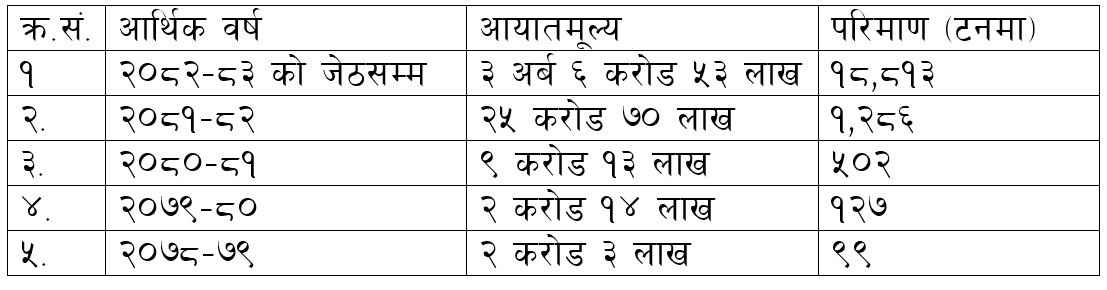
In recent times, the import of melon/watermelon seeds (magaj) into Nepal has increased significantly. Statistics show that more than 3 billion rupees worth of such seeds have been imported by Jestha of the current fiscal year alone. According to data provided by the Customs Department, 18,813 tons of magaj, valued at 3 billion 6 crore 53 lakh rupees, have been imported in the 11 months of the current fiscal year.
According to the department, the largest import was 6,449 tons from Afghanistan, followed by 5,811 tons from Nigeria, 3,472 tons from Sudan, and 2,551 tons from the UAE.
In the last fiscal year, 1,286 tons were imported at a value of 25 crore 70 lakh rupees. The largest share was 445 tons from Afghanistan, 324 tons from Nigeria, and 145 tons from China. The Customs Department's data shows that the import of magaj started increasing from Chaitra of 2081 BS.
Similarly, in the previous fiscal year (2080/081 BS), 502 tons were imported at a value of 9 crore 13 lakh rupees, in 2079/080 BS, 127 tons at 2 crore 14 lakh rupees, and in 2078/079 BS, 99 tons at 2 crore 3 lakh rupees, the department stated.
See Statistics
What is it used for?
In India, melon seeds are reportedly used the most for making vegetable gravy. As spicy food is popular in India, magaj is also used as a spice. When making pastes for meat or vegetables, magaj is ground along with cashews, almonds, and poppy seeds. Often, a paste of poppy seeds and magaj is made.
Magaj is also used as a snack in India and other developed countries as it is a nutritious food. It is often consumed as a snack after roasting (roasted melon seeds). It is also used in sweets. The white seeds seen in sweets like Gundpak and Laddu are indeed magaj.
Why the Ban in India?
The police claim that businessmen have been importing goods into Nepal and smuggling them into India since India imposed quantitative restrictions on the import of magaj from 2023.
The Indian government, with the aim of providing good prices to its farmers, imposed quantitative restrictions on the import of magaj from June 2023. India distributed import permits for 35,000 tons of unprocessed magaj without removing the shell for industrial processing from June to October 2023. Immediately after, industrial import was allowed for two months from May to June 2024. After that, India has not granted import permission to industries so far.
India consumes 60 to 65 thousand tons of magaj annually. However, its domestic production is only 35 to 40 thousand tons. Therefore, India has to rely on imports for the deficit of 20 to 25 thousand tons of magaj. Meanwhile, during the two-month
This specific news has been automatically translated by AI. As a result, there may be some inaccuracies or language errors.