Gandaki Province Government Faces Budget Execution Challenges


Pokhara. The Gandaki Province government had presented a budget of 31.99 billion for the current financial year. By the end of the period, with amendments, a budget of 32.05 billion was presented, but the province's expenditure this year was only 20.60 billion rupees.
The Gandaki government could not spend 11.45 billion rupees in the current financial year. While presenting the budget for the upcoming financial year (2083/084), the provincial government has considered the 2 billion rupees that will remain after the implementation of the current year's programs as a source for the upcoming year's budget. According to the Provincial Treasury and Comptroller Office, approximately 2.5 billion rupees will remain as surplus due to unspent funds from the current year. The office stated that the exact figures will be available only after the end of the financial year, as accounting work is not yet complete.
Every year, Gandaki Province presents a budget exceeding 30 billion. Gandaki, which presented a budget of 24 billion in its establishment year, has been presenting budgets exceeding 30 billion in subsequent years. In terms of size, the budget always appears attractive and large, but the expenditure figures for the year are limited to around 20 to 22 billion.
With the budget exceeding 32 billion every year but the expenditure not increasing, a question has now arisen: 'What is the actual budget of Gandaki Province?'
Kiran Gurung, who handled the Ministry of Finance in the first term, used to say, 'Once budget expenditure exceeds 70 percent, pressure starts mounting on us. If expenditure reaches 80 percent, the consolidated fund goes into deficit.'
This means that no matter how much budget is presented, it is intended that only 70 to 75 percent will be actual income. Looking at the figures, the budget expenditure has not exceeded 75 percent since the government's establishment. In the year with the highest expenditure, 2078/079, out of a budget of 31.35 billion, 22.04 billion, or 75 percent, was spent. In other years, expenditure has been less than that, occasionally reaching 70 percent with difficulty.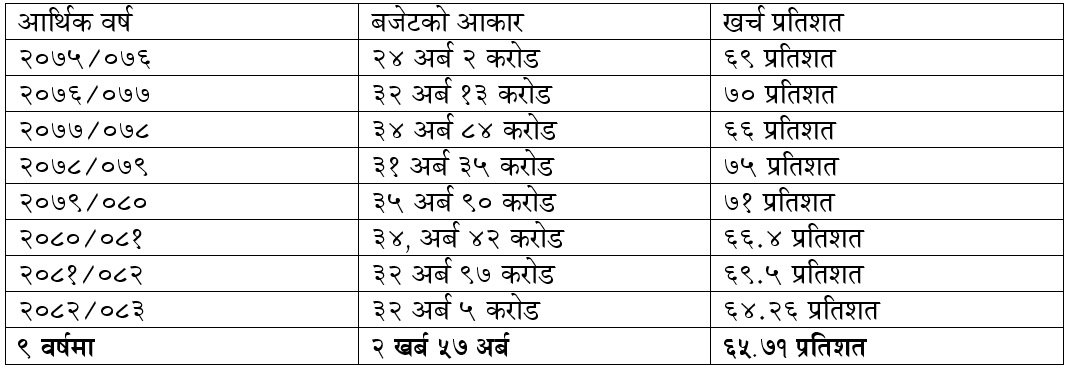
In terms of amount, the highest expenditure reached 25 billion. In the financial year 2077/078, out of a budget of 34.84 billion, 25.62 billion was spent. In other years, expenditure has been between 20 to 23 billion annually. The government, which has presented a budget of 2.57 billion so far, has spent 169 billion in capital and current expenditures. Analyzing the data from the past 9 financial years, the gap between the budget announced by the Gandaki Provincial Government and the actual expenditure appears to be quite large. On average, the government has only spent 65.71 percent of its budget.
The Gandaki government has managed to spend an average of only about 21.16 billion rupees annually. Looking at it this way, government documents clearly indicate that more than one-third of the budget remains on paper. An official from the Treasury and Comptroller Office said, 'The main issue is the government's implementation capacity. Conditional, complementary, and special grants received from the federal government are disbursed only based on expenditure progress, so a large portion of grants cannot be utilized due to weak expenditure capacity.' He added that this disrupts the revenue and expenditure details.
However, he stated that compared to other provinces, Gandaki's budget is balanced and theoretically successful.
Sudhir Kumar Poudel, chairman of the Public Accounts Committee under the Gandaki Provincial Assembly, argued that the budget itself is not realistic. 'Our income and spending capacity is 22 to 23 billion, but every year we prepare a budget of 32 to 33 billion. A deficit budget of 10 billion is created during the budget preparation itself,' he said. 'When political interests are accommodated in plans, making the budget unnecessarily ambitious, it leads to a shortage of resources on one hand and weak expenditure percentages of the allocated budget on the other.'
Poudel mentioned that problems also arise due to the inability to expand the scope of internal revenue and the weakness in implementation. 'Since its establishment, no new areas have been explored or researched to expand the revenue base,' he said. 'There is a practice of giving assurances when the budget is presented, but neglecting implementation after its approval, which has been deeply rooted in Gandaki since the beginning.'
Experts argue that the province's revenue relies on hypothetical estimations, causing problems in financial discipline. Gandaki, which estimates more than 5 billion in internal income every year, barely reaches 3 billion. Finance Minister Jit Bahadur Sherchan states that sometimes grants from the federal government are also reduced.
Sujan Regmi, director of the Pokhara Research Center, which studies federalism implementation and financial balance, sees problems in the budget estimation and implementation system itself. According to his argument, based on the current system and structure, Gandaki does not have the capacity to spend more than 24 billion. In a conversation with RatoPati, he said, 'The tendency to estimate an ambitious budget exceeding the target every year is the main financial problem. The size is increased without ensuring income, but our current administrative structure and human resources do not have the actual capacity to spend more than 20 to 24 billion rupees annually.'
He suggested improving the budget estimation process to bring a realistic budget.
Regarding implementation, he identified the delays and laziness caused by the bureaucracy as a major problem for budget expenditure. 'Even if the budget is received in Asar, there is a tradition of remaining idle from Saun to Kartik. Consequently, glorious and large projects that would transform the province are overshadowed during budget preparation, and capital expenditure has not been effective due to the scattering of the budget on minor projects,' he said. 'This cycle cannot be stopped until the initial months are utilized and a practice of selecting only result-oriented projects is developed.'
Experts argue that the province's revenue relies on hypothetical estimations, causing problems in financial discipline. Gandaki, which estimates more than 5 billion in internal income every year, barely reaches 3 billion. Finance Minister Jit Bahadur Sherchan states that sometimes grants from the federal government are also reduced.
'Financial equalization grants come at 91 percent sometimes, and 93 percent at other times. We have kept internal loans, but we haven't taken them yet. The revenue target has also not been met,' he said. 'There isn't just one reason for low expenditure. Expenditure would have increased now. Annual work could not be done. Some projects were not even contracted.'
He argues that next year's expenditure will be much higher than the current year. He maintains that Gandaki has maintained discipline in budget preparation.
This specific news has been automatically translated by AI. As a result, there may be some inaccuracies or language errors.