Adikavi Bhanubhakta Acharya's 211th Birth Anniversary Celebrated

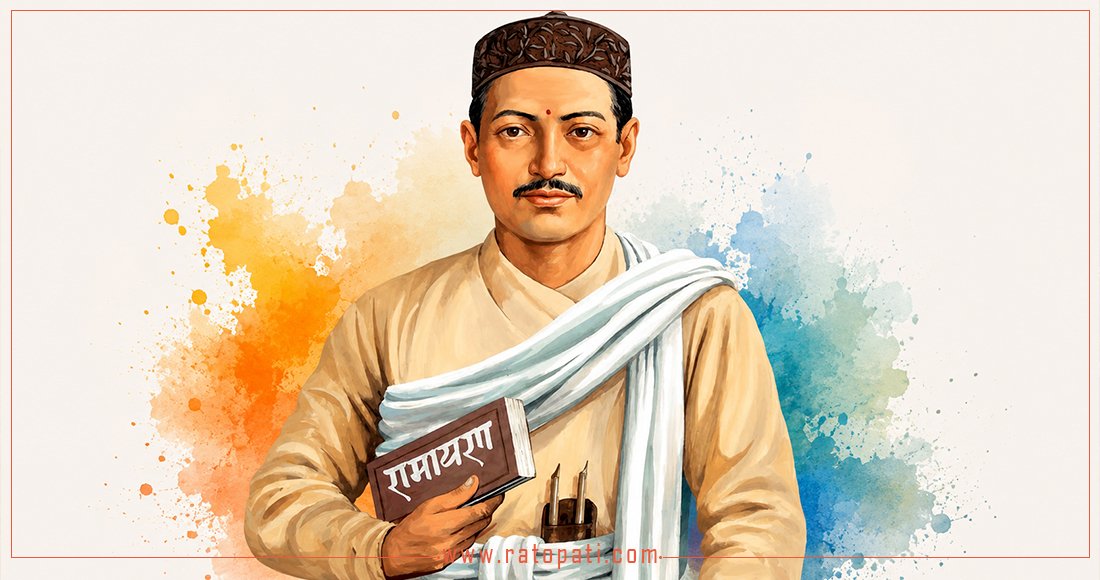
Today is the 211th birth anniversary of Adikavi Bhanubhakta Acharya of Nepali literature. Adikavi Bhanubhakta Acharya, born on Ashar 29, 1871 BS, is well-known as an immortal figure of Nepali language and literature for bringing the Ramayana into the reach of the public by translating it into the Nepali language.
The contribution of his works to the development of the Nepali language is considered equally relevant today. Bhanubhakta, known as a representative poet of the primary period of Nepali literature, is also the translator of Valmiki's Ramayana. He was born in Chundi Ragh in Tanahun district as the son of Dhananjay Acharya and Dharmavati Devi.
His grandfather Shri Krishna Acharya had migrated to Tanahun district from the Sinja valley of Jumla district. He was educated from a young age by his grandfather Shri Krishna Acharya. His father Dhananjay was a government employee during the Rana regime. Bhanubhakta's grandfather had collected and written books such as Nakshatra Balidan Vidhi, Kapur Stotra, Tirtha Shraddha, Kartik Mahatmya, Jyotish Ratnamala.
Motiram Bhatta first gave Bhanubhakta the title of 'Adikavi' in the Nepali language. Bhanubhakta has written works like Prasnottar, Bhaktamala, Vadhushiksha, and after Motiram Bhatta collected and published his manuscripts in book form, he became known in Nepali literature. Bhanubhakta Acharya, the light of Nepali literature, was a guide who created the ideal of Ram in the difficult and unstable environment of the Rana era. He propagated the ideal that 'one must make any sacrifice for the welfare of the people' through the journey of Ram from the royal palace, which symbolizes human life and the entire world, the forest of desire, and death.
Bhanubhakta has received the honor of a national luminary of Nepal by providing a comprehensive sense of coordination and totality of subjects such as language, literature, culture, religion, philosophy, tradition, character, dignity, filial love, fraternity, conjugality, duty, patriotism, and public affection all at once in the Nepali world. Bhanubhakta Jayanti is celebrated every year on the occasion of the birth anniversary of Bhanubhakta Acharya. Every year, the Government of Nepal and the Nepali people, as well as Nepali speakers scattered around the world, celebrate this festival. Bhanubhakta Jayanti is also a popular cultural festival among Nepalis scattered around the world. Every year, on the occasion of Bhanubhakta Jayanti, it is celebrated as a grand ceremony with literary seminars and programs in the significant presence of Nepali writers, novelists, and other litterateurs.
Bhanubhakta has done a great favor to the Nepali people by presenting the 'Ramayana' with a conceptual translation of the biography of King Ram of Ayodhya written in Sanskrit. The Ramayana written by him is still recited with melody in the homes of Nepalis. While Prithvi Narayan Shah unified Nepal geographically, Adikavi Bhanubhakta unified it emotionally through language, literature, and culture. We find in various historical and literary documents that he was inspired to compose the Ramayana in Nepali after a common grass-cutter advised him, 'After being born, one should earn fame by doing good deeds'.
'Vadhushiksha' is another of his famous works. Similarly, there are works like 'Prasnottar', 'Bhaktamala', 'Ramgita', and miscellaneous compositions. Adikavi Acharya, who was imprisoned for failing to reconcile the accounts of Kumari Chok, was a staunch opponent of the procrastination and 'tomorrow-ism' in government offices. He wrote against procrastination through poetry: 'Tomorrow, tomorrow, the whole house is gone, may today be spared with this bag'.
Bhanubhakta has made a historical contribution to awakening Nepali national unity, national identity, and Nepali cultural consciousness, and to strengthening national culture. Since Bhanubhakta is a historical figure, it is a major necessity today for all Nepalis to respect him and to hold discussions and critical programs on the controversies raised about his ideas. Many research theses have been written at the postgraduate level about Bhanubhakta by various universities, including Tribhuvan University.
Arguments are also occasionally raised that he should not be called Adikavi because there were poets writing poetry in the Nepali language even before Adikavi Acharya. However, it is just to call Bhanubhakta Adikavi because he made a significant contribution to linguistic unity by conceptually translating a text like the Ramayana into Nepali folk rhythm. The Ramayana text is considered to have created a new era in the linguistic field. Adikavi Acharya passed away in Ashwin, 1925 BS. Bhanubhakta's birth anniversary is also celebrated in places like Darjeeling, Sikkim, Bhutan, Burma, America, and other countries and places where there are many Nepali speakers.
Therefore, Bhanubhakta Acharya holds an important place in the Nepali poetic world. Some believe that he is more important in India than in Nepal. Just as the Ramayana has a special place in various Indian languages, Bhanubhakta's Ramayana also holds a high place as a work in the Indian language. Many works of Ramayana have been published in languages such as Sanskrit, Gujarati, Marathi, Maithili, Odia, Tamil, Telugu, Kannada, Hindi, etc. We also find about thirty or so epics and books in the tradition of Ramkavya published in Nepali. Among these, Bhanubhakta's Ramayana is considered the best. Bhanubhakta has made the Ramayana very interesting with great skill. He has presented it to the readers by taking the essential storyline without altering the original subject matter.
This specific news has been automatically translated by AI. As a result, there may be some inaccuracies or language errors.