Supreme Court Judgments Remain Unimplemented by Government


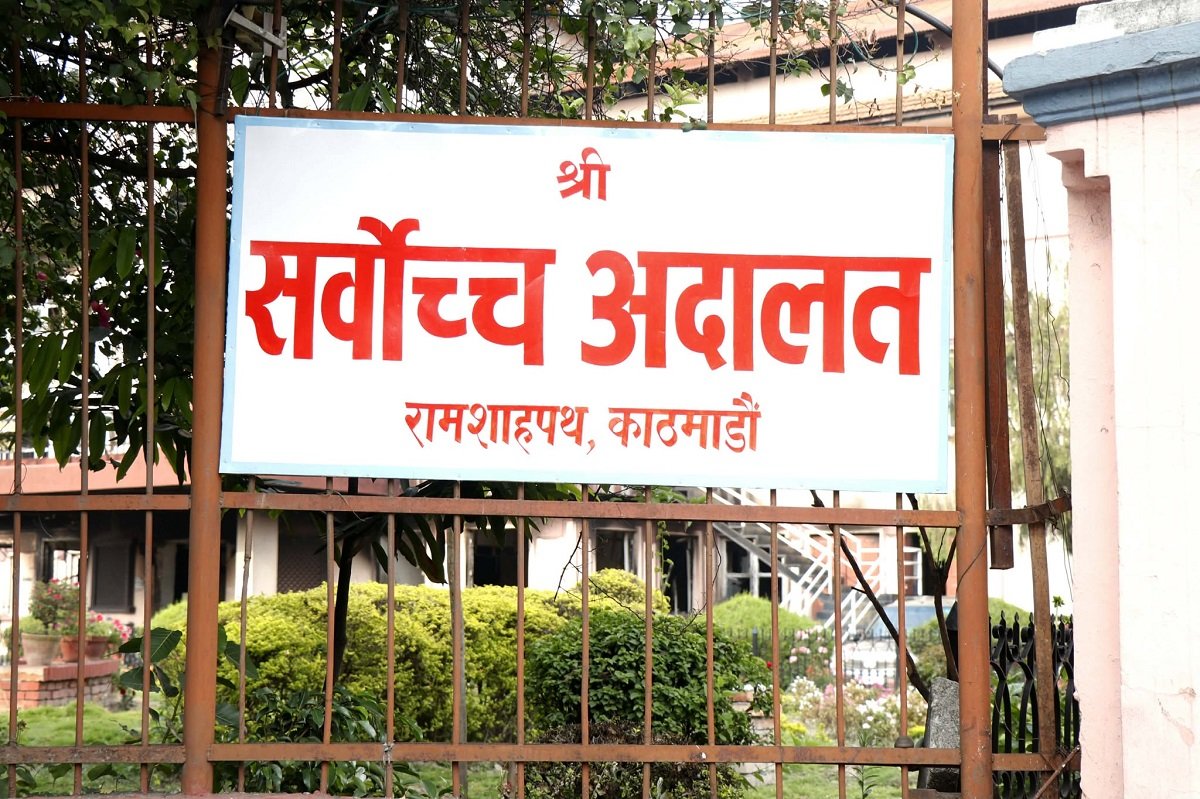
Kathmandu. The Constitution of Nepal not only recognizes the Supreme Court as the final interpreter of the constitution and laws, but also clearly stipulates that compliance with its judgments and orders is the mandatory duty of every organ of the state. However, the government has been neglecting the implementation of court judgments for a long time.
In Nepal's justice system, the Supreme Court has delivered numerous far-reaching and historic judgments on citizens' rights and matters of national importance, but due to the indifference of the executive (government) responsible for implementing these judgments, dozens of high-profile cases have remained confined to court records for years.
Looking at the statistics of the Supreme Court's Judgment Execution Directorate and the current status of various public interest litigations, the saying 'Justice delayed is justice denied' seems to be proving true in the context of Nepal.
The Supreme Court issued a historic mandamus on Bhadra 11, 2082, to make Lumbini, the birthplace of Gautam Buddha, pollution-free. A bench of Justices Kumar Regmi and Sunil Kumar Pokharel had given a two-year deadline to close or relocate industries causing pollution within a 15-kilometer radius of Lumbini (up to the Indian border to the south). However, the government is seeking a review of the court's decision rather than implementing it. The court has asked to remove industries within 15 kilometers of Lumbini, but the government is preparing for a review by interpreting the mandamus in various ways, stating that the Indian border falls within 15 kilometers.
The Supreme Court's five-year-old verdict on the Nepal-India border dispute remains unimplemented. The Supreme Court had delivered a verdict five years ago on petitions filed by senior advocate Dr. Chandrakant Gyawali and border experts Buddhinarayan Shrestha, Bimal Gyawali, Liladhar Upadhyay, and Shashikumar Karki, among others. It does not seem possible for Nepal alone to implement this verdict.
The verdict delivered by the joint bench of then Supreme Court Justice Prakashman Singh Raut and Justice Purushottam Bhandari clarified that the border dispute between the two countries is not a matter to be resolved by demarcating the border from this or that location or by any specific method. 'Rather, the border with the neighboring country is linked to Nepal's independence, nationality, and sovereignty. An independent nation has a defined boundary. Equal participation from both sides is necessary to resolve the border issue,' the full text of the judgment stated.
In 2074 BS, in the case of Premchandra Rai versus the Office of the Prime Minister and Council of Ministers, the Supreme Court issued a 'mandamus' to ensure the right to vote for Nepali citizens residing abroad in future elections. It is estimated that more than 4 million Nepalis live abroad, contributing significantly to the country's economy through remittances. However, years after the court's order, the government has not prepared any legal or technical structure to involve them in the voting process.
In a case filed by Sunil Babu Pant and others in 2064 BS, the Supreme Court had ordered the formation of a study committee to provide legal rights to homosexual and transgender individuals according to their identity and to recognize same-sex marriage. However, this community still faces legal complexities in society and has to repeatedly knock on the court's door even for basic rights like marriage registration.
In the case of Akhandaprasad Subedi, the Supreme Court issued an order in 2075 BS to determine the boundaries of Pokhara's Phewa Lake, reclaim encroached land, and protect the lake's environment. Although the court ordered the removal of structures within 65 meters of the lake, this order has not yet been fully implemented due to a lack of coordination between local and central governments and pressure from influential individuals.
In the case filed by Rishiram Ghimire, the Supreme Court ordered in 2066 BS to protect the legal rights of HIV/AIDS infected individuals, keep their identity confidential, and take action against those who discriminate against them. However, infected individuals still face insults and discrimination in government hospitals and public places, defying the court's order.
- Justice in Numbers: A Dire Situation
According to the Judgment Execution Directorate, 244 public interest judgments are still awaiting implementation. A competition to shelve judgments seems to be underway from the Prime Minister's Office to the Ministries of Home, Finance, and Land Management.
According to Bimal Poudel, Chief Registrar of the Supreme Court, due to non-implementation of judgments, the state has to collect 34 billion rupees in revenue, and criminals have not served 121,000 years of imprisonment. This is not just a statistic, but a grim picture of impunity. Chief Registrar Poudel stated that it is not possible for the judiciary alone to implement judgments, and therefore, the police, land revenue offices, local levels, and concerned stakeholders involved in the judgments also need to be vigilant. He also emphasized the need to make the judgment execution process of the judiciary more robust, technology-friendly, and effective.
Gajendra Bahadur Singh, Director General of the Judgment Execution Directorate, said that the aspect of judgment execution is extremely important and technical in the administration of justice. Singh referred to the Tahsil branch as 'a court within the court' and stated that its effectiveness determines the public trust in the judiciary.
Singh mentioned that the Tahsil execution aspect is highly technical, and in some cases, even experienced employees and lawyers do not have sufficient knowledge about it. 'Although I myself have been working in this field for a long time, I find it challenging to work in the field,' Singh said. 'Therefore, arrangements should be made to provide at least two days of special training to employees assigned as Tahsildars from now on.'
- What is the definition in the Supreme Court Rules?
The Supreme Court Rules, 2074 BS, define the Judgment Execution Directorate as the central body with the authority related to judgment execution. The directorate is responsible for functioning as the central body for judgment execution, collecting fines, imprisonment, and government dues as per the judgments of various courts, assisting in the recovery of amounts, execution of possession, division of property, and compensation to victims, and monitoring these activities. It is also responsible for monitoring, inspecting, evaluating, and directing the execution of judgments of subordinate courts. However, the execution aspect has not been effective.
- What is the status in the judgment execution statistics?
According to the integrated statistics of the Supreme Court Judgment Execution Directorate until the end of Jestha in the fiscal year 2082/083, out of a total of 165,881 years, 2 months, and 10 days of imprisonment liability, only 41,197 years, 10 months, and 29 days have been settled. There are still 122,904 years, 10 months, and 5 days of imprisonment to be served, which is approximately 75 percent of the total liability.
According to Govinda Ghimire, spokesperson for the Judgment Execution Directorate, out of a total liability of 43,211,728,610 rupees in fines, only 11,455,335,604 rupees have been collected. More than 31,756,393,000 rupees in fines are yet to be collected.
The most pathetic situation is seen in the compensation to be paid to crime victims and the recovery of government dues. Out of 1.5838 billion rupees to be paid to victims, only 78.3 million (4.95%) has been settled. In terms of government dues, out of a liability of 2.3732 billion, only 37.9 million (1.60%) has been collected, according to the statistics.
This specific news has been automatically translated by AI. As a result, there may be some inaccuracies or language errors.