Russia Imposes Full Ban on Diesel Exports Amidst Domestic Shortages and Geopolitical Tensions
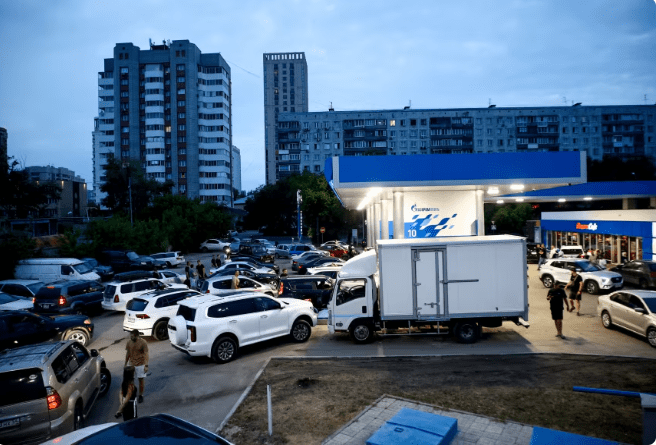
Moscow. Russia has imposed a complete ban on diesel exports. Russia has imposed a complete ban on diesel exports amidst a severe fuel shortage across the country following continuous drone attacks by Ukraine on Russian oil refining centers. Meanwhile, further instability has been observed in the global energy market due to rising tensions in the Strait of Hormuz.
Russian Deputy Prime Minister Alexander Novak announced the decision to completely ban diesel exports in a televised meeting with President Vladimir Putin, stating that the objective is to ensure sufficient supply in the domestic market.
Previously, Russia had only banned diesel exports by non-productive companies involved in fuel trading. With the new decision, diesel-producing companies will also be prohibited from exporting abroad, covering the entire diesel export market.
Just a few days ago, Novak had claimed that Russia had sufficient supply of diesel and petrol. However, his claim was questioned after long queues of vehicles were observed at petrol pumps across the country. According to CNN's analysis, petrol shortages or supply disruptions have been observed in most of Russia's 83 regions. Many petrol pumps have implemented a quota system for fuel, and local media have reported that in some places, the public has had to wait for up to 18 hours to fill fuel.
Ukrainian drones have also been targeting fuel and electricity infrastructure in Crimea, which Russia illegally occupied in 2014. Analysis of NASA satellite images shows a significant decrease in electricity light during nighttime in Crimea compared to a year ago.
This decision is considered to have come at a sensitive time for the global energy market. Concerns are rising that the Strait of Hormuz could be blocked again as the ceasefire between the US and Iran weakens. This is a waterway through which about 20 percent of the world's market's oil is transported. Any disruption here has a significant impact on the international market.
Meanwhile, the US has reimposed sanctions on Iranian oil sales, creating a situation where the supply of oil available in the global market is further expected to decrease. Natalia Losada, a senior analyst at energy analysis firm Energy Aspects, stated that the diesel export ban will have a negative impact on the global market. According to her, oil transportation through the Strait of Hormuz has not yet returned to full normalcy.
Davin Toyan, a senior research analyst at market research firm Kpler, also stated that the US-Iran tensions and Russia's export ban could further increase the price of diesel in the international market. However, he analyzes that Russia is unlikely to maintain this ban for a long time as it would mean losing significant income from exports.
According to Kpler, Russia is the world's second-largest diesel exporter after the US. Its main customers are Turkey and Brazil. With the reduction in supply from Russia, it is analyzed that these countries will have to compete with Europe to purchase diesel from the US, West Asia, and India.
According to data from Intercontinental Exchange, the benchmark price of diesel in the global market increased by approximately 13 percent after the ban was announced on Wednesday. However, by Thursday morning, the price had decreased slightly to about 3 percent.
This specific news has been automatically translated by AI. As a result, there may be some inaccuracies or language errors.