Opposition Leader Criticizes Prime Minister's Absence in Parliament

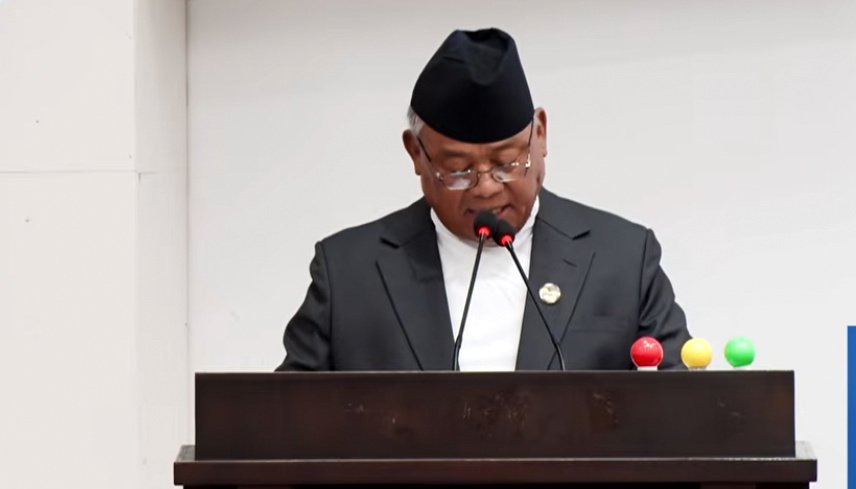
Kathmandu. Chief opposition party Nepali Congress Parliamentary Party leader Bhishma Raj Angdembe has expressed dissatisfaction saying the tradition of the Prime Minister being present when the opposition leader speaks in the parliament has been broken.
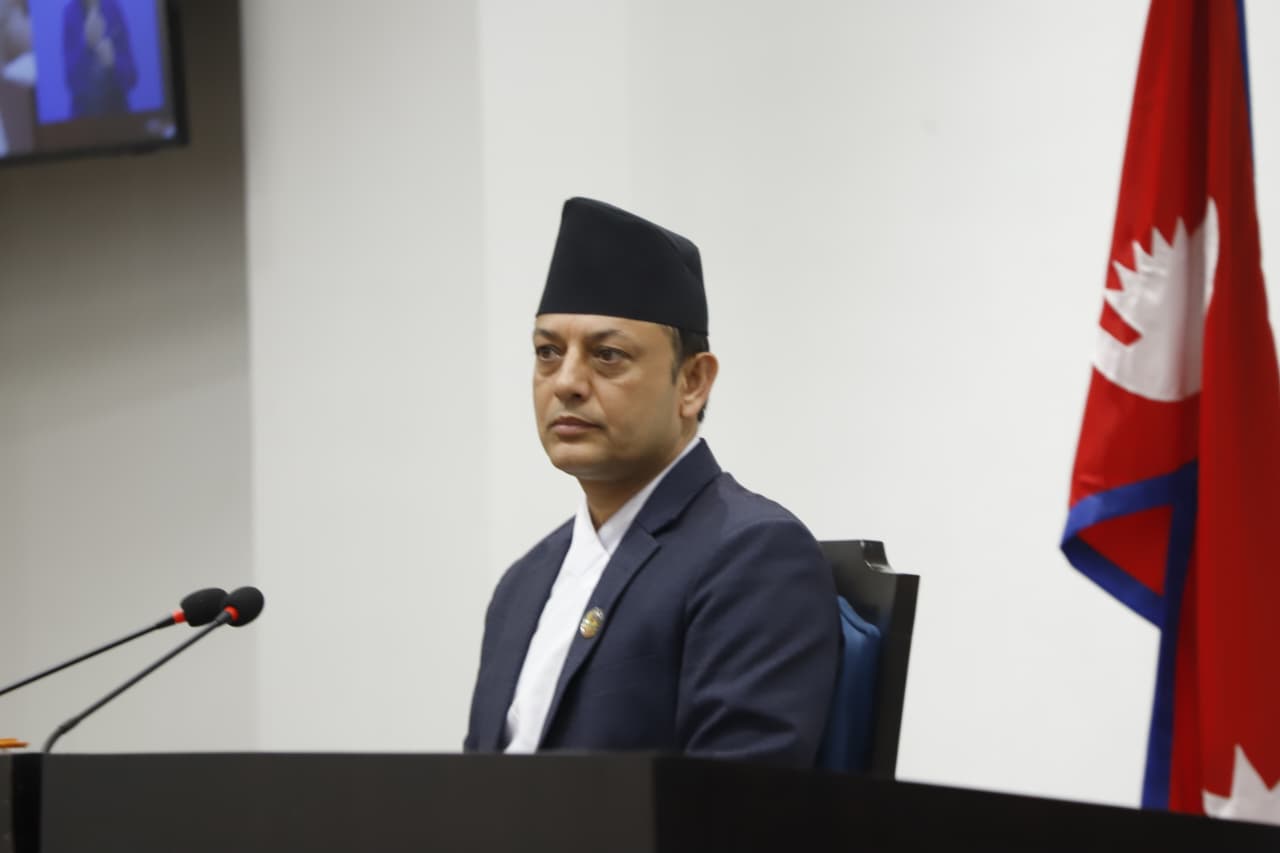
Speaking in a special time of the House of Representatives meeting on Monday, leader Angdembe expressed dissatisfaction, stating that Prime Minister Balen Shah broke the tradition.
Angdembe said that the practice of the Prime Minister being present when the opposition leader speaks in parliament is also international.
'Whenever the opposition leader speaks in parliament. There is a custom in the world. When the opposition leader speaks in parliament, the Prime Ministers of countries with democratic governance around the world smile and proudly make their presence felt by sitting in the front bench,' Angdembe said.
Angdembe said that the practice of the Prime Minister being present is because the comments made by the opposition leader also guide the government, and he had already anticipated that Prime Minister Shah would be absent this time.
He also said that it is his duty to remind the Prime Minister that he should be present in parliament.
Full Text of the Address:
Honorable Speaker,
The government has completed its first 100 days in office. No one expects miracles in just 100 days. But 100 days show the government's thinking, priorities, style of work, attitude towards democracy, and the direction in which it intends to take the country. And, 100 days are not just an opportunity to list achievements, but also a time for self-reflection.
During this time, I read the achievements published by the government on the occasion of its 100 days. My party reviewed it. I take some of the government's efforts positively. The government appears active in areas of good governance, corruption control, administrative reform, service delivery, and some structural reforms. Congress does not hesitate to praise positive work where it has been done. Because when the government succeeds, it is ultimately the Nepali people who succeed. Nepal is the country.
But in a democracy, the government is not evaluated by the booklet of achievements prepared by the government itself. Evaluation comes from the citizen's experience. It comes from respect for the constitution. It comes from accountability to parliament. It comes from the credibility of public institutions. It comes from whether the law has been applied equally to all. And, most importantly, it comes from whether the lives of citizens have changed.
Today, from the opposition, I want to ask some questions, and these questions are intended to make the government more responsible. And, let's not forget that in a democracy, asking questions is not opposition, it is accountability. First of all, we want to talk about the Prime Minister's parliamentary accountability.
The Constitution of Nepal has made the Prime Minister accountable to the parliament. Parliament is the supreme representative body of the people. The Prime Minister is a member of that body. His government is sustained by the confidence of that parliament. Therefore, the Prime Minister must be accountable to parliament. But after observing the Prime Minister's style of work for the past 100 days, I want to remind the Prime Minister that one should not forget the ladder after climbing the roof. You climb the roof of power and forget the parliament that put you on the roof? Devalue parliament?
I want to ask the Prime Minister seriously, if parliament is not your priority, how will parliamentary democracy be strengthened? If you consider writing messages on social media more effective than attending parliament, how will the dignity of the supreme representative institution of the people be maintained?
In a democracy, being popular and being accountable are not the same thing. At the same time, I want to remind you - being famous and being popular are also not the same. To put it more clearly, when we become famous, we sometimes live a life of illusion thinking we have become popular. And I want to tell the Prime Minister - it is easy to go viral on social media, but it is difficult to work deeply and seriously as the Prime Minister of the country. Therefore, Mr. Prime Minister, give up the path of going viral. Forget it. You have become the Prime Minister of the country. As Prime Minister, drive the country in the right direction. Drive on the expressway, but very carefully. If you have an accident, not only you, but the entire country will be in an accident.
Honorable Speaker,
Whenever the opposition leader speaks in parliament, the Prime Ministers of countries with democratic governance around the world sit smiling in the front bench. But here, instead of listening to the opposition leader with a smile, I do not see the Prime Minister. Despite this, I will not look for him again. It is his responsibility to be in parliament. It is my duty to remind him. I know - I don't want to bother looking for him when he is not here.
Honorable Speaker,
Another important pillar of democracy is dialogue. Democracy runs on dialogue, moves forward with consensus, and respects disagreement. But looking at the government's style of work in the past 100 days, it appears to have prioritized distance over dialogue, conflict over cooperation, and unilateral decisions over consultation.
A common understanding should have been formed on matters of national importance and moved forward. But the government tried to move forward alone. Remember - you cannot reach your destination by wearing your feet inside out and your shoes backward. The democratic path is the right one. Since Prime Minister, who came from the right path, is trying to wear his shoes backward, it is certain that he cannot reach the right destination. To reach the destination, one must walk the right path. And it is not enough to walk fast. The path must be right, and although Prime Minister came from the path of the democratic constitution, I feel that he is carrying North Korea in his mind. This is not a good sign at all.
I humbly request - the opposition party will cooperate with the government for the development of the country, the strengthening of the democratic system, and the meaningful amendment of the constitution. If the government extends a hand for national consensus, the Nepali Congress is always ready to play a positive role.
Honorable Speaker,
The government calls itself democratic but acts undemocratically; it talks about good governance but does not disclose the source of assets. But in its 100-day achievements, it claims to have launched an anti-corruption campaign by investigating assets. Naturally, I welcome the government's determination to control corruption. Whoever commits corruption, regardless of their party or position, must be brought under the law. The Nepali Congress has no objection to this.
But there is a question. Prime Minister, you said there was no environment to work in the country for 35 years. But immediately after becoming Prime Minister, nearly two hundred tolas of gold were found in your assets. More than crores in bank deposits. Mr. Prime Minister! The Nepali Congress does not ask or seek why you earned gold. But what is the source of earning gold? It is the responsibility of the opposition to ask that. We will fulfill that responsibility. We will not run away from it.
Honorable Speaker,
Our main concern is controlling corruption. I respectfully mention the name of the Honorable Prime Minister and say, let the investigation of assets begin with opposition leader Bhishma Raj Angdembe and Prime Minister Balendra Shah. Let the investigation of my three houses in Umblang (Navamidanda), Silauti, and the slopes of Phungsing in Panchthar be conducted. Let the investigation of the Prime Minister's nearly 200 tolas of gold also be conducted. But I have no faith that the Prime Minister earned gold by doing something wrong. But the voters who voted for you are asking from afar - 'Aamam... what could be the source of so much gold? Where did it come from?' Therefore, Mr. Prime Minister, let's investigate. Let's investigate the assets of former Prime Ministers as well. Let's investigate who among other former high-ranking political figures and employees needs to be investigated, but let's start with us, not with others. Mr. Prime Minister, are you ready? I am ready. Investigation should not be done only on others, not on oneself.
Honorable Speaker,
Let the principle of selectivity not be applied in asset investigation. And the campaign to investigate assets against corruption must be credible. That trust will only come when the Prime Minister himself is ready for an impartial investigation and shows as much strictness in investigating his own people as he does towards the opposition.
And the necessary law is needed for asset investigation. Which was in the manifesto of the ruling party RSP in list 100. Forgetting that promise and investigating without making a law on asset investigation raises questions about legal validity.
Honorable Speaker,
The most serious concern in the government's 100 days has been the interference in the democratic process. It is surprising that in a constitutional council of 6 members, where it does not happen anywhere in the world, the presence of only 3 people is considered a majority. I think this happened in a country with a miraculous young Prime Minister driving the country on the expressway. And, to add to the glory, another wonder has been added to the world.
However, Honorable Speaker,
Such a practice is unconstitutional. It is against the spirit of democracy. It has weakened the culture of consensus. Constitutional bodies are being brought under the influence of the government, not made independent. The government has worked to weaken democracy, not strengthen it. The Nepali Congress does not accept unconstitutional acts. It condemns them.
Honorable Speaker,
I want to reiterate - our aim is not to oppose the government for the sake of opposition. We want the government to succeed, because when the government succeeds, it is the Nepali people who succeed. The lives of the Nepali people will change.
But the success of the government is not measured by how many bulldozers it operated, but by how much it secured the lives of its citizens. A citizen's residence may have been illegal.
But Honorable Speaker,
His birth was not illegal, was it? The womb that gave birth was not illegal, was it? His birth on Nepali soil was not illegal, was it, Honorable Speaker? Therefore, the long-term management of squatters must be done from a practical perspective. But in the name of a solution, thousands of squatters and residents of unorganized settlements were displaced at the beginning of the monsoon season without alternative arrangements. That was a moment when the government had zero human empathy.
Before removing a family, at least where will that family live from tomorrow? Does the state not have to think about the elderly, the infirm, pregnant women, and young children? Can the state be so insensitive? Yesterday, in the name of management, they were forcibly removed from squatter settlements and kept in shelters. And today, they are being driven away from there overnight?
Honorable Speaker
Is this country only for the powerful? Is it only for those who drive black cars wearing black sunglasses and black suits and pants? Is this country not for squatters, residents of unorganized settlements, the poor, farmers, and laborers? If not, it should be said. If yes, why are the powerless citizens being oppressed? Is this in line with the character of a welfare state?
Therefore, my humble request is - let's solve the problem of squatters. But let's do it humanely. Let's consider human dignity. Let's not use the arrogance of power against the powerless citizens. Let it end - the government's victory over the citizens will never happen.
However, recently, the police arrested squatter Dambar Tamang, who criticized the government. I demand his release. While a video was seen of a minister from the government itself threatening to break the legs of a construction entrepreneur. I don't think that was an AI-generated video. A Member of Parliament from the ruling party even made violent, provocative, and illegal statements like dragging the police on the street. Perhaps that was not an AI-generated video either. Honorable Sir, he might be somewhere here. But the government remained silent. Be aware that this is not a dark rule that silences the voice of the citizens. The Nepali people made that history more than 7 decades ago. We will not let such history repeat itself. We will not let it happen either. But it should not be that those who are powerful get away with anything they say, while the small are arrested.
And in a democracy, criticizing the government is not a crime. Disagreeing with the government is not opposition, and democracy is not strengthened by suppressing disagreement. Democracy is strengthened when the government can patiently listen to the words of its critics.
Honorable Speaker,
The Constitution of Nepal is a national agreement made through decades of struggle, sacrifice, movement, and political consensus of the Nepali people. Therefore, it is not that the constitution cannot be amended; it can be. It is not a religious scripture to be immutable. But the Nepali Congress will not accept unnecessary tampering with the fundamental spirit of the constitution, democratic values, and the federal system in the name of amendment.
So far, there has been no in-depth dialogue on a serious issue like constitutional amendment. There has been an attempt to tamper with the federalism institutionalized by the constitution. Remember, the Madhes revolted for federalism. Federalism is a political achievement obtained through the sacrificial struggle of indigenous peoples, Tharus, Dalits, and women. Therefore, federalism is not a system that came easily. Let's not think that it can be tampered with; rather, let's think about how to strengthen federalism.
Honorable Speaker,
Let's have dialogue among all parties in parliament, parties outside parliament like the Janata Samajwadi Party, constitutional law experts, etc., for the constitution's formation. Let's discuss what to amend. But without attacking the basic structure of the constitution.
Honorable Speaker,
The current constitution was promulgated when Sushil Koirala, former president of Congress, was Prime Minister. The implementation of the constitution began after Sher Bahadur Deuba, the immediate past president of Congress, became Prime Minister. Therefore, the Nepali Congress bears the greatest guardianship and ownership of this constitution. This is our responsibility. But the process of constitutional amendment must be carried forward inclusively. The government is currently taking the amendment of the constitution lightly and is having a debate paper prepared by a person who is not a constitutional law expert or a constitution maker - very immature work is being done. Congress has had reservations about this from the beginning. We have been saying that a commission should be formed to suggest constitutional amendments under the leadership of a former Supreme Court justice.
Meanwhile, the ruling party is bent on dismantling federalism. The proposal to abolish the provincial assembly, considered the backbone of federalism, has been passed, and it has been called the political view of RSP. I want to ask the government - the current Prime Minister, after going to Janakpur and Jhapa, said before the election that he would strengthen federalism. But the first general convention of the ruling RSP decided to abolish the provincial assemblies. Honorable Speaker,
Whose statement should we believe - Prime Minister Balen or the president of his party, Honorable Ravi Lamichhane? I want to ask. Just like in the song of popular singer Kunti Moktan, 'Love made while going to graze cattle was forgotten while going as a laborer,' he forgot what he said in Janakpur when he reached Chitwan. This is not good. Prime Minister, you should not forget what you said about strengthening federalism, that the citizens of Madhes will not come to Kathmandu, but will do all their work in Janakpur, and will only go to Kathmandu for sightseeing.
Honorable Speaker,
After the government completed 100 days, I thought - the crowd seen at Tribhuvan International Airport must be relatives who came to welcome the youth returning from abroad. Because at one time, I heard a promise that within 100 days of forming the government, at least 100 youths would be brought back from abroad and given employment in their own country. For that, stickers were pasted on every street in Australia, Europe, and America, and a campaign was run to bring youth back to the country, promising employment with the same income as abroad. But now it seems that promise was also made to be forgotten. And so, the crowd at the airport was not of youth brought back, but of youth being sent abroad. If not, from which plane did at least 100 youths, who were said to be brought back from abroad, arrive? Or has the plane to bring back our youth not yet taken off from the runway? I want an answer from the government.
Honorable Speaker,
Article 76 (9) of the constitution states that the number of ministers, including the Prime Minister, should not exceed 25. But the government reduced the number of ministers. Even after reducing it, a secretariat of more than two hundred people, including 57 advisors at the secretary level and personal staff, was formed, adding to the burden on the state treasury. The government propagated austerity by reducing the number of ministries, but prioritized managing cadres by making hundreds of political appointments.
The question to the government is - if the administrative machinery is capable, why is such a large contingent of advisors needed? What additional service did the public receive from this? The public's tax money should be spent on development, education, health, and employment, not on maintaining a contingent of political appointees. Adding chairs of advisors by reducing ministerial chairs is not austerity, it is just a way to hide expenses. This is a blatant joke on the public's tax money.
Honorable Speaker,
The current government came to power with the slogan of transparency. But the government appears to be completely opaque. After being accused of hiding share ownership, the then Home Minister resigned. The report of the investigation committee formed thereafter has not been made public to this day.
We have repeatedly demanded that the report be made public. But the government has continuously tried to hide it. The conclusions of the report, who was held responsible, and what actions were recommended have not been brought before the public.
The main opposition Nepali Congress had demanded an independent, impartial, and high-level investigation into all allegations related to the Home Minister. But the government appeared to be more focused on covering up the issue than bringing out the truth. The government's style of work, unable to make public the investigation report related to its own minister, raises serious questions about good governance, transparency, ethics, and public trust.
Honorable Speaker,
The government has made a big announcement in its commitment paper to reduce multidimensional poverty to 10 percent within five years. But the budget has burdened the public by adding a 3 percent equalization fee to education and health. There is no effective plan to control inflation, no program to provide relief to the poor. And on what basis will poverty be reduced?
Commitment has been made to provide grants to small farmers, landless, and marginalized sections, but the budget has made arrangements to provide 40 percent subsidy to farmers investing 20 million rupees. Has the government adopted a policy of showing small farmers while distributing benefits to large investors?
Committing to make education and health free respectively, but adding new fees in the same sectors; promising to make health insurance accessible to all, but the finance minister himself expressing that health insurance is unaffordable—is this the government's policy or a contradiction? One thing is committed, another in the budget, and yet another in the ministers' statements. This is why the government's manifesto is just a document to show the public, not a guide for implementation.
Honorable Speaker,
The reports of the Gauri Bahadur Karki Commission and the National Human Rights Commission regarding the Jan-Ge protests of August 23 and 24 last year have been submitted to the government. But the government has kept both reports in its drawer so far and has not made them public.
I want to state clearly - all those involved in the massacre of the 23rd and the destruction of the 24th must be brought under the law. I had said this in this parliament before, that any report that sees the massacre of the 23rd but ignores the destruction of the 24th, or sees the destruction of the 24th but overshadows the massacre of the 23rd, cannot be the basis of justice.
Therefore, the government must immediately make both reports public. Especially, the report of the National Human Rights Commission should be made public, and based on it, impartial investigation, legal action, and implementation process should be initiated. No one should be exempted under the guise of power or authority.
Honorable Speaker,
The BYD car incident has shown the true face of this government. The Finance Minister was seriously accused of leaking confidential information regarding changes in revenue rates to benefit certain traders. It was made to seem like over 700 BYD cars were seized. And after the accusation, there should have been an independent and impartial investigation. But what did the government do? The accused minister himself formed a committee led by his ministry's employees and exonerated himself.
Is this good governance? If you declare yourself innocent, how will the public trust you? In similar incidents in the past, the minister who accused others of 'cleansing by sprinkling holy water' is today repeating the same practice himself.
Good governance is measured not by speeches, but by impartial investigation. If the government has the moral courage, it should conduct an independent judicial or high-level investigation into this matter. Otherwise, the slogan of good governance will be proven to be just a political slogan to deceive the public.
Honorable Speaker,
The government has talked about increasing agricultural production, reducing imports, and increasing self-reliance. These all sound good in policy. But even in the middle of the monsoon, farmers are not getting fertilizer. The government, however, says there is enough fertilizer. So why are farmers wandering around?
Honorable Speaker,
The elephant menace has so far claimed 25 lives. A situation where four members of the same family have lost their lives is tragic. The government has not been able to bring an effective plan to control the elephants that have been causing havoc for years. Local residents are forced to live insecure lives in their own homes and fields. The government's responsibility is not fulfilled by just distributing relief. A long-term policy to protect citizens' lives and agriculture from wild animals, an effective rescue mechanism, and immediate intervention should be implemented immediately. Protecting the lives of citizens is the primary responsibility of the state.
Honorable Speaker,
In conclusion, I want to say this - looking at the list of 100 points of governance reform published by the government and the status of their implementation, it has been proven that they are just 'showing teeth like an elephant'. Reform on paper, opacity in practice, good governance in speeches, selectivity in actions, democracy in commitments, unilateral decisions in practice. Hope was shown to the public, but the result was disappointing. Again, I say - in a democracy, the government is not evaluated by its publicity material, but by the people. The people are probably noting all these things in their black diaries. One day the people will surely make a decision. In summary, the government's claim of 100 points of governance reform turned out to be just empty promises like an elephant's tusks.
This specific news has been automatically translated by AI. As a result, there may be some inaccuracies or language errors.
_HRhqZ7mz2X.jpg)
-education-and-sport_c0BHyFjlfq.jpg)

_CI16rghsRT.jpg)