Panauti Celebrates Hile-Jatra Festival

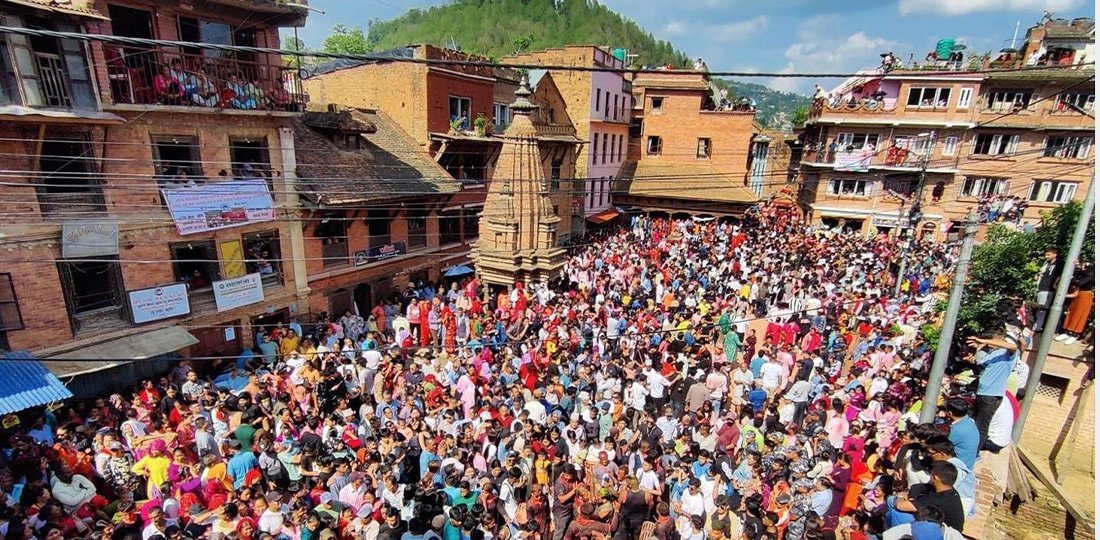
Kavrepalanchok. The Hile-Jatra, celebrated for 1,422 years in the historic city of Panauti in Kavrepalanchok, has begun today. According to the tradition of the festival, two bamboo poles symbolizing snakes are placed horizontally in the Punyamata River this evening, and the special festival is considered to have begun after the Devgans (Dui-cha Nyakegu) slowly cross them.
On the day the festival begins, the chariot of Bhadrakali is pulled late tonight, and the Gairdu Puja (performing Homa) is conducted throughout the night, as informed by the Panauti Jatra Main Management Committee.
According to the committee, during the festival, on the day of Chaturdashi (second day), prayers are offered with great fanfare in all the temples of Panauti city. Also, the idol of Maheshwor Ganesh, located east of the Indreshwor Mahadev temple, is taken on a palanquin, paraded through the city with abir (colored powder), and in the evening, the chariot of Bhadrakali is pulled and Chakra Puja is performed.
Similarly, on the third day of the festival, the full moon day, the chariots of Bhadrakali, Mahadev, and Indreshwor are made to clash in the market early in the morning, and when the chariots meet, sexual performances (activities depicting sexual acts) are displayed as the chariots are made to collide with each other.
According to the legend of the festival, on the day of the full moon, Bhadrakali takes the form of 64 Yoginis and chases Mahadev in a lustful manner. Mahadev jumps into the Triveni and hides, but when Bhadrakali does not leave him even there, Mahadev takes the form of Unmatta Bhairav and chases Bhadrakali away.
In the course of this chase, the abir jatra is performed and the chariots are made to collide, representing the act of fleeing and pursuing. As the chase continues, Bhairav corners Bhadrakali from all sides and pushes her from behind, while Indreshwor Mahadev, coming from the front, also pushes her from the front. Based on religious grounds, the tradition of colliding chariots is considered a representation of sexuality.
As the excitement increases during the chariot collision, young men and women are seen vying to participate in pulling the chariots. According to Ramesh Jangam, the priest of the Indreshwor temple, since erotic acts had to be performed during the chariot collision, the chariots used to be collided before dawn in the past.
Especially because it is a festival related to sexual activities, it was traditionally believed that the chariot collision should be completed between midnight and dawn. However, in recent years, the chariots, considered divine, have been made to collide in the afternoon with large participation.
According to the tradition of the festival, the Karmacharyas (Achajus) must walk slowly carrying offerings and Sukunda (a ritual lamp). This tradition is called Nhyaikegu in the Newari language. It is believed that the Naga Raja rises from his seat when the Karmacharya reaches गोरखनाथ across the river, and it is believed that water and paddy transplantation will be successful due to the grace of the Naga Raja.
The day after the Hile Jatra, which is celebrated from Trayodashi until the night of the full moon, the tradition of starting agricultural work has been prevalent here. Locals say that since the tradition of starting paddy transplantation after the festival has been going on for a long time, it is also called Hile Jatra, or Jya: Punhi in the Newari language.
It is believed that on the day the festival ends and for four days thereafter, strong winds blow in Panauti, and then it starts raining. There is also a belief that one must eat chiura and bananas and then go to see the festival. Locals still maintain the custom of offering sacrifices in every house throughout the festival and welcome their guests with hospitality and feasts.
This festival, celebrated for three days, is considered one of the most significant local festivals, due to which Panauti Municipality has declared a public holiday on Monday.
This specific news has been automatically translated by AI. As a result, there may be some inaccuracies or language errors.
_Sw2x64Nala.jpg)