Underdog Teams Showcasing Strategic Prowess in FIFA World Cup 2026

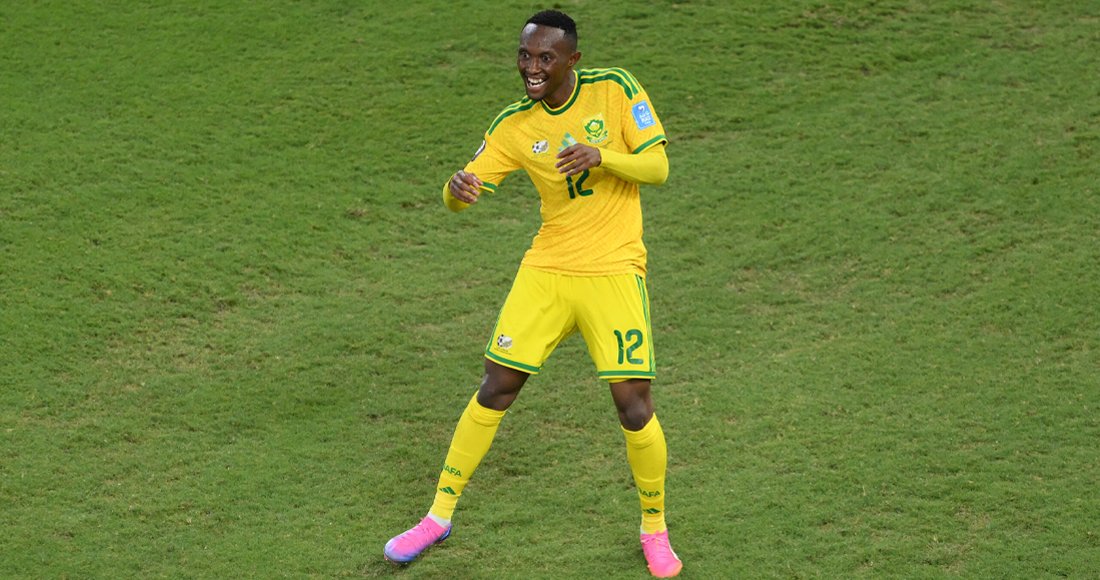
This World Cup, featuring 48 teams, has witnessed some very interesting clashes. Lower-ranked teams are putting up impressive performances against the world's top teams.
Cape Verde, Curacao, Ghana, and South Africa, ranked 64th, 81st, 65th, and 54th respectively in the FIFA rankings, have so far managed to snatch points from strong teams like Spain (third), Ecuador (29th), England (fourth), and South Korea (28th).
Are these surprising results seen in the initial stages merely a game of luck or the result of skillful planning and excellent execution?
A closer look at the matches that produced unexpected results reveals some common patterns.
- Avoiding the Opponent's Trap
The 0-0 draw between Cape Verde and Spain was perhaps the biggest 'upset' of the tournament so far. Strategically, the match was equally impressive.
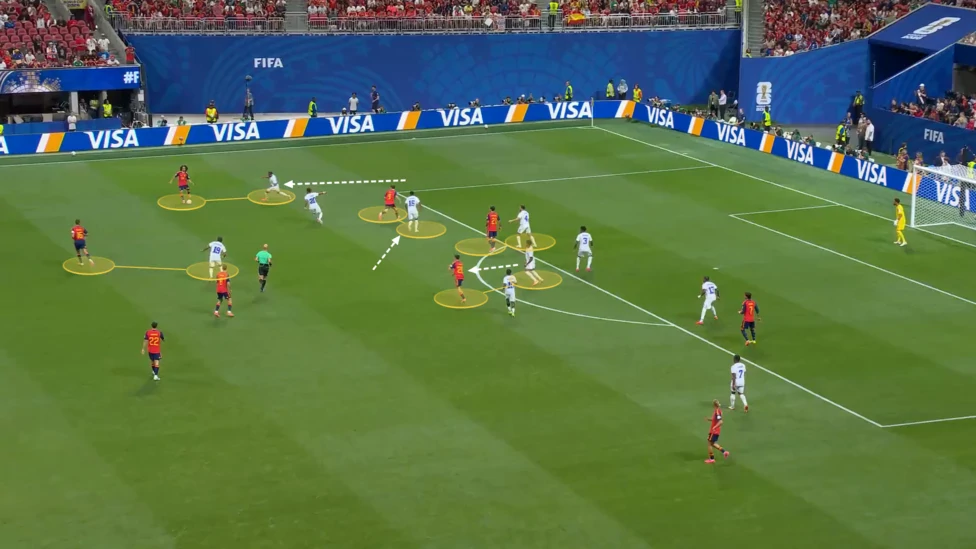
Cape Verde, the third smallest nation in World Cup history, held Spain at bay with their 4-5-1 defensive formation. The key to their success was the very small gap between the midfield line and the defensive line.
When facing such a challenge, teams that play possession football try to lure the opponent forward by passing the ball backward.
When Spain passed the ball backward, hoping their midfielders would advance and create space between the defenders, Cape Verde did not fall into that trap. They maintained their compact structure.
Then, Spain's defenders advanced with the ball themselves, looking to see the opponent's reaction. But Cape Verde's players did not let their structure break down until the last moment.
As a result, Spain found it very difficult to find their players within the block of the opposing players. Spain was left with only the option to play the ball from the side of Cape Verde's players or pass it over the top.
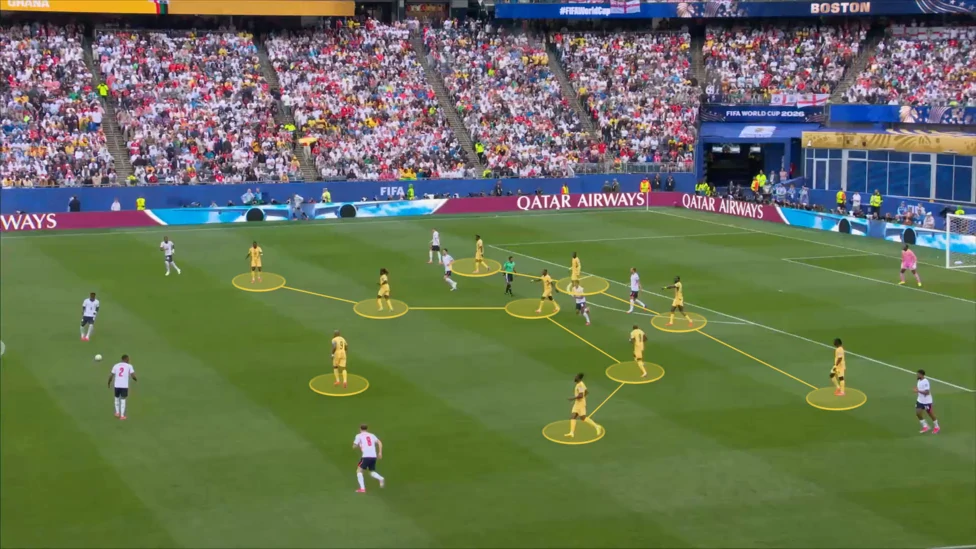
Ghana's defensive strategy against England showed the exact same pattern.
England, under coach Thomas Tuchel, has increasingly emphasized a strategy of passing the ball backward to provoke the opponent into pressing and then launching quick attacks into the space that opens up.
To counter this, Ghana had a compact structure. Jordan Ayew took a slightly advanced position to man-mark Elliot Anderson. But the rest of the team, like Cape Verde, formed two lines just outside the penalty area, leaving no space between the lines.
The strategy of both these teams, not applying pressure when the opponent tries to draw them out, is further clarified by a statistic that measures how intensely a team presses.
This is known as 'PPDA' (Passes Per Defensive Action), which measures how many passes the opponent is allowed to play before a defensive action is taken. The higher this number, the less the team is able to disrupt the opponent's play.
In the draw against Spain, Cape Verde's average PPDA was 51.2, while Spain's was only 5.9. Similarly, in the first 15 minutes of the match against England, Ghana's PPDA was 62.
Both these underdog teams were deliberately defensive.
Interestingly, as the game progressed, both Ghana and Cape Verde increased their pressing. This can be interpreted as teams like Ghana looking to take more initiative and risks towards the end of the game, hoping to turn the result in their favor.
- Strategy to Cover the Width of the Field
To understand why some underdog teams are performing well, it is useful to analyze where other teams made mistakes and allowed the opponent to benefit.
Saudi Arabia's loss to Spain highlighted a common weakness seen in many teams that adopt a 'park the bus' (highly defensive) strategy.
From the outside, having five defenders should mean the team is defensively strong. But the opposite happened. Saudi Arabia's back five lacked clarity, and they were mostly drawn towards the player with the ball.
Their four midfielders in the low block drifted too much towards the side where the ball was, more than necessary. This meant they could not cover the entire width of the field. Spain, understanding this weakness, switched the ball well from right to left.
Lamine Yamal and Pedro Porro created 'two-against-one' situations against Saudi Arabia's wing-backs. Exploiting this tactical advantage, Spain scored their third goal.
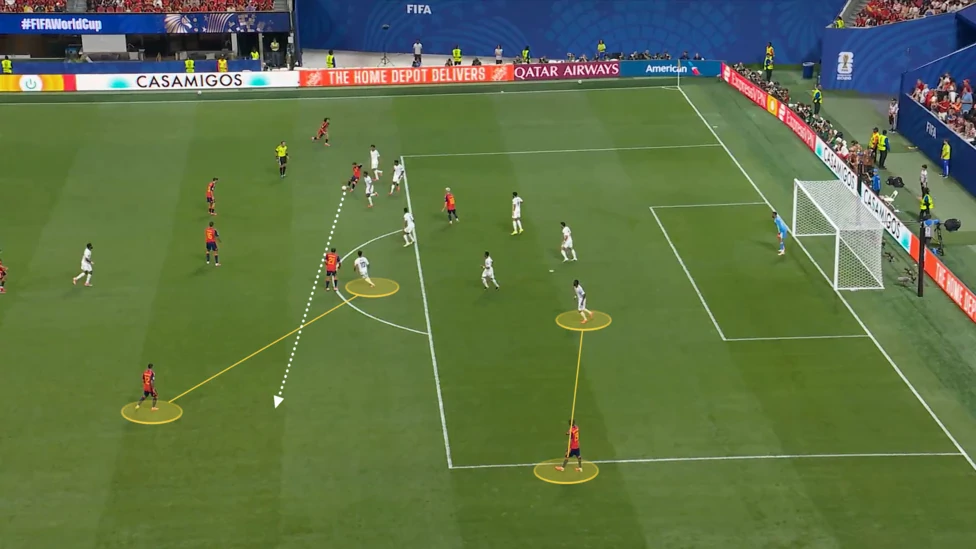
The wide midfielder, drawn towards the ball, found it difficult to return to pressure Porro when the ball switched. The wing-back also could not advance to stop Porro; if he had, Yamal would have been free.
Porro, with ample time and space on the ball, delivered a cross to the back post, which Mikel Oyarzabal easily converted into a goal by tapping it in.
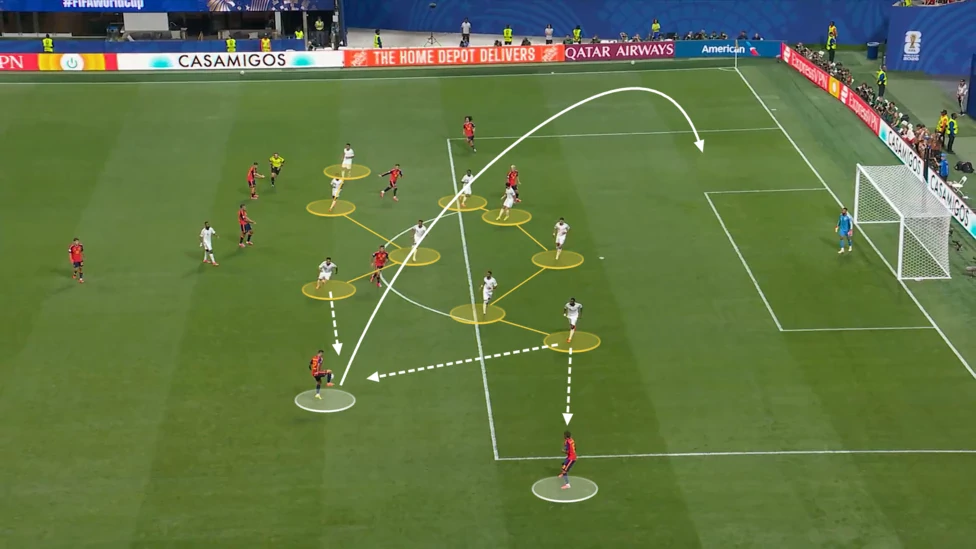
Sweden, the 36th ranked team, also suffered a 5-1 defeat against the eighth-ranked Netherlands due to the same defensive weakness. With only three midfielders in their 5-3-2 formation, compared to Saudi Arabia's four, the width of the field was covered even less.
The Netherlands used their right-winger to push Sweden's left wing-back deep. As Sweden's three midfielders advanced towards the ball, Denzel Dumfries made an excellent forward run from a deep position, unmarked by anyone.
Sweden could not handle this 'two-against-one' situation. Only when they adopted a 4-5-1 formation, similar to Cape Verde and Ghana, did their play improve towards the end of the game.
- Drawing the Press and Playing Long Passes
Finally, to get results against strong opponents, teams must be able to create danger when they have the ball.
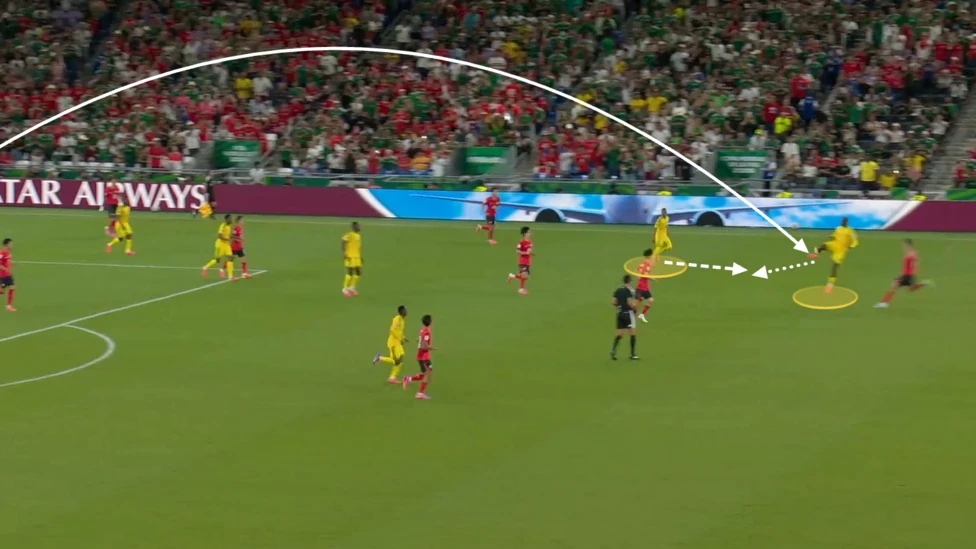
South Africa had only 31% possession against South Korea but took 14 shots, while South Korea only managed 7.
The main reason for this was their ability to deliberately advance the ball forward instead of the goalkeeper launching a direct long kick.
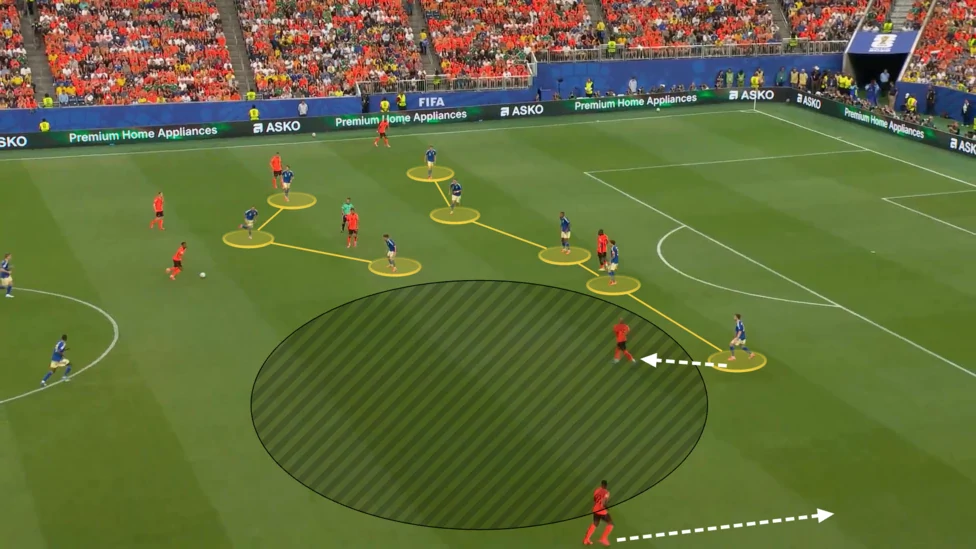
Underdog teams that have performed well have often played short passes from goal kicks, which draws the high-pressing big teams towards them, and then they chip the ball to their players in the space that opens up.
Teams like Cape Verde, Iraq, and South Africa have been seen using short goal kicks, keeping their players positioned far from each other, which is quite interesting.
The main idea behind this is that when there is a large distance between players, opponents who prefer man-to-man pressing have to run a lot to close down the players. In the time it takes, defenders can find midfielders and attackers in open space.
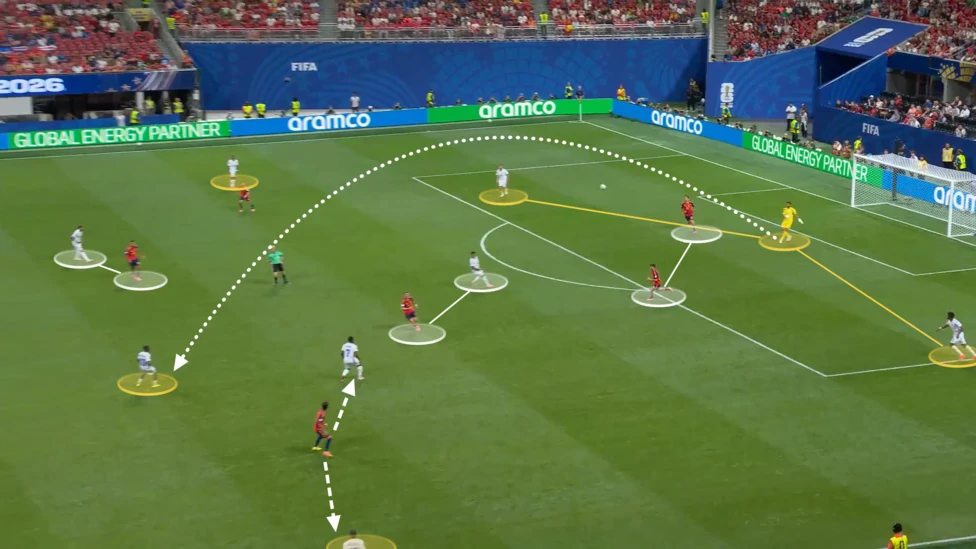
Playing from the back with large distances between players also increases the risk of losing the ball in dangerous areas. South Africa conceded goals in such situations against Mexico, and Iraq did so against Norway.
However, they also created many good opportunities. If the final movement had been better, the outcome of the match could have been different.
Football is a game of give and take. When South Korea high-pressed South Africa, Bafana Bafana did not abandon their principle and advanced the ball even more accurately.
Once they got upfield, they attacked at high speed and scored a goal, securing their entry into the next round of the tournament.
- And a Bit of Excellent Performance
These examples show that regardless of the countries' rankings, their strategic quality is increasing.
Even with lower-ranked players, teams can pose a real challenge to opponents by structuring themselves correctly and moving collectively in the same direction. And even then, they need the support of luck.
In this tournament, 40-year-old goalkeeper Vozinha won many hearts with his excellent saves against Spain. Curacao's goalkeeper Eloy Room also equaled a World Cup record by making 15 saves in a single match, helping his country secure their first point.
Strategy can help smaller nations bridge the gap and play on their own terms. But the World Cup atmosphere brings out such excellent performances from players that even they themselves are unaware of.
This specific news has been automatically translated by AI. As a result, there may be some inaccuracies or language errors.