Book Review: 'Bakhan' Chronicles Chitwan's History and Struggle
Nepali Congress President Gagan Kumar Thapa's statement in Chitwan last Sunday has become a topic of discussion not only in political circles but also in historical debates. While inaugurating the National Independent Party's general convention, he reminded of a painful chapter connected to Chitwan's political history, saying: “Today you have the right to hoist the blue flag. While hoisting the flag, look down at the ground. There is a little red there. Right beneath where you are standing, about 50 people's bodies are buried from the year 2018 B.S. The Panchayat government cut them and buried them.”
Thapa's statement has brought the 2018 B.S. Bharatpur incident, also known as the Bharatpur Revolution, back to the center of public debate. Along with this episode that recalls an important but less discussed event in Nepali political history, the book 'Bakhan' has also gained attention.
- What is the Bharatpur Rebellion/Revolution?
The massacre that took place in Bharatpur from January 29 to February 1, 2018 B.S. is the Bharatpur Revolution. In protest of King Mahendra overthrowing the elected government and implementing the Panchayat system on December 15, 2017 B.S., the Nepali Congress revolted across the country. Bharatpur was one of them. Congress freedom fighters had set up camps in Narkatiyaganj. They came in four groups to capture Chitwan and succeeded. However, within 72 hours, the army regained control and carried out a massacre. The army tied up those taken into custody, including Buddhi Singh Rana and Hari Prasad Gurung, and dragged them behind a tractor. Seven people were killed by bayonet. Some were cut with leaves and rubbed with salt and chili by the army. They were tortured and killed by bayonet. Jagat Prakash Jung Shah's hands and feet were cut off, and his head was gouged out before being buried. Guest House Chaur is the place where they were murdered and buried.
'Bakhan' has made this incident the central theme of its subject matter in detail, with Commander Bakhan Singh Gurung of that time as the main character.
The exact number of people killed in this incident is not definitively known. However, 'Bakhan' mentions the discovery of 84 pairs of slippers and the death of 26 people. Although Professor Dr. Suryamani Adhikari, who has studied the history of 2018 B.S., has also mentioned the death of 26 people in Chitwan at that time in his various works.
There are various reasons to believe that Parajuli in 'Bakhan' used historical documents as a basis when writing the death toll.
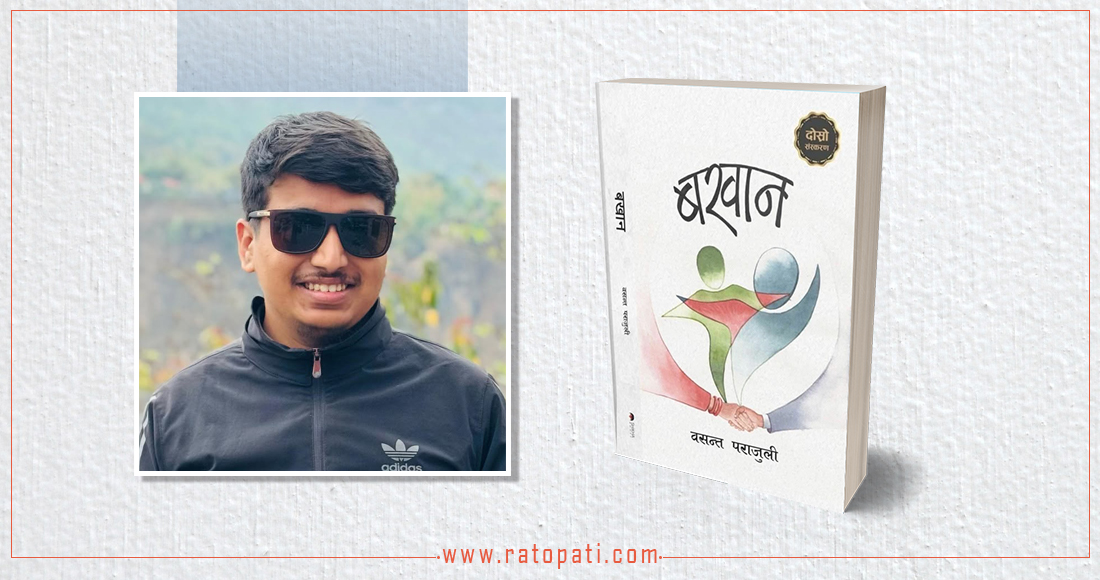
Based on this historical background, 'Bakhan' released a new cover for its second edition just last Thursday. The work not only excavates the Bharatpur Revolution of 2018 B.S. but also attempts to revive an important period of Chitwan's settlement development, democratic movement, and political struggle through narrative.
- Bakhan Singh Gurung, a Character in History
This is the latest investigative narrative by journalist and author Basanta Parajuli. Parajuli, who gained fame with his short story collection 'Kumata', has authored 'Bakhan' as his fourth work. Previously, his short story collections 'Momcho' and 'Dreamiaz' have been published. 'Bakhan' is his first novel. It presents real characters and events connected to Chitwan's history in a literary structure.
Bakhan Singh Gurung is at the center of the work. Through his personal life, struggles, political consciousness, and social contributions, the author has written not just the story of an individual but the story of an era.
After his youngest son Dharmadhwaj was martyred in Bandipur during the 2007 B.S. revolution, Bakhan Singh was forced to leave his hilly life and settle in Chitwan, which was at risk of malaria. How did his eldest son, Laldhwaj, achieve martyrdom in the 2018 B.S. Bharatpur Revolution? How did he become a leading figure in Chitwan's settlement development? This journey is the main attraction of this narrative. His life struggle is seen as connected from personal pain to social change.
- A Story of Life Beginning from Death
The most impressive aspect of 'Bakhan' is its narrative structure. The novel begins with the character's death. Unlike stories that typically show the journey from life to death, the author takes a different approach, moving backward from death to life to advance the story.
This creates curiosity in the reader from the beginning. Bakhan Singh's death is not just the end of a character; it becomes a means to re-explore the history, ideas, and struggles that his life built.
Using the style of documents, memoirs, archives, and narrative reconstruction common in historical fiction, the author attempts to connect the past with the present.
- Combination of History and Emotion
The specialty of 'Bakhan' is to highlight the human aspect connected to political events, rather than just presenting them as facts.
The author presents the Bharatpur incident, the Congress's democratic movement, Panchayat-era repression, political ideals, and the sacrifices made for them by connecting them to the lives of the characters.
Both achievements and losses are seen in Bakhan Singh's political journey. When he achieves success in the social and political fields, he pays a price in his personal life. This conflict makes the character more vivid.
The internal struggles within the Congress, the distance between political idealism and practical politics, and the relationship with historical figures like Subarna Shamsher Rana help in understanding the political environment of that time.
- Culture, Identity, and Chitwan's History
This work is not just a political narrative. Chitwan's cultural and social history is equally important in it.
Aspects like the rituals of the Tharu community, religious traditions, temple restoration, historical sites like Someshworgadhi, the context related to the naming of Chitwan, the history of the Chitsari fair, and natural resources like elephants and rhinos make the work multifaceted.
The author conveys the message that culture and politics are not separate subjects. The work reflects the perspective that social consciousness, cultural preservation, and political change are interconnected issues.
Supporting Characters and the Role of Historical Documents
Characters like Parmeshwar Chaudhary, Mallu, and Maheshwar Sapkota are not just means to advance the story; they represent the social and political conditions of the time.
Through these characters, the author presents historical facts, social practices, and political ideas in a balanced manner. The responsibility of intergenerational transfer and social consciousness is linked through Bakhan Singh's sacrifice and Chandradhwaj's thinking.
- Limitations
'Bakhan' is a very important work for readers interested in historical and political subjects. However, for readers less familiar with Nepali political history, the expansion of events in some places may feel a bit long.
The mixture of diary style, political events, and cultural details may give the feeling of a somewhat slow narrative pace in some places.
While the main character Bakhan Singh and his family members develop gradually, some supporting characters seem limited to the role of advancing the plot.
- The Question of History, Heritage, and Civic Responsibility
However, looking beyond these limitations, 'Bakhan' is a literary reconstruction of a historical document. It raises some important questions. For example—How is balance possible between political ideals and practical politics? What is the role of culture and tradition in building national identity? How is the sacrifice made by one generation transformed into the social responsibility of the next generation?
Chandradhwaj's thinking, embracing his grandfather's legacy and focusing on settlement development and social contribution above party conflicts, gives the work philosophical depth.
- Conclusion
Through 'Bakhan', author Basanta Parajuli has encompassed Chitwan's history, political struggles, cultural consciousness, and the extraordinary life journey of an individual in a single narrative.
This work is important for understanding historical events like the Bharatpur Revolution, knowing the background of Chitwan's social development, and experiencing the human aspect of Nepal's democratic movement.
'Bakhan' is not just the biography of an individual; it is the story of an era. Because it is an effort to bring to light the voices buried in the depths of history through literature, this work has been established as a collectible and readable historical narrative.
This specific news has been automatically translated by AI. As a result, there may be some inaccuracies or language errors.