Jalpa Devi Cable Car Project to Boost Tourism and Economy in Far-Western Nepal

Kailali. When the Karnali River, Nepal's longest, flowing from above, reaches Chisapani in Kailali, it seems to pause for a moment to admire its own beauty. The Chisapani bridge, standing on a pillar above the river, sways with the wind, reflecting a wonderful dialogue between nature and technology. The river's whisper, the surrounding green hills, and the view of the bridge add to its beauty, easily captivating anyone who reaches here.
Not just the small geography of Chisapani, nature has given a lot to the Far-West, but for years those gifts have remained within the limits of potential. Therefore, a question has remained unanswered here for decades—can the natural resources here ever become a basis for prosperity? In recent days, however, some efforts have begun from both government and private sectors to answer that. One of the ambitious projects among those efforts is the Jalpa Devi Cable Car.
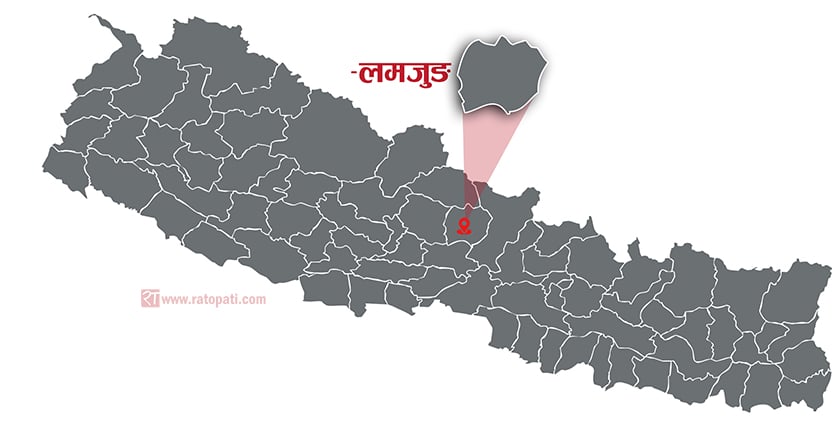
Cable cars and various infrastructures under this project are being built in the area from Chisapani in Lamkichuha Municipality-3, Kailali to Rajkanda in Mohanyal Rural Municipality-7. This project, with main investment from IME Group, is seen as an important infrastructure for the tourism and economic development of the Far-West. The project, with an estimated investment of approximately Rs 6 billion in various phases, involves the construction of a 3.1-kilometer-long cable car, hotels, restaurants, skywalks, parks, walking trails, and other tourist infrastructures.
Many believe that this project will lay the 'foundation' for the economic future of the Far-West and establish Chisapani as an attractive tourist destination in Nepal. Therefore, it is viewed not just as an infrastructure, but as a big dream connected to the tourism, employment, and economic development of the Far-West.
Pushparaj Kunwar, Chairman of the Federation of Nepalese Chambers of Commerce and Industry, Far-West, says that such a large private investment in a tourism project should be taken as a historic opportunity. He says, 'It is historic in itself that a tourism project with such a large private investment is being constructed in the Far-West. Once the cable car is operational, the hotel, transportation, agriculture, trade, and service sectors will all benefit directly.'
Similarly, Santosh Khadka and Padmaraj Chaulagain, chairmen of Tikapur and Lamki Chambers of Commerce, also believe that this large investment project in the Far-West region is a matter of pride for the residents of the province, and it will greatly help in attracting further investment to the province.
Dreams of Prosperity Will Sway with the Gondola
About a decade ago, local businessmen had a grand dream of developing tourism infrastructure in the Chisapani area. 99 businessmen from various sectors were associated with that dream. The plan, which could not move forward for a long time due to various reasons, has now reached the construction phase with the participation of IME Group. The project was laid its foundation on Poush 13, 2081 BS and construction began in Asar last year.
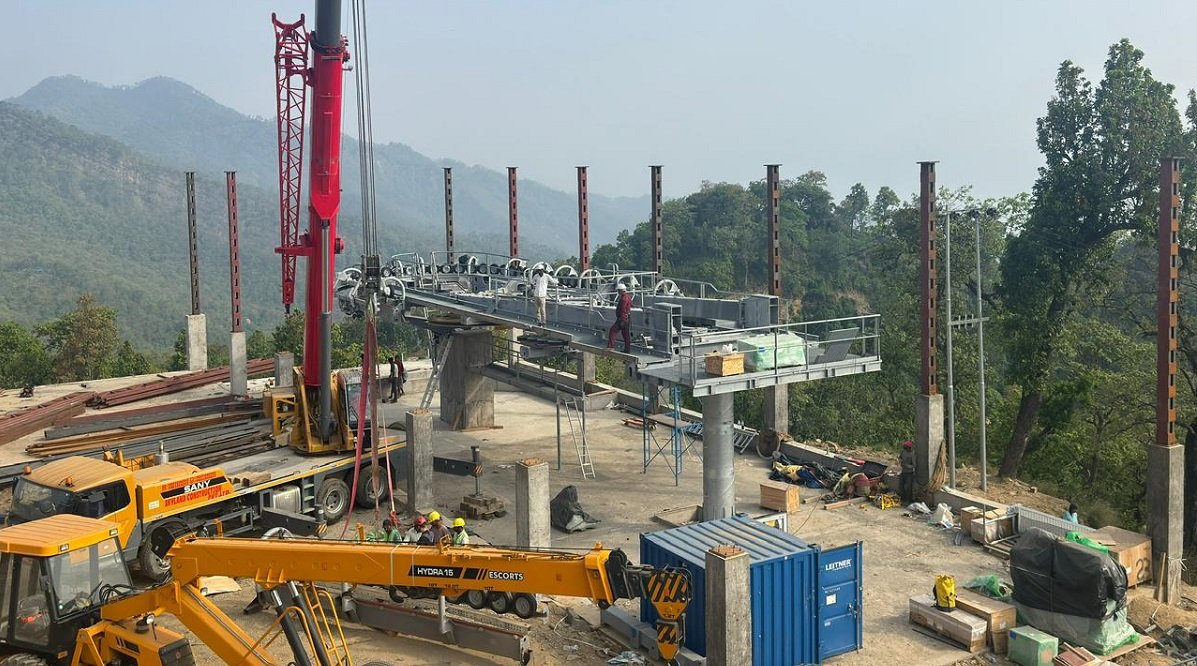
According to Vijay Poudel, the project's engineer, the construction work of the project is progressing rapidly. Currently, work such as erecting poles, and constructing bottom and top stations are in the final stages. After that, the technical process of pulling the wire and installing the gondolas will proceed.
'We are working with the goal of completing the project on time. We are preparing to bring the project into operation by next Asauj. With that goal, we are carrying out the first phase of work at full speed,' he said. 'The work of erecting poles, and constructing bottom and top stations is nearing completion. Immediately after that, the technical work of pulling the wire (stringing) and installing the gondolas will move forward.'
Currently, hotels, restaurants, parks, Jalpa Devi temple, skywalk, walking trails, and other tourist structures are being built at the top station, while a five-star hotel, banquet hall, and other well-equipped structures are being prepared at the bottom station. Engineer Poudel says, 'The infrastructures being built here will establish this area as a major tourist destination in the country.'
Deepak Timilsina, Chairman of Lamkichuha Chamber of Commerce, says that the dream of about 13 years ago is starting to take shape, adding enthusiasm to the local area. Once the cable car project is operational, Rajkanda will become an excellent 'hill station' for both local residents seeking coolness from Kailali's extreme heat and external tourists. Timilsina believes that the well-equipped infrastructure to be built here will play a crucial role in extending the stay of tourists, increasing their spending, and making the local economy dynamic.
Basis for Improving Tourism and Economy
Currently, there are not many infrastructures in the Chisapani area except for the Chisapani bridge, yet about five to seven hundred domestic tourists visit here daily just to see the bridge, according to knowledgeable sources. Most of these tourists return after spending a few hours, but tourism entrepreneur Devraj Jaisi believes that once the new structures are operational, their stay will be extended, opening doors for local economic opportunities.
The cable car to be built here will connect Chisapani with Rajkanda, but its impact will not be limited to a few minutes of travel. The infrastructure to be built here is expected to establish Rajkanda as a new tourist center. For that, it is suggested by entrepreneur Jaisi to develop adventurous tourism such as jungle safari in Bardia National Park and rafting (water tourism) as a 'package'.
'The state should also work according to the policy of 'Destination Far-West'. If the potential here can be combined and developed into a package, a new journey of prosperity can be embarked upon from Karnali Chisapani. The cable car and its associated structures can be taken as the basis for that,' he says.
There is a belief that the local community should receive the greatest benefit from tourism development. Hotel entrepreneur Tank Parajuli says that once the Jalpa Devi Cable Car project is operational, it will contribute to the creation of employment opportunities at the local level. 'Once the project is operational, the arrival of domestic and foreign tourists will certainly increase here, which will create a market for products produced in Rajkanda and surrounding villages. This will help farmers increase production and encourage youth towards entrepreneurship. Therefore, it is a matter of great joy that such projects are being built in our area, and it is necessary for the locals to develop a sense that such projects are common property,' he said.
New Door of Employment is Opening
For many youths in the Far-West, the last option for employment is still India or the Gulf countries. The emptying houses in the villages, the social structure limited to the elderly and children, speak of this reality, but locals hope that the Jalpa Devi Cable Car project can curb that trend to some extent.
With the operation of the cable car, hotels, resorts, restaurants, transportation, entertainment, and service sectors will expand. Businessman Kalu Hamal expects that thousands of direct and indirect employment opportunities will be created from these activities.
This specific news has been automatically translated by AI. As a result, there may be some inaccuracies or language errors.


_TqAiZajEEB.jpg)