Bagmati Province Government Presents Realistic Budget Focusing on Agriculture, Innovation, and Employment

The Bagmati Province government has presented its budget for the upcoming fiscal year. The budget, presented on Asar 1, is scheduled for discussion in the Provincial Assembly from Asar 16.
Although the size of the budget has decreased compared to previous years, the provincial government claims it to be realistic and implementable. The provincial government has halved the number of fragmented projects seen in the past and has prioritized agriculture, innovation, job creation, and large infrastructure projects.
Bagmati Province, which has adopted a strict policy of increasing capital expenditure while reducing current expenditure, also claims that the province is the real model for development in federalism.
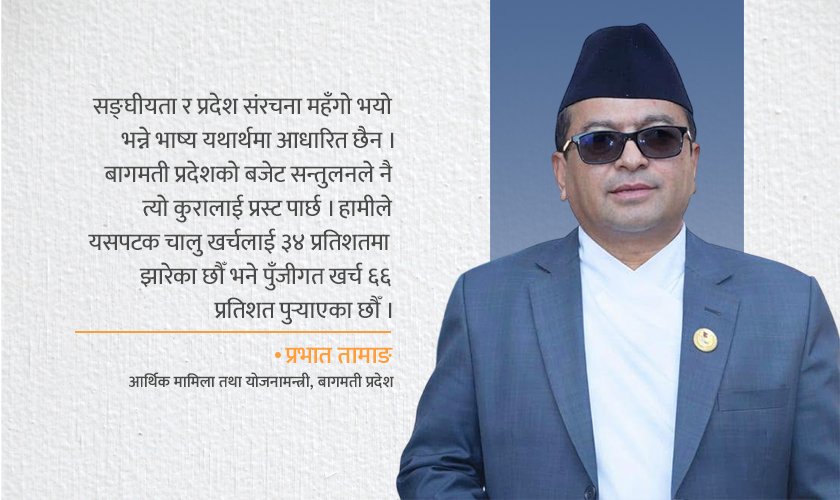
In this context, an edited excerpt of an interview with Prabhat Tamang, Minister of Economic Affairs and Planning of Bagmati Province, regarding the priorities of the upcoming fiscal year's budget, resource management, budget implementation assurance, and the state of fiscal federalism is presented. (Detailed interview in video)
- Compared to previous years, the size of Bagmati Province's budget has decreased this time. On one hand, the budget has shrunk, and on the other hand, there are various questions about the province's budget. How do you interpret this year's budget?
Increasing or expanding the budget size is not an achievement; bringing an unusually large budget only adds challenges to implementation. Looking at the federal government, it aims to collect revenue of about 14 trillion and spend more than 12 trillion on current expenditures. Only about 200 billion rupees remain for capital investment. There is also a liability of about 400 billion to repay loans, and there is a compulsion to borrow again for it. The federal structure is bloated, and a large portion of the budget is going into unproductive sectors. Meeting revenue targets is very challenging. Therefore, it is not good to just bring a large budget; our belief is that it should be realistic.
Bagmati Province also used to present a budget of around 60 to 70 billion rupees, but considering the province's actual capacity and revenue collection reality, that size is not more than 57 to 60 billion. Currently, we have presented a budget of 66 billion 930 million rupees.
This budget is not contracted or shrunk; rather, we have made it realistic by bringing it down to earth. Instead of gaining cheap popularity by speaking about things that cannot be implemented and for which there is no source, only what can be done has been included in the budget. Therefore, this is not an ambitious but a completely realistic budget.
- While calling the budget realistic, what are the priorities and main programs of the province this time?
This year's budget has primarily prioritized business promotion, job creation, and the agricultural sector. To stimulate the province's economy by supporting small businesses and new entrepreneurs, we have introduced concessions from company registration to operation. To stop the rapid migration from rural areas and encourage people to return to villages and become entrepreneurs, we have allocated the budget in a different way.
We have introduced a program to provide a 5 percent interest subsidy on business loans. For this, the Ministry of Economic Affairs and Planning has allocated 200 million rupees. This 200 million will mobilize about 4 billion rupees stuck in banks. We have made arrangements for new entrepreneurs to get loans through banks, and the provincial government will pay the interest on them.
Similarly, 200 million rupees have been allocated separately for providing easy loans to farmers in the agricultural sector, which will mobilize an additional 4 billion capital. On one hand, liquidity is piled up in banks, and on the other hand, the province does not have a large budget to invest directly in large projects. Therefore, mobilizing an additional 8 billion capital from banks within a budget of 64 billion to create employment is our new and different model.
- The Provincial Government has put forward the slogan that no citizen should go hungry, live in darkness due to lack of education, or suffer due to lack of treatment. These slogans sound attractive, but what are the plans to implement them?
These slogans are addressed with as much seriousness by the budget as they sound attractive. Not dying of hunger means connecting people with income generation. For this, as we mentioned earlier, we have introduced programs to create employment and provide interest subsidies for agriculture and new entrepreneurs. When people become self-employed and entrepreneurs, they can earn their livelihood.
Education and health are completely linked to socialist concepts. We are making innovative experiments in education this time. Although basic education falls under the jurisdiction of local levels, keeping in mind the current technological era, we are starting AI education in basic schools as a pilot project through the Chief Minister's Innovation Program.
In terms of health, we have already awarded the contract to start robotic surgery services at Bhaktapur Hospital using the highest level of technology. In addition, sufficient budget has been allocated to provide specialized services in the provincial hospitals in all 13 districts of the province.
Our goal is to provide quality services at the district level to end the compulsion of citizens having to travel to Kathmandu for even general treatment. Besides this, socialist programs such as building houses for 1,000 extremely poor families and providing them with collateral-free loans to establish businesses in their villages are also included in the budget.
- Amidst widespread criticism that the provincial structure is burdensome and expensive, Bagmati Province appears to have significantly increased capital expenditure and reduced current expenditure. How was this balance achieved, and what impact will it have on delivery to the public?
The narrative that federalism and the provincial structure are expensive is not based on reality. The budget balance of Bagmati Province makes this clear. This time, we have reduced current expenditure to 34 percent and increased capital expenditure to 66 percent.
In the previous fiscal year, current expenditure was around 39-40 percent. Despite a 21 percent increase in employee salaries and allowances, we have succeeded in reducing current expenditure by 5 percent. Current expenditure, which used to be around 26 billion, is now limited to around 22 billion.
This was possible because as soon as the current government was formed, we adopted a policy to make the province's structure efficient and service-oriented. The jumbo structure of 14 ministries was reduced to 8. Along with the reduction in ministries, offices in the districts were also restructured and adjusted.
Old structures transferred from the federal government were demanding a lot of expenditure, which we made completely efficient. Reducing current expenditure means cutting unproductive sector spending and increasing capital expenditure for public service and development construction. As for delivery, we have reduced expenditure but not service delivery. Rather, through the use of technology and effective management of offices, we have developed a system to provide delivery to service recipients more easily.
- Approximately 44 billion rupees have been allocated for capital expenditure. What modality has been adopted for infrastructure and large projects? How have the complaints of budget being concentrated only in the districts of influential MPs and ministers, and zero elsewhere, been addressed?
This time, the tradition of allocating budget based on influence has been completely eradicated. We have allocated budgets to all districts and regions based on need and balance.
In the field of infrastructure, we have advanced 17 pilot projects targeting areas lagging in human development indicators in all 13 districts (e.g., Ruby Valley, Ganga Jamuna in Dhading, Naukunda in Rasuwa, etc.). Among the 200 roads identified under the Provincial Road Act, we are upgrading 50 to 60 roads by allocating more than 50 million rupees. Among the 119 local levels in the province, budget has been ensured to connect the centers of 30 municipalities that do not have paved roads.
Similarly, in terms of drinking water, we have selected 87 projects as pilot projects after conducting feasibility studies for 187 projects in all 13 districts. In the past, there was a tendency to scatter the budget but not complete the work. Until last year, 4400 drinking water schemes were left incomplete. We have invested 2 billion rupees to immediately complete those schemes where 80 percent of the work is done after classification.
Regarding the budget not being proportional, I myself am the Minister of Economic Affairs, but budget has not been piled up in my home district of Rasuwa based on influence. In Rasuwa, only one large drinking water project (with a total cost of 400 million) has been allocated 130 million rupees this year based on need. Investment is concentrated in the hilly regions due to the greater need for infrastructure, while in the Kathmandu Valley, new programs have been implemented instead of infrastructure.
The opportunity given to MPs to select projects worth 30 to 50 million rupees for provincial roads to easily identify the needs of their constituencies is not an allocation based on influence, but a response to local needs. We have reduced fragmented projects from 24,000 in number last year to 13,000 this year. Although the policy is not to have projects smaller than 5 million, some small projects have been included in the budget to complete old incomplete buildings or projects that were initiated in previous years and can be completed with a small amount.
- The issue of tunnels and metro rail in Kathmandu has also been included in the budget. There is also criticism that budget has been allocated in the name of studying the already completed DPR again?
The provincial government has not said it will prepare the DPR (Detailed Project Report) for these large projects again. DPR is something prepared just before starting work in the final stage of project construction. We are only talking about conducting feasibility studies now.
Regarding the Bhimphedi tunnel, the Kathmandu-Terai Fast Track is currently under construction. Once the Fast Track is operational, will this tunnel really be needed or not? The study is being conducted only to technically and economically evaluate whether it is financially feasible. Regarding the metro rail in Kathmandu, our plan is to reach a conclusion only after conducting a feasibility study in coordination with the federal government.
- There is still an overlap in the areas of authority and project selection between the federal and provincial governments. For example, both the federal and provincial governments talk about connecting roads to municipal centers. In such a situation, how will budget resource management and implementation be streamlined?
We coordinate and partner on large projects that fall under the federal jurisdiction, but the reality is that none of the roads connecting local levels under federal jurisdiction have been built yet.
The local roads being built in rural areas are being constructed with the budget and initiative of the province. It is clear from looking at how many local levels the federal government has included in its Red Book. Therefore, the province has allocated budget to 30 rural municipalities that do not have paved roads, considering it its responsibility.
Regarding resource management, we are completely realistic. The main internal sources of revenue for the province are land registration fees and vehicle taxes. We have introduced plans to develop Hetauda and Changunarayan in Bhaktapur as smart cities and 12 rural municipalities as smart villages, which will increase land transactions and economic activities, thereby increasing revenue.
Another important point is that we have given high priority to digitalization. Currently, there is a compulsion to visit the office for blue book renewal and tax payment for vehicles. Within the upcoming fiscal year, we are upgrading the federal government's VRS software to synchronize it with the national identity card.
Once this system is implemented, service recipients will be able to renew licenses and blue books and pay taxes online. This will prevent leakage in revenue collection and provide great relief to citizens. Regarding the collection of taxes on riverbed materials (dahatar-bahattar), there are some problems due to the complexity of environmental impact assessment and legal ambiguity with local levels, which we are trying to resolve.
- The National Natural Resources and Fiscal Commission has recommended that the province can raise internal debt up to 12 percent of its internal revenue, but the provincial government does not seem to be interested in raising debt?
Yes, we have not tried to raise debt, and we do not feel the need for it at present. There is no point in raising debt and spending it on unproductive sectors. The budget of 64/66 billion allocated for the Bagmati Province government is sufficient for now. The main thing is not how large the budget is, but how effectively it is implemented.
The federal government has a budget of 21 trillion, but the situation of capital expenditure and development construction is extremely dire. What is the use of having a budget of 50 trillion if it is not based on reality and is not implemented? We want to show development without bearing the burden of debt by making the best and most effective use of available resources.
- As the Finance Minister of the province, how do you evaluate the state of fiscal federalism? On one hand, neo-liberal policies are being promoted, while on the other hand, socialist programs are also being advanced. Do these two not conflict?
There are some serious flaws in the division of fiscal federalism during the constitution-making process itself. In reality, the provincial government is the real driver of 'development'. Looking at the federal government's budget, more than 70 percent goes into current expenditure, and capital expenditure is only 30 percent, whereas the province has limited current expenditure to 34 percent and is achieving 66 percent capital expenditure.
Adding up the total budgets of all 7 provinces across the country reaches about 21 trillion, which is equivalent to the federal government's annual budget. But look at the development results - the federal government has built only 2100 kilometers of paved roads so far, while the provinces have constructed more than 5200 kilometers of paved roads.
In the health sector too, the federal government's hospitals are limited to Kathmandu and Chitwan, but the provinces are operating well-equipped hospitals in all 13 districts. Delivery is done by local levels, development construction by provinces, and the federal government should only make policies, but now the smallest budget share has gone to the provinces. If Bagmati Province alone were to receive a budget of about 3 trillion, we could bring about development that would change the face of the country.
As for ideology and policy, we believe in democratic socialism. Neo-liberal economics and democratic socialism are not opponents but complements. The state cannot do everything directly. Providing concessions to the private sector, offering discounts on company registration, and providing interest subsidies to make them dynamic is a neo-liberal policy.
When the private sector becomes strong, people's purchasing power increases, trade and business flourish, and the state receives VAT, excise duty, and income tax. With the revenue thus generated, we implement socialist programs like building free houses for the poor and providing free health and education. Therefore, our clear policy is to achieve economic growth through the private sector and distribute the obtained resources equitably by the state.
This budget will not be frozen due to non-implementation like in previous years. We have reduced the number of projects. We have set clear priorities in roads, drinking water, and agriculture. We have introduced the concept of software and employment banks to connect technically educated manpower with employment. Therefore, I can say with full confidence that more than 80 percent of Bagmati Province's budget will be implemented this year.
This specific news has been automatically translated by AI. As a result, there may be some inaccuracies or language errors.